How to Memorize Medical Terms and Anatomy
Master medical terminology and anatomy with proven strategies including etymology, visual diagrams, and spaced repetition for pre-clinical success.
Table of Contents
- Etymology as a Shortcut to Medical Terminology
- The Core Building Blocks
- High-Value Roots to Learn First
- High-Value Prefixes and Suffixes
- How to Actually Learn Roots
- Visual Anatomy: Using Diagrams for Muscle and Organ Recall
- Drawing From Memory
- Anatomical Mnemonics for Structure Sequences
- Color-Coding by System
- The Spatial Chunking Method
- Spaced Repetition Schedules for Pre-Clinical Medical Content
- The Basics of a Spaced Repetition Schedule
- What to Put on Flashcards
- Separating Your Decks
- Integrating Spaced Repetition Into Clinical Contexts
- Common Mistakes in Medical Term Memorization
- Mistake 1: Learning Terms Without Context
- Mistake 2: Passive Rereading of Term Lists
- Mistake 3: Skipping the Etymological Connections
- Mistake 4: Trying to Learn Everything Before Reviewing
- Building a Weekly Memorization Routine
- The Long View
There’s a rite of passage every medical student goes through in their first weeks of pre-clinical training: opening a textbook, seeing a word like “sternocleidomastoid” or “pheochromocytoma,” and wondering if they accidentally enrolled in a foreign language course.
Medical terminology is genuinely dense. The human body has thousands of named structures, processes, diseases, and procedures , and the exams test all of them. But here’s the thing: the students who struggle the most with medical vocabulary are usually the ones trying to brute-force memorize each term as a standalone blob of text. The students who handle it well have a system.
This guide is about building that system. Whether you’re in your first semester of anatomy, grinding through pathophysiology, or preparing for your boards, these strategies will help you memorize medical terms faster, retain them longer, and actually understand what you’re saying when you use them.
Etymology as a Shortcut to Medical Terminology
The single most powerful thing you can do to accelerate medical vocabulary acquisition is to learn Latin and Greek roots, prefixes, and suffixes. Medical terminology isn’t a random collection of words , it’s a highly structured system built from a relatively small number of building blocks. Once you know those blocks, you can decode words you’ve never seen before.
The Core Building Blocks
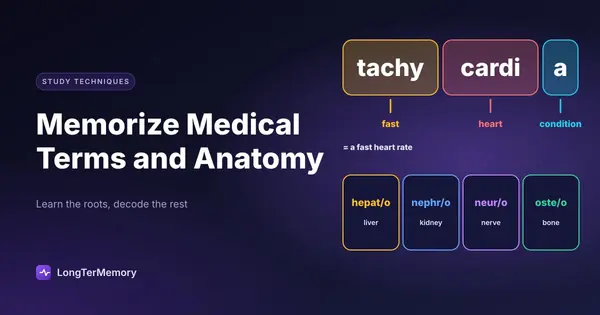
Medical terms are almost always combinations of:
- A root , the core meaning of the word (e.g., cardi- = heart)
- A prefix , modifies the meaning at the front (e.g., brady- = slow)
- A suffix , modifies meaning at the end (e.g., -itis = inflammation)
So bradycardia = slow + heart = a slow heart rate. You didn’t need to memorize that as a single item , you assembled it from parts you already knew.
High-Value Roots to Learn First
| Root | Meaning | Example Terms |
|---|---|---|
| cardi/o | heart | cardiomyopathy, tachycardia |
| hepat/o | liver | hepatitis, hepatomegaly |
| nephr/o | kidney | nephritis, nephrectomy |
| neur/o | nerve | neuralgia, neuropathy |
| oste/o | bone | osteoporosis, osteosarcoma |
| gastr/o | stomach | gastritis, gastroparesis |
| pulmon/o | lung | pulmonary, pneumonia |
| derm/o | skin | dermatitis, dermis |
High-Value Prefixes and Suffixes
| Affix | Meaning | Example |
|---|---|---|
| brady- | slow | bradycardia |
| tachy- | fast | tachycardia |
| hypo- | below normal | hypoglycemia |
| hyper- | above normal | hypertension |
| -itis | inflammation | appendicitis |
| -ectomy | surgical removal | appendectomy |
| -plasty | surgical repair | rhinoplasty |
| -ology | study of | cardiology |
| -megaly | enlargement | splenomegaly |
| -penia | deficiency | thrombocytopenia |
Once you can reliably decode prefixes, roots, and suffixes, your vocabulary expands exponentially. Instead of memorizing 200 individual terms, you’re learning 40 building blocks that assemble into hundreds of words.
How to Actually Learn Roots
Don’t just read a list. Active recall is essential. Create flashcards where one side shows a root/prefix/suffix and the other shows the meaning. Then practice building words: given “hyper-” + “glyc-” + “-emia,” can you build hyperglycemia and define it on the fly?
Once you’re comfortable with the components, practice the reverse: given a term like thrombocytopenia, can you decompose it into thrombo- (clot) + cyto- (cell) + -penia (deficiency)? A deficiency of clot-making cells , that’s a low platelet count, which is exactly what it means.
This two-way fluency , building and decomposing , is far more robust than memorizing definitions by rote.
Visual Anatomy: Using Diagrams for Muscle and Organ Recall
Anatomy is not a subject that rewards text-heavy study. The human body is a three-dimensional physical system, and trying to understand it through written descriptions alone is like trying to learn carpentry by reading about it. Visual and spatial learning strategies are not optional in anatomy , they’re essential.
Drawing From Memory
This is one of the most effective and most underused anatomy study strategies. Instead of passively re-reading labeled diagrams, close the book and draw the structure yourself.
Here’s the protocol:
- Study the labeled diagram for 2-3 minutes. Pay attention to spatial relationships, not just individual structures.
- Close the book and draw the structure from memory. Label everything you can.
- Compare with the original. What did you miss? What was in the wrong place?
- Repeat on the next study session, starting fresh each time.
The act of retrieving and drawing forces your brain to actively reconstruct the spatial information rather than passively recognizing it on a page. Students who draw from memory retain anatomical structures significantly better than those who re-read diagrams.
Anatomical Mnemonics for Structure Sequences
Anatomy exams often require you to recall sequences , the branches of the brachial plexus, the layers of the epidermis, the cranial nerves. For these, traditional mnemonics work brilliantly.
Cranial nerves (Olfactory, Optic, Oculomotor, Trochlear, Trigeminal, Abducens, Facial, Vestibulocochlear, Glossopharyngeal, Vagus, Accessory, Hypoglossal):
“Oh Oh Oh, To Touch And Feel Very Good Velvet. AH!”
Carpal bones (Scaphoid, Lunate, Triquetrum, Pisiform, Trapezium, Trapezoid, Capitate, Hamate):
“Some Lovers Try Positions That They Can’t Handle”
These sentence mnemonics don’t just tell you the items , they encode the order, which is what anatomical exams typically test.
Color-Coding by System
When studying with diagrams, use a consistent color system across all your materials. Assign one color to each body system:
| Color | System |
|---|---|
| Red | Cardiovascular |
| Blue | Respiratory |
| Yellow | Nervous |
| Green | Lymphatic/Immune |
| Purple | Endocrine |
| Orange | Musculoskeletal |
When you color-code consistently, the visual patterns reinforce system relationships. Over time, the colors become memory cues , just seeing red in your notes triggers cardiovascular associations, which helps you retrieve related terms and structures faster.
The Spatial Chunking Method
Rather than memorizing individual muscles one by one, memorize them in functional groups within anatomical regions. For the rotator cuff, learn all four muscles together: SITS , Supraspinatus, Infraspinatus, Teres minor, Subscapularis. They work as a unit, they’re tested as a unit, and you should learn them as a unit.
This spatial chunking approach , grouping structures by region, function, or innervation , reduces memory load by turning 20 isolated facts into 5 meaningful clusters.
Spaced Repetition Schedules for Pre-Clinical Medical Content
Anatomy and terminology aren’t just exam content , they’re foundational knowledge you’ll use for the rest of your medical career. That means you need to move it from short-term memory into long-term memory, and the most evidence-backed method for doing that is spaced repetition.
The core principle: review material at increasing intervals. The first review happens soon after learning (while the memory is still fresh). Subsequent reviews happen progressively later. Each successful recall strengthens the memory trace and allows a longer gap before the next review.
The Basics of a Spaced Repetition Schedule
For a new batch of medical terms or anatomical structures, a basic schedule looks like this:
| Session | Timing | Purpose |
|---|---|---|
| Session 1 | Day 1 | Initial learning |
| Session 2 | Day 2 | First recall practice |
| Session 3 | Day 4 | Reinforce weak items |
| Session 4 | Day 7 | Weekly consolidation |
| Session 5 | Day 14 | Two-week check |
| Session 6 | Day 30+ | Long-term retention |
The key insight is that reviews should be timed to happen just before you would forget. Too soon, and you’re wasting effort reviewing things you’d remember anyway. Too late, and you’ve already forgotten and have to re-learn from scratch.
The Learning Scientists’ spaced practice resource provides excellent research-backed guidance on implementing spacing schedules , it’s worth reading alongside this guide.
What to Put on Flashcards
Flashcard design matters enormously. A bad flashcard is:
- Front: “What is bradycardia?”
- Back: “Slow heart rate”
This tests recognition of a word you’d look up anyway. A good flashcard is:
- Front: “A patient with a resting heart rate of 42 bpm. What term describes this, and what’s the threshold?”
- Back: “Bradycardia , resting HR below 60 bpm”
Or work the etymology angle:
- Front: “Build the medical term for inflammation of the liver”
- Back: “Hepatitis (hepat/o = liver + -itis = inflammation)“
Separating Your Decks
In pre-clinical years, you’re dealing with enormous volumes of terminology across anatomy, histology, physiology, biochemistry, and pathology simultaneously. Keeping these in separate, organized decks prevents interference between subjects and lets you track your progress in each area independently.
A practical deck structure:
- Anatomy: Regional decks (head/neck, thorax, abdomen, limbs)
- Pathology: Organized by system, then by disease class
- Pharmacology: Drug class decks (mechanism, indication, side effects)
- Etymology: Root/prefix/suffix cards (cross-referenced with all other decks)
Integrating Spaced Repetition Into Clinical Contexts
The most durable anatomy and terminology knowledge comes from connecting what you’re memorizing to clinical scenarios. When you learn the brachial plexus, link each nerve to its clinical injury scenario: “radial nerve damage → wrist drop,” “ulnar nerve → claw hand,” “median nerve → ‘hand of benediction.’”
This clinical contextualization serves double duty: it anchors the anatomical term to a meaningful scenario (making it easier to remember) and it simultaneously prepares you for clinical vignette-style exam questions.
If you’re managing large volumes of spaced repetition cards across multiple medical subjects, tools that auto-generate flashcards from your notes and apply spaced repetition scheduling can save enormous amounts of setup time , letting you focus on actual review rather than card creation. LongTerMemory does exactly that: upload your lecture notes or study guides and it generates ready-to-review flashcard decks with built-in spaced repetition.
Common Mistakes in Medical Term Memorization
Mistake 1: Learning Terms Without Context
Memorizing “pheochromocytoma = catecholamine-secreting tumor” is far less effective than learning it in context: a patient with episodic hypertension, sweating, and palpitations turns out to have a pheochromocytoma , a catecholamine-secreting tumor of the adrenal medulla. The clinical story creates a memory scaffold that the isolated definition never could.
Mistake 2: Passive Rereading of Term Lists
Reading through a list of medical terms and their definitions creates the illusion of familiarity. You recognize the words, so you feel like you know them. But recognition is not recall. Test yourself: cover the definitions and try to produce them. You’ll quickly discover the gap between what you think you know and what you can actually retrieve.
Mistake 3: Skipping the Etymological Connections
Students who dismiss etymology as “extra work” end up memorizing each term in isolation, with no connections to other terms and no way to decode unfamiliar vocabulary. Those who invest even two or three sessions in learning core roots immediately gain the ability to make educated guesses about terminology they’ve never seen , a skill that becomes increasingly valuable in clinical medicine.
Mistake 4: Trying to Learn Everything Before Reviewing
Many medical students attempt to learn all the terms in a unit before reviewing any of them. By the time they get to reviewing, the earliest terms have substantially faded. A better approach: review continuously as you learn, with small daily flashcard sessions rather than pre-exam cramming marathons.
Building a Weekly Memorization Routine
Here’s a practical schedule for a pre-clinical student:
Monday/Wednesday/Friday: Learn 15-20 new terms per day (etymology-based deconstruction + first flashcard session).
Tuesday/Thursday: Review previous weeks’ cards using spaced repetition. Draw anatomical diagrams from memory. Check weaker terms.
Saturday: Mixed review session , practice building and decomposing terms, work clinical vignettes that use the vocabulary.
Sunday: Light review only. Let consolidation happen.
This routine keeps the daily review load manageable (15-20 minutes of flashcards + 20-30 minutes of drawing practice) while ensuring that nothing gets lost in the shuffle of an overwhelming curriculum.
The Long View
Medical terminology doesn’t stop being useful after your anatomy exam. The terms you learn in pre-clinical years appear throughout your clinical rotations, your board exams, and ultimately in your daily practice as a physician. Investing in solid, well-organized memorization now pays dividends for years.
The students who build etymology knowledge, use visual learning strategies for anatomy, and apply spaced repetition from day one are the ones who cruise through boards because they’re reviewing material they already know , not cramming material they let decay. Start building those foundations now, and your future self will thank you.