How to Memorize a Presentation Without Notes
Structure your talk for natural recall, rehearse without scripting, and handle memory blanks confidently during live delivery. No notes needed.
Table of Contents
- The Core Insight: You're Not Memorizing Words, You're Memorizing Architecture
- Step 1: Build a Narrative Arc Your Brain Can Follow
- Step 2: Rehearsal Techniques That Build Memory Without Scripting
- Step 3: The Transitions Are What You Actually Need to Memorize
- Handling Memory Blanks Confidently During Live Delivery
- Memory Techniques That Accelerate Presentation Memorization
- The Night-Before Check
There’s a particular kind of confidence that comes from walking to the front of the room with nothing in your hands , no notes, no prompt cards, no glances at the screen. It signals preparation. It signals ownership of the material. And it creates a connection with the audience that reading from a script or stealing glances at bullet points simply can’t match.
The problem is that most people believe you have to either have a photographic memory or spend 40 hours rehearsing to pull it off. You don’t. Memorizing a presentation without notes is a learnable skill , and the core of it isn’t about memorizing words. It’s about understanding structure.
The Core Insight: You’re Not Memorizing Words, You’re Memorizing Architecture
The biggest mistake people make when trying to memorize a presentation is trying to memorize it like a script , word for word, sentence by sentence. This approach fails for two reasons.
First, it’s nearly impossible to store verbatim text reliably under pressure. Your brain isn’t a recorder. Even if you can recite something perfectly in rehearsal, stress and adrenaline on the day can knock individual words loose, and when you can’t remember the exact phrasing you rehearsed, you blank , not because the content is gone, but because you were relying on a word-for-word retrieval that the brain simply doesn’t do well.
Second, even if it works, it sounds like a script. Audiences can hear it. The rhythm is too uniform, the pacing too controlled, the eye contact too obviously counted out. It kills the naturalness that makes presentations compelling.
The alternative is to memorize the architecture of your presentation , the sequence of sections, the logical flow from one to the next, and the key point of each section. The words come naturally once you know where you are and where you’re going.
This is exactly how the world’s best speakers operate. They know their structure cold. The language is always slightly different, always live.
Step 1: Build a Narrative Arc Your Brain Can Follow
Before any memorization work, your presentation needs a structure that is genuinely memorable. Not just logical , memorable.
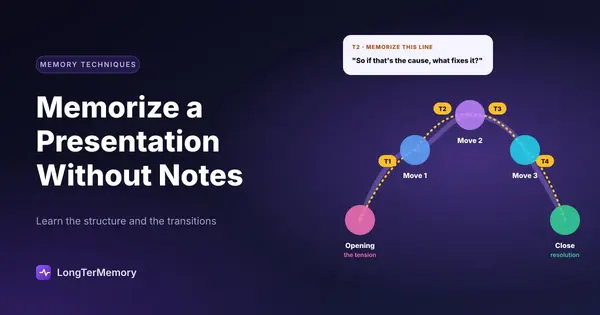
The most brain-friendly structures follow a narrative arc: tension, development, resolution. Even in technical or academic presentations, this arc can be embedded:
- Opening: A problem, a question, a tension that needs resolving
- Body: A series of 3–5 moves that progressively address the problem
- Conclusion: Resolution, synthesis, what the audience should do or think now
Three to five main sections is the human brain’s natural chunking capacity for this kind of material. More than five and the sequence becomes hard to hold. Fewer than three and you haven’t given your memory enough anchor points to navigate.
Name each section. Assign a single word or phrase to each section that captures its core move , “The Problem,” “The Evidence,” “The Counterargument,” “The Solution,” “The Call to Action.” These labels become the waypoints in your mental map. You’re not navigating a script; you’re navigating a route.
Step 2: Rehearsal Techniques That Build Memory Without Scripting
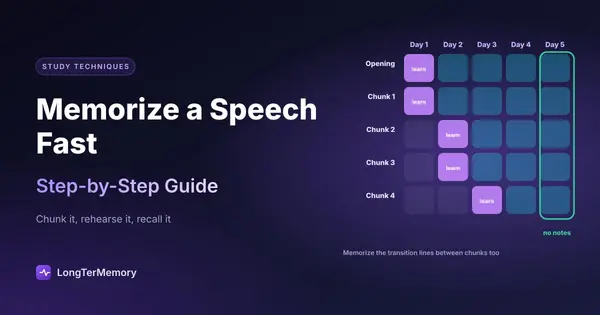
Once your architecture is solid, the memorization happens through a specific type of rehearsal: progressive revelation rehearsal. This is the opposite of running through the presentation from start to finish every time.
Round 1 , Section summaries. Look at your section labels only. For each one, say out loud what that section covers , not the actual presentation content, just a one-sentence summary. Do this until you can move through all sections fluently from memory.
Round 2 , Key points per section. For each section, try to name the 2–3 key points it contains. Don’t try to say the presentation , just the points. Say them in any order first, then try to get them in the right order. Repeat until the sequence is automatic.
Round 3 , Full section run-throughs. Now take one section at a time and deliver it fully from memory. No notes, no slides , just talk. It will be rough. That’s fine. Do each section twice.
Round 4 , Full presentation run-through. Deliver the complete presentation from start to finish, out loud, standing up (this matters , standing activates different muscle memory than sitting). Time yourself. Note which transitions felt weak , those are your memorization gaps.
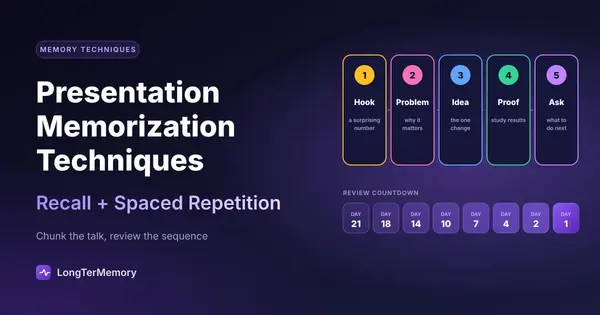
Round 5 , Spaced review. Run through the section labels and key points once a day for the 3 days before the presentation. Full run-throughs once a day. The spacing between rehearsals is what moves the content from short-term to long-term memory.
This typically takes 3–4 hours spread over several days, not a single marathon session. The spreading is important: sleep consolidates what you rehearsed during the day. A presentation rehearsed over three nights is more reliably memorized than the same content rehearsed intensively the night before.
If you want a fully mapped-out version of that schedule, our guide to presentation memorization techniques based on active recall and spaced repetition lays out a three-week rehearsal plan day by day.
Step 3: The Transitions Are What You Actually Need to Memorize
Here’s something most presentation coaches don’t tell you: the hardest moments in a notes-free presentation aren’t within sections , they’re between them.
Within a section, momentum carries you. You know the topic, and once you’re talking about it, the content flows. The dangerous moment is when one section ends and the next needs to begin. That transition , “what comes after this?” , is where people freeze, glance around for a prompt card that isn’t there, or repeat themselves to buy time.
Memorize your transitions explicitly. Write out the link sentence between each section and rehearse it until it’s automatic. It doesn’t need to be clever , it needs to be reliable. Something like:
- “That’s the problem. Now let’s look at why it happens.”
- “So those are the three causes. What does that mean for the solution?”
- “Before I get into the data, it’s worth pausing on what we mean by…”
When you’re nervous and the section you just finished is fading, a pre-memorized transition sentence pulls you forward into the next section automatically. It’s a bridge your brain can walk without thinking.
Handling Memory Blanks Confidently During Live Delivery
Even with excellent preparation, blanks happen. Adrenaline, distraction, an unexpected question, a sound from the audience , any of these can knock you off your mental map. How you handle it determines whether the blank is invisible or catastrophic.
The pause technique. When you blank, don’t fill the silence with “um” or “uh” or visibly scanning for your notes. Pause. Take a breath. Look calm. A 2–3 second pause is invisible to the audience , they experience it as deliberate pacing. For you, it’s recovery time.
Return to your last anchor. Mentally go back to the last section label you remember being on. Say it quietly to yourself. In most cases, this reactivates the sequence and the next point comes.
Paraphrase to buy time. If you’re on a specific point and the detail won’t come, paraphrase what you just said more broadly. “And the key thing here is , at a high level , that [restate the section’s core idea].” This often triggers the specific detail, or it bridges naturally to the next point.
Accept imperfection. Audiences are not following a transcript. They don’t know what you planned to say. If you skip a point or land in the wrong section, only you will know. The presentation isn’t ruined by a blank; it’s only ruined by panicking about the blank.
The goal isn’t a perfect recitation. It’s a confident, connected delivery of the core content. That’s entirely achievable without notes , and with the architecture-based approach, it’s achievable faster than most people believe.
Memory Techniques That Accelerate Presentation Memorization
Two classical memory techniques are especially useful for presentations:
The Method of Loci (Memory Palace). Mentally place each section of your presentation in a different location along a familiar route , your home, a walk you know well. To retrieve the structure during delivery, mentally walk the route. Each location cues the content associated with it. This technique is most useful for presentations with many sections or complex sequences.
The Story Spine. If your presentation has a narrative arc (most good ones do), encode it as a story: “Once there was a problem… Every day it caused… Until one day… Because of that… Until finally…” The story spine is the same structure as a presentation arc, and human brains remember stories far more reliably than lists of information.
For most presentations , 15 minutes or under, with 4–5 sections , the architecture-plus-progressive-rehearsal approach above is sufficient without additional memory techniques. Add method of loci only if you’re dealing with complex or lengthy material.
For presentations you give often, or talks packed with facts and figures, LongTerMemory can turn your script or slides into question and answer flashcards and schedule them with spaced repetition, so your key points and transitions stay sharp between rehearsals.
The Night-Before Check
The night before your presentation:
- Run through section labels from memory , can you name all of them in order?
- Run through key points per section , 2–3 per section, from memory
- Say your transition sentences out loud
- Do one full run-through, standing up, timed
- Stop. Don’t rehearse again tonight. Sleep consolidates.
If you can pass steps 1–3 confidently, you’re ready. The full run-through (step 4) is a confidence confirmation, not more memorization.
Walk in with your architecture memorized, your transitions rehearsed, and your recovery plan in place. Notes or no notes, that’s what confident presenting looks like.
Memorizing a presentation without notes isn’t a party trick. It’s the result of building a structure your brain can navigate naturally and rehearsing that structure until it’s automatic. The language takes care of itself. The confidence comes from knowing exactly where you are , and where you’re going , at every moment.