How to Prepare for the Occupational Therapy Board Exam (NBCOT)
A complete guide to NBCOT exam prep for occupational therapy students, covering high-yield domains, clinical reasoning, and question strategy.
Table of Contents
- What the NBCOT Exam Actually Tests
- The Question Formats You'll See
- High-Yield Content Areas for NBCOT Readiness
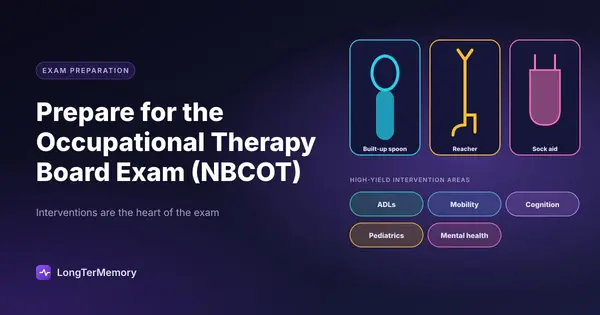
- The Big Intervention Areas
- Don't Neglect the Foundations
- Practice Question Strategy and Clinical Reasoning Development
- Building Clinical Reasoning Through Practice Questions
- Mastering the Multi-Select Scenario Sets
- Recommended Study Resources
- Building Your NBCOT Study Plan
- A Six-Week Study Framework
- Daily Study Session Structure
- The Mental Side of NBCOT Preparation
- The Day Before and the Day Of
You’ve made it through OT school. Fieldwork is done. And now there’s one more mountain to climb: the NBCOT exam. The National Board for Certification in Occupational Therapy exam is the certification exam that US states rely on for occupational therapist licensure, and if you’re staring at your study materials right now feeling slightly overwhelmed, you’re in good company.
This guide is going to walk you through how to prepare systematically, what the exam actually tests, where to spend your time, and how to approach the clinical reasoning questions that trip up so many otherwise well-prepared candidates.
What the NBCOT Exam Actually Tests
First, let’s get clear on what you’re dealing with. The NBCOT Occupational Therapist Registered (OTR) exam consists of 180 items, and you have four hours to complete it. That sounds like a lot of time until you actually sit down and start working through complex clinical scenarios.
The exam is built around the four domains of the official 2022 OTR Examination Content Outline:
| Domain | Weight |
|---|---|
| 1. Evaluation and Assessment | 23% |
| 2. Analysis, Interpretation, and Planning | 23% |
| 3. Select and Manage Interventions | 38% |
| 4. Competency and Practice Management | 16% |
Select and Manage Interventions is the largest domain at 38%, and evaluation plus analysis and planning add another 46% between them. This tells you something important about how you should be allocating your study time. You can’t afford to spend equal attention on all four domains if you only have a limited number of weeks to prepare.
The Question Formats You’ll See
Since January 2024 the OTR exam uses two item types:
- Single-response multiple-choice items with three or four options and one correct answer
- Multi-select scenario sets: an opening scene describing a practice situation, followed by four related items, each with six options of which you select the three best
The scenario sets replaced the old clinical simulation items, and they deserve particular attention because they’re different from most other standardized exams. You’re not looking for a single right answer. You’re choosing the three best actions out of six, where the wrong options are often plausible but less appropriate, and the right ones reflect strong OT clinical reasoning. We’ll come back to how to practice for these specifically.
High-Yield Content Areas for NBCOT Readiness
You cannot study everything equally and expect to do well. You need to identify the content areas that carry the most weight and the ones where your knowledge is shakiest, then prioritize ruthlessly.
The Big Intervention Areas
Neurological conditions are pervasive throughout the NBCOT. Stroke, traumatic brain injury, Parkinson’s disease, multiple sclerosis, and spinal cord injury all appear regularly. For each condition, you need to know:
- The typical functional deficits you’d expect to see
- The appropriate assessment tools (FIM, AMPS, Barthel, COPM, and others)
- Evidence-based intervention approaches
- Precautions and contraindications
Musculoskeletal and orthopedic conditions are another major category. Joint replacements, hand therapy, cumulative trauma disorders, fractures, and post-surgical protocols all require solid knowledge. Weight-bearing restrictions, splinting principles, and range-of-motion guidelines come up repeatedly.
Pediatric OT covers a wide range of developmental conditions, including autism spectrum disorder, cerebral palsy, sensory processing disorders, developmental delays, and congenital conditions. Sensory integration theory shows up often, as do standardized assessments like the Sensory Profile and Bayley Scales.
Mental health is an area many candidates underestimate. Psychosocial OT, group dynamics, activity analysis in psychiatric settings, and occupational therapy’s role in mental health recovery are all fair game.
Geriatrics rounds out the major content areas, including fall prevention, dementia care, assistive technology, and aging-in-place interventions.
Don’t Neglect the Foundations
The NBCOT also expects competency in foundational knowledge that underpins clinical reasoning:
- Occupational therapy models and frames of reference (Model of Human Occupation, Occupational Adaptation, Biomechanical Frame of Reference, Sensory Integration, Cognitive Behavioral approaches)
- Activity analysis and therapeutic use of occupation
- Professional ethics and AOTA standards
- Legislation affecting OT practice (ADA, IDEA, Medicare/Medicaid)
- Documentation requirements and professional communication
These might feel like background knowledge rather than exam content, but they form the reasoning framework for answering clinical questions correctly. You need to know your models well enough to apply them to scenarios, not just recite their names.
Practice Question Strategy and Clinical Reasoning Development
Here’s where many NBCOT candidates go wrong. They read, they review notes, they watch review videos. What they don’t do enough of is practice questions with rigorous review of every wrong answer.
The NBCOT is a reasoning exam as much as a content exam. Yes, you need to know the material. But the questions are designed to test whether you can apply that knowledge appropriately in a clinical context, prioritizing client-centered goals, selecting evidence-based interventions, and recognizing when to modify an approach.
Building Clinical Reasoning Through Practice Questions
The most effective way to develop NBCOT-level clinical reasoning is to work through a high volume of practice questions, but not just grinding through them. The review of wrong answers is where the real learning happens.
For every question you get wrong, ask yourself:
- Was I missing content knowledge? If so, go back to the source material and fill that gap.
- Did I understand what the question was asking? Many NBCOT errors come from misreading the question or the clinical scenario.
- Did I reason correctly but pick the wrong answer anyway? This often indicates you need to sharpen your understanding of what the NBCOT considers the “best” answer, which usually emphasizes client-centered, occupation-based, and evidence-supported approaches.
A useful target is working through at least 1,500 to 2,000 practice questions in your dedicated study period, with thorough review of everything you got wrong. That sounds like a lot, but at 50 questions per session, it’s manageable over six to eight weeks.
Mastering the Multi-Select Scenario Sets
Scenario sets require a different kind of preparation. You read an opening scene, then answer four related items, each asking you to pick the three best of six options. You receive credit for each correct option you select, and there are no deductions for incorrect ones, so always select three.
To practice for scenario sets:
- Think in decision trees. For any scenario, work through: what do I need to assess first? What intervention approach fits this client’s needs, goals, and context? What precautions apply?
- Know your contraindications cold. The wrong options are often actions that are contraindicated for the condition, out of sequence, or outside OT scope of practice.
- Practice articulating your reasoning out loud. If you can explain why an action is appropriate or inappropriate, you understand it well enough to apply it correctly.
Recommended Study Resources
Several resources have strong track records for NBCOT preparation:
- NBCOT Practice Exams (official): These are the most representative of the actual exam in terms of question style and difficulty.
- TherapyEd’s OT Review Guide: Comprehensive content coverage with practice questions, widely used in OT programs.
- OT Miri’s NBCOT Study Materials: Strong for visual learners and those who prefer structured review.
- OT Flourish and similar YouTube channels: Good for reinforcing concepts you’re struggling with.
- Quizlet decks and spaced repetition apps: For vocabulary, assessments, frames of reference, and factual content that benefits from repetitive review.
For the spaced repetition piece specifically, tools like LongTerMemory allow you to upload your NBCOT review notes and generate flashcard-style question-answer pairs automatically, then schedule reviews based on how well you know each item. This is especially useful for the large volume of assessment tools, frames of reference, and condition-specific information you need to have at your fingertips.
Building Your NBCOT Study Plan
Let’s get practical about scheduling. Most candidates need six to twelve weeks of dedicated study time after graduation, depending on how much clinical knowledge they’ve retained from fieldwork and coursework.
A Six-Week Study Framework
Weeks 1 and 2: Content review by domain
Work through each of the four exam domains systematically. Spend more time on domains where you feel weakest and on the high-yield content areas described above. Start doing practice questions early, even in week one. Reading without doing questions is passive study.
Weeks 3 and 4: High-volume practice questions
Shift the balance so that 60 to 70 percent of your study time is spent on practice questions and review. Identify your weakest content areas based on what you’re getting wrong and do targeted review of those topics.
Week 5: Mixed practice and simulation questions
Focus specifically on the multi-select scenario sets. Work through NBCOT’s sample scenario sets and full practice sets, and practice articulating your reasoning for each option you choose.
Week 6: Full-length practice exams and light review
Take two or three full-length timed practice exams. Review wrong answers but don’t introduce new material at this stage. Focus on confidence, sleep, and mental preparation.
Daily Study Session Structure
| Phase | Time | Activity |
|---|---|---|
| Warm-up | 15 min | Review yesterday’s flashcards (spaced repetition) |
| Content review | 45 min | Read and take notes on target domain |
| Practice questions | 60 min | Work through 30 to 50 questions |
| Error review | 30 min | Analyze every wrong answer thoroughly |
| Flashcard creation | 15 min | Add new cards from today’s content errors |
This two-and-a-half-hour daily session is sustainable and covers all the key activities. On days when you have more time, extend the practice question block.
The Mental Side of NBCOT Preparation
Let me be direct about something that review guides often skip: the NBCOT is a high-stakes exam and the psychological pressure is real. Many candidates have solid content knowledge and still perform below their ability because anxiety affects their reasoning in the exam.
A few things help:
Simulate exam conditions during your practice. Time yourself. Don’t use notes. Sit at a desk rather than sprawled on a couch. The more familiar the exam-taking experience feels, the less cognitive load the anxiety of the unfamiliar will create on exam day.
Trust your clinical training. You have done fieldwork. You have worked with real clients. When you read a clinical scenario and something feels wrong about an intervention approach, that clinical instinct is worth paying attention to.
Don’t interpret question difficulty as failure. The NBCOT includes questions of varying difficulty, and some are specifically designed to be challenging for most candidates. A question that stumps you doesn’t mean you’re going to fail. Keep moving.
Maintain basic self-care. Sleep genuinely affects your clinical reasoning ability, and that matters for an exam that’s testing clinical reasoning. The candidate who sleeps seven hours and studies six hours a day will almost certainly outperform the candidate who sleeps five hours and studies ten.
The Day Before and the Day Of
The day before your exam: do a light review of your most important flashcards, confirm your logistics (exam location, required ID, arrival time), eat well, and stop studying by early evening. Your brain needs time to consolidate, and last-minute cramming tends to increase anxiety without adding meaningful knowledge.
On exam day: eat a solid breakfast, arrive early, read every question carefully before looking at answer choices, and flag difficult questions to return to rather than getting stuck on them. Manage your time across the four hours so you’re not rushing at the end.
The NBCOT is a significant challenge, but it’s a challenge with a clear structure and a lot of good preparation resources. Most candidates who put in six or more weeks of deliberate practice, not just passive review, but active question-based learning with thorough error analysis, pass on their first attempt.
You know OT. Now it’s about demonstrating that you know it under standardized exam conditions. That’s a learnable skill, and every practice question you work through is making you better at it.