How to Use Spaced Repetition for Neurology Board Review
Master neurology board review with spaced repetition. Build high-yield decks, organize by diagnosis and anatomy, and pair SRS with clinical case reasoning.
Table of Contents
- High-Yield Neurology Content for Flashcard-Based Board Preparation
- Organizing Neurology Decks by Diagnosis, Anatomy, and Clinical Findings
- Dimension One: Anatomical Location
- Dimension Two: Disease or Diagnosis
- Dimension Three: Clinical Finding
- Dimension Four: Board Exam Relevance
- Combining Neurology SRS With Localization and Case Reasoning Practice
- Designing Cards That Test Understanding, Not Just Recall
- Managing the Volume Without Burning Out
- Using Spaced Repetition for Long-Term Neurology Competence
- The Bottom Line
Neurology is one of the most intimidating subjects in medical education. The anatomy is three-dimensional, the pathways cross in confusing ways, and the clinical presentations range from subtle to dramatic. For board exams like the USMLE, ABIM, or neurology residency boards, the volume of material is enormous and the stakes are high.
Spaced repetition is the single most effective tool for memorizing the foundational facts of neurology. But using it well requires more than loading Anki with every fact you encounter. You need a system that separates high-yield anatomy from low-yield trivia, organizes content by how boards actually test it, and connects flashcard review to the clinical reasoning skills that separate passing from excelling.
High-Yield Neurology Content for Flashcard-Based Board Preparation
Not everything in neurology belongs in a spaced repetition deck. Some material is better learned through diagrams, videos, or clinical exposure. The content that benefits most from SRS is discrete, testable, and frequently forgotten between reviews.
Here is a breakdown of what to prioritize in your neurology decks.
| High-Yield for SRS | Lower Priority for SRS |
|---|---|
| Cranial nerve functions and deficits | Detailed embryology of the nervous system |
| Spinal cord tracts and their pathways | Rare genetic neurodegenerative disorders |
| Vascular territories of major arteries | Historical classification systems no longer used |
| Neurotransmitter associations and drug targets | Lengthy case descriptions from textbooks |
| Classic stroke syndromes by artery | Every possible variant of a rare syndrome |
| Seizure types and first-line medications | Comprehensive pharmacokinetic parameters |
| Dermatomes and myotomes | Obscure eponyms with no clinical relevance |
The highest-yield area for most neurology board exams is localization. Boards love questions that ask you to identify the lesion location based on a cluster of findings. A classic example: a patient has ipsilateral facial paralysis and contralateral body weakness. The lesion is in the pons. These patterns are perfect for flashcards because they are discrete, rule-based, and easily forgotten if not reviewed.
Another high-yield category is pharmacology. Neurology medications have specific first-line uses, side effect profiles, and contraindications that are heavily tested. A card that asks “What is the first-line treatment for absence seizures?” with the answer “Ethosuximide” is far more board-relevant than a card listing every antiepileptic drug ever developed.
When building cards, use cloze deletion for paired associations and question-based cards for clinical scenarios. For example, instead of a card that says “The middle cerebral artery supplies the lateral surface of the hemisphere,” use a card that asks “Which artery supplies the lateral surface of the hemisphere, including Broca’s and Wernicke’s areas?” The second version tests retrieval in a way that mirrors how boards ask the question.
Organizing Neurology Decks by Diagnosis, Anatomy, and Clinical Findings
Deck organization matters more in neurology than in almost any other subject. The material is deeply interconnected. A lesion in one location produces findings across multiple domains. If your deck is a random collection of facts, you will struggle to build the mental maps that neurology requires.
The best organization uses a hybrid tagging system that lets you study by dimension. Here is a structure that works well for board preparation.
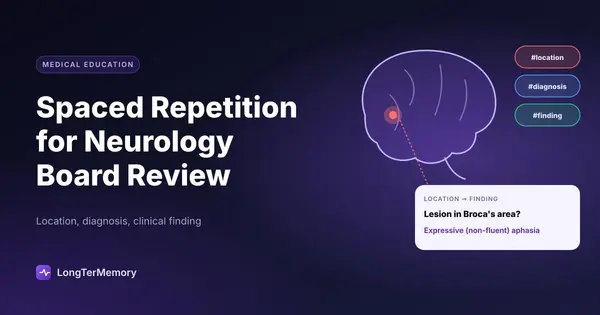
Dimension One: Anatomical Location
Organize cards by the major anatomical divisions: cerebral cortex, basal ganglia, brainstem, cerebellum, spinal cord, peripheral nerves, and neuromuscular junction. When you review by location, you build a spatial understanding of how deficits cluster. This is essential for localization questions.
Dimension Two: Disease or Diagnosis
Create tags for major diseases: stroke, multiple sclerosis, Parkinson’s disease, Alzheimer’s disease, epilepsy, meningitis, and so on. When you review by diagnosis, you reinforce the complete clinical picture. A Parkinson’s tag should pull up cards on pathophysiology, cardinal symptoms, pharmacologic management, and surgical options.
Dimension Three: Clinical Finding
Tag cards by the presenting complaint or examination finding: weakness, sensory loss, aphasia, ataxia, tremor, visual field defect. This dimension is especially useful when you want to practice the differential diagnosis approach. Seeing all the causes of ataxia in one review session builds comparison and contrast skills.
Dimension Four: Board Exam Relevance
Use a priority tag system: high yield, medium yield, and low yield. High-yield cards get reviewed most frequently. Low-yield cards are available if you have extra time but do not dominate your schedule. This prevents the common mistake of spending review time on obscure material while neglecting the topics that drive your score.
If you use LongTerMemory, you can upload your neurology notes or textbooks and the system will generate cards organized by these dimensions automatically. The AI identifies testable concepts, writes question-style prompts, and tags content by topic. You spend less time on deck architecture and more time on actual review.
Combining Neurology SRS With Localization and Case Reasoning Practice
Flashcards build fact retrieval. Boards test reasoning. If your entire neurology study plan is SRS, you will know isolated facts but struggle to apply them in clinical vignettes. The solution is to pair spaced repetition with active case practice.
Here is a weekly structure that balances both.
| Day | Morning Session (45 minutes) | Evening Session (30 minutes) |
|---|---|---|
| Monday | SRS review: anatomy and localization | UWorld or NBME neurology questions |
| Tuesday | SRS review: pharmacology and treatments | Read one clinical case and write the localization |
| Wednesday | SRS review: mixed high-yield deck | Sketch the lesion location for a given syndrome |
| Thursday | SRS review: weak cards from Monday through Wednesday | Timed question block with neurology focus |
| Friday | SRS review: full deck shuffle | Review incorrect answers and update cards |
| Saturday | Rest or light review | Rest or light review |
| Sunday | Case-based reasoning practice with a partner | Plan next week’s weak areas |
The morning SRS sessions build the vocabulary of neurology. The evening sessions teach you to speak the language by applying that vocabulary to cases. Neither alone is sufficient.
For localization practice specifically, use a technique called blank diagram recall. Print a blank brain diagram, spinal cord cross-section, or vascular territory map. Close your notes and fill in as much as you can from memory. Then check against a labeled version and update your SRS cards for anything you missed. This combines visual-spatial learning with retrieval practice, which is especially effective for neurology’s anatomy-heavy content.
Designing Cards That Test Understanding, Not Just Recall
The difference between a good neurology card and a bad one is whether it tests pattern recognition or mere memorization. Boards rarely ask “What is the function of cranial nerve III?” They ask “A patient has ptosis, a dilated pupil, and an eye that is deviated down and out. What is the most likely cause?”
Your cards should mirror this style. Here are examples of weak versus strong card design.
Weak card: Front: “What does the anterior spinal artery supply?” Back: “The anterior two-thirds of the spinal cord.”
Strong card: Front: “A patient loses motor function and pain/temperature sensation bilaterally below the waist, but proprioception and vibration are intact. Which artery is affected?” Back: “The anterior spinal artery.”
The strong card requires you to integrate multiple facts: the sensory and motor pathways, their locations in the cord, and the vascular supply. This is exactly what boards require. Writing strong cards takes more time, but each strong card is worth five weak cards in terms of learning efficiency.
For image-based content, which is common in neurology, use image occlusion cards. Cover the label on a brainstem cross-section and ask yourself to identify the structure and its function. Cover the artery on a vascular territory diagram and name the classic syndrome produced by its occlusion. Visual cards are harder to create but produce better retention for spatial material.
Managing the Volume Without Burning Out
Neurology boards cover thousands of facts. If you try to memorize all of them with equal intensity, you will burn out before you reach the exam. The key is strategic triage supported by data.
Track your performance by tag. If your cards tagged “cerebellar disorders” have an 85 percent correct rate and your cards tagged “neuro-ophthalmology” have a 55 percent correct rate, you know where to spend your time. Most SRS apps provide basic statistics. Use them. Do not review what you already know just because it feels good.
Set a daily card limit that is sustainable over months. For most medical students, 100 to 150 new reviews per day is the upper limit of what can be maintained alongside clinical duties. If your deck grows too large, suspend the lowest-yield cards rather than pushing through an unsustainable load. A smaller deck you review consistently beats a massive deck you abandon.
Build in review holidays. One day per week with no new cards and only essential reviews prevents the fatigue that destroys retention. Your brain consolidates memories during rest. Reviewing while exhausted is not studying. It is ritual.
Using Spaced Repetition for Long-Term Neurology Competence
Board exams are not the end of the journey. Neurology residents, practicing neurologists, and specialists in related fields all need to maintain a large body of knowledge over a career. Spaced repetition is not just a test-prep tool. It is a maintenance system for professional knowledge.
After your board exam, convert your deck into a maintenance schedule. Reduce the frequency to the minimum interval that keeps your accuracy above 80 percent. Add new cards as you encounter unusual cases, rare presentations, or updates to treatment guidelines. Over time, your deck becomes a personalized knowledge base that reflects your actual practice, not just what was in the textbook.
This long-term approach is especially valuable for clinicians who move between specialties or return to general practice after subspecialty training. The deck preserves knowledge that would otherwise decay during periods of disuse.
If you want to streamline the process of building and maintaining your neurology knowledge base, LongTerMemory offers AI-generated cards from your clinical notes, case write-ups, and board review materials. The system handles the scheduling, the question formatting, and the tagging. You upload your source material and focus on review and clinical application. For a subject as complex as neurology, removing the administrative burden of card creation can be the difference between a sustainable system and one that collapses under its own weight.
The Bottom Line
Neurology rewards structured study. The anatomy is too complex, the differential diagnoses too broad, and the clinical presentations too varied for passive review to work. Spaced repetition gives you the factual foundation. Case reasoning gives you the application skill. Organization gives you the efficiency to cover everything without losing your mind.
Build your decks with intention. Organize by location, diagnosis, and clinical finding. Write cards that test pattern recognition. Pair your daily SRS with active case practice. Track your weak areas and adjust. Do this consistently, and neurology transforms from a subject that intimidates you into one where you have a clear, structured advantage.