
How to Pass the NPTE Physical Therapy National Exam
Pass the NPTE with confidence. This guide covers domain weighting, high-yield content areas, practice exam strategy, and a study plan that works.
Table of Contents
- Understanding What the NPTE Actually Tests
- The Content Outline: Where the Points Come From
- The Highest-Yield NPTE Content Areas
- Musculoskeletal: The Foundation
- Neuromuscular: The Differentiator
- Cardiovascular and Pulmonary: Don't Skip It
- Non-Systems Content: More Important Than It Looks
- Practice Exam Strategy: The Core of Your Preparation
- Quality Resources for Practice Questions
- How to Review Practice Questions Effectively
- Scheduling Your Practice Tests
- Managing the Mental Side of NPTE Preparation
- Structure Reduces Anxiety
- Rest Is Not Wasted Time
- The Final Week
- Putting It Together
After four years of physical therapy school, hundreds of clinical hours, and more anatomy diagrams than you ever wanted to memorize, the NPTE stands between you and your license. It’s the final gate, and it’s one you have to take seriously. The pass rate for first-time US graduates is typically around 89-91%, which sounds reassuring until you consider that the candidates who don’t pass did four years of PT school too.
The difference between passing and failing isn’t intelligence. It’s how you prepare. Here’s a comprehensive guide to passing the National Physical Therapy Examination on your first attempt, built around how the exam is actually structured and what the research on effective exam preparation actually recommends.
Understanding What the NPTE Actually Tests
The NPTE is developed by the Federation of State Boards of Physical Therapy (FSBPT). The exam contains 200 questions, though only 150 count toward your score. The remaining 50 are unscored pretest items that FSBPT uses to evaluate for future exams. You don’t know which is which, so treat every question as if it counts.
The exam is computer-adaptive, meaning the difficulty of subsequent questions adjusts based on your performance on prior ones. This isn’t something you can strategize around, it just means that the exam is reading your knowledge level in real time.
The Content Outline: Where the Points Come From
The FSBPT publishes a content outline that specifies exactly what the exam tests and in what proportions. This document is free, authoritative, and one of the most valuable study resources available. If you haven’t already downloaded it, do that today.
The exam is organized around two major dimensions: system (the body system being tested) and clinical application (what you’re being asked to do, such as examination, evaluation, intervention, or outcomes).
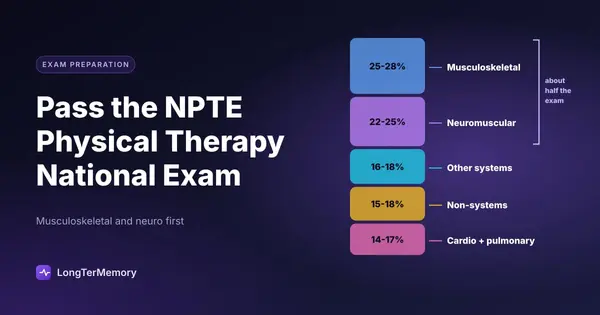
The system distribution is roughly as follows:
| System | Approximate Weighting |
|---|---|
| Musculoskeletal | ~25-28% |
| Neuromuscular | ~22-25% |
| Cardiovascular / Pulmonary | ~14-17% |
| Other Systems (integumentary, metabolic/endocrine, gastrointestinal, genitourinary, lymphatic, multisystem) | ~16-18% |
| Non-Systems (equipment, devices, administration, safety, professional responsibilities) | ~15-18% |
The clinical application weighting shows that the exam heavily emphasizes examination and intervention over pure knowledge recall. It’s testing your ability to apply what you know to patient scenarios, not just recite textbook definitions.
This matters enormously for how you study.
The Highest-Yield NPTE Content Areas
Knowing where the points are isn’t enough. You need to know what’s actually difficult and what separates passing candidates from those who fail. Based on the content weighting and the kinds of questions that candidates consistently find challenging, here are the areas that deserve the most preparation time.
Musculoskeletal: The Foundation
Musculoskeletal content is the single largest section of the NPTE, and it’s also one of the areas where most PT graduates feel most comfortable, having spent substantial clinical time in ortho settings. But “comfortable” and “exam-ready” aren’t the same thing.
The NPTE goes beyond basic anatomy and orthopedic special tests. Questions in this domain frequently require you to:
- Interpret findings from a combination of tests and select the most appropriate diagnosis or treatment direction
- Prioritize interventions given patient-specific constraints (age, comorbidities, goals, precautions)
- Progress or modify treatment in response to changes in patient presentation
The key is practicing with scenario-based questions, not just reviewing anatomy. Being able to describe the anatomy of the rotator cuff is table stakes. Being able to identify which rotator cuff structure is most likely involved based on a described mechanism of injury, physical exam findings, and the patient’s functional limitations, that’s the NPTE level.
For musculoskeletal, make sure you’re solid on:
- Orthopedic special tests and their sensitivity/specificity implications
- Spinal dysfunction and nerve root levels
- Post-surgical protocols and precautions for common procedures (ACL repair, shoulder instability, hip arthroplasty)
- Manual therapy principles and application
Neuromuscular: The Differentiator
Neuromuscular is where many candidates feel less confident, and performance here often separates passing from failing candidates. The content spans a wide range: stroke, traumatic brain injury, spinal cord injury, Parkinson’s disease, multiple sclerosis, peripheral neuropathies, vestibular dysfunction, and pediatric neurological conditions.
The NPTE doesn’t just ask you what a condition is. It asks you to select the most appropriate intervention for a patient at a specific stage of recovery, which requires understanding not just the condition but how recovery progresses, what functional goals are realistic, and what precautions apply.
Key neuromuscular areas to master:
- Stroke rehabilitation: stages of recovery, appropriate interventions at each stage, positioning and splinting, gait training considerations
- Spinal cord injury: American Spinal Injury Association (ASIA) classification, functional outcomes by level, appropriate equipment and compensation strategies
- Parkinson’s disease: LSVT LOUD and BIG, cueing strategies, fall prevention
- Vestibular rehabilitation: BPPV repositioning maneuvers (Epley, Semont), central vs. peripheral vertigo differentiation
- Pediatric development: normal developmental milestones, how neurological conditions affect development, early intervention approaches
For neuromuscular content, one of the most effective study approaches is organizing your knowledge by functional outcome: for each condition, what can the patient do at each level of severity, and what interventions are appropriate at each stage? This framing matches how NPTE questions are typically structured.
Cardiovascular and Pulmonary: Don’t Skip It
Cardiopulmonary is often the area candidates feel least confident in, particularly those whose clinical experience was heavily ortho-focused. It’s also where significant points are available.
The NPTE tests:
- Exercise testing interpretation (VO2 max, heart rate response, blood pressure response, contraindications for testing)
- Cardiac rehabilitation phases: inpatient phase I through outpatient phase III/IV, appropriate activities and monitoring at each phase
- Pulmonary conditions and respiratory therapy: COPD, asthma, cystic fibrosis, pneumonia, postural drainage and percussion techniques
- Monitoring and response: when to stop exercise, how to interpret vital sign changes during activity, appropriate exercise intensity prescription
The cardiopulmonary questions on the NPTE tend to be highly scenario-based: “A patient in cardiac rehab phase II shows the following vital sign response during exercise. What is the most appropriate action?” Getting comfortable with these scenarios requires practice with clinical vignettes, not just content review.
Non-Systems Content: More Important Than It Looks
The non-systems category covers equipment, safety, professional responsibilities, patient education, documentation, and outcomes measurement. At roughly 15-18% of the exam, it’s substantial, and many candidates underinvest here because it doesn’t fit neatly into their clinical experience.
Key non-systems areas:
- Equipment: assistive devices (appropriate selection, fitting, gait patterns), electrophysical agents (indications, contraindications, parameters), orthotics and prosthetics basics
- Safety: body mechanics, fall prevention, infection control, emergency procedures
- Professional responsibilities: scope of practice, documentation standards, ethical considerations, supervision requirements
- Outcomes measures: knowing which outcome measures are appropriate for which populations, and how to interpret results
Build your non-systems knowledge through targeted review using prep resources specifically designed to cover these areas systematically.
Practice Exam Strategy: The Core of Your Preparation
Here’s the single most important thing to know about NPTE preparation: the number of quality practice questions you complete is the strongest predictor of your score. Not the number of hours you spend reviewing content. Not the quality of your textbooks. The practice questions.
This doesn’t mean drilling endlessly without thinking. It means completing practice questions under exam conditions, analyzing every answer, understanding why correct answers are correct and why incorrect answers are wrong, and building from that analysis rather than just counting answers as right or wrong.
Quality Resources for Practice Questions
The most trusted NPTE prep resources include:
PEAT (Practice Exam and Assessment Tool): This is FSBPT’s own official practice exam. It’s the gold standard for question quality because it’s built by the same organization that writes the real exam. If you do nothing else, complete the PEAT and analyze it thoroughly.
Scorebuilders and Therapyed: Both produce well-regarded prep materials specifically designed for the NPTE, with large question banks, content review, and simulated exams. Most candidates who pass do so using one of these two platforms alongside PEAT.
NPTE Clinical Files by FSBPT: Another official resource, with additional practice items released by FSBPT. Well worth using.
How to Review Practice Questions Effectively
This is where most candidates go wrong. They complete a practice question set, note their score, and move on. That approach wastes the most valuable learning opportunity in your preparation.
After completing any practice set, review every question, including the ones you got right. For questions you answered correctly, confirm that you got it right for the right reason, not through guessing or elimination. For questions you got wrong, do not just read the explanation and move on. Instead:
- Identify which content area was being tested
- Identify where your reasoning went wrong (did you misread the question? Did you lack the content knowledge? Did you choose a plausible but suboptimal answer?)
- Go back to your study materials and fill in the gap
- Create a flashcard or note for the specific concept that tripped you up
This process is slow. It’s supposed to be slow. A 100-question practice set that takes three hours to complete and analyze is far more valuable than three 100-question sets completed in three hours total with no real review.
Scheduling Your Practice Tests
Most candidates prepare for the NPTE over an 8-12 week period. Here’s a rough approach to integrating practice questions:
- Weeks 1-4: Content review by system, with topical practice questions after each system (50-75 questions per system, done and reviewed)
- Weeks 5-8: Mixed practice sets (100+ questions per session, simulating exam conditions), content review targeted at identified weak areas
- Weeks 9-10 (if using 10-week plan): Full timed simulated exams, targeted review of persistent weak areas, pacing and stamina practice
The PEAT should be saved for approximately 2-3 weeks before your exam date, when you’ve done enough preparation to get meaningful diagnostic information from your performance.
Managing the Mental Side of NPTE Preparation
Four years of school behind you, a licensing exam ahead, and probably some financial and professional pressure on top of it all. The mental dimension of NPTE preparation is real, and ignoring it is a mistake.
Structure Reduces Anxiety
Anxiety thrives in ambiguity. The more clearly defined your study plan is, the less mental energy gets consumed by worry about whether you’re studying the right things in the right amount. Build a week-by-week plan at the start of your preparation period and follow it. Adjust as needed, but have the structure in place.
Rest Is Not Wasted Time
Memory consolidation happens primarily during sleep. Cutting sleep to add more study hours is counterproductive beyond a certain point: you’re adding input while reducing the brain’s ability to process and store it. Protect your sleep, especially in the final two weeks before the exam.
The Final Week
In the final week before your exam, reduce the volume of new content you’re consuming. This is the time for light review of your notes, spaced repetition drilling of your flashcard deck, and maintaining your normal sleep schedule. Adding a lot of new content in the final week is more likely to create confusion than to add useful knowledge.
Putting It Together
Passing the NPTE requires a combination of solid content knowledge, high-volume quality practice, thoughtful analysis of your performance, and the mental discipline to maintain your preparation schedule. None of those things are mysterious or beyond any physical therapy graduate.
What separates successful candidates isn’t innate ability. It’s the willingness to do the less exciting work: analyzing every wrong answer, reviewing content systematically rather than just drilling questions, and maintaining the preparation structure even when motivation dips.
If you want to streamline your flashcard and content review process during your NPTE preparation, LongTerMemory can generate Q&A pairs automatically from your own study materials and apply spaced repetition scheduling to your review sessions. It’s particularly useful for building your custom review deck from the content areas you’ve identified as weak, based on your practice question analysis.
You’ve done the hard part. Four years of PT school was the hard part. This is the last step. Prepare with structure, practice with purpose, and go pass your boards.