How to Prepare for CFA Level 2: Advanced Study Strategies
Pass CFA Level 2 with advanced study strategies. A realistic 400-hour plan, vignette practice tips, and spaced repetition for finance mastery.
Table of Contents
If you cleared CFA Level 1, take a moment to celebrate. Seriously, you earned it. But if you are already thinking about Level 2, you have probably heard the warning that gets passed down from candidate to candidate like folklore: Level 2 is where things get real. It is not folklore. It is accurate, and underestimating it is the fastest way to join the large group of smart people who walk out of the testing center stunned.
The pass rate for Level 2 historically sits around 45%, which sounds better than Level 1’s recent 40-43% until you realize the pool is self-selected. Everyone sitting for Level 2 already passed Level 1. These are not beginners. They are committed, intelligent candidates who simply did not adjust their preparation to match what the exam actually tests. This post is your guide to not becoming one of them. We are covering the exact shift in content and format, how to master the vignette question style, and a realistic 400-hour study plan spread across six months. We will also talk about why spaced repetition is not optional at this level, and how to avoid the mistakes that sink otherwise capable candidates.
What changes from CFA Level 1 to Level 2 in content and format
Level 2 stops testing whether you remember facts and starts testing whether you can apply them under time pressure. That is the single biggest change, and it should reshape every decision you make about how to study.
Level 1 is fundamentally a breadth and recognition exam. You memorize formulas, definitions, and basic relationships across ten topic areas. The questions are standalone multiple-choice items that ask you to identify the correct formula, pick the right accounting treatment, or calculate a simple ratio. It is demanding, but it is predictable. If you know the material, you can usually recognize the right answer quickly.
Level 2 assumes you already know all of that. The curriculum builds directly on Level 1 foundations but pushes you into complex valuation, deep financial statement analysis, and multi-step quantitative problems. Instead of asking you to calculate a single ratio, Level 2 presents you with a full set of financial statements, a detailed company description, and an economic scenario, then asks you to select the right analytical framework, adjust for differences in accounting standards, and compute a valuation under specific constraints.
The exam format changes dramatically too. Level 1 has 180 standalone multiple-choice questions. Level 2 has 22 item sets called vignettes, each containing a dense case study followed by four to six questions. You face 88 questions total, but every single one is anchored to an information-heavy case. This means your reading load per question skyrockets. A single vignette might run a full page of small text, packed with tables, footnotes, and intentionally distracting details that exist solely to test whether you can tell signal from noise.
Here is how the two levels compare at a glance:
| Feature | CFA Level 1 | CFA Level 2 |
|---|---|---|
| Question style | Standalone multiple choice | Vignette-based item sets |
| Total questions | 180 | 88 (inside 22 vignettes) |
| Focus | Breadth and recall | Depth and application |
| Topic weights | Evenly spread | Concentrated in FSA, equity, fixed income |
| Pass rate (recent) | ~40-43% | ~45% (self-selected pool) |
| Average study hours | 300 hours | 325-400 hours |
The jump in study hours is not just about volume. It is about the kind of practice you need. You cannot cram application skills. You have to rehearse them repeatedly, under time pressure, with realistic material. That takes hours, and more importantly, it takes the right kind of hours. Candidates who try to brute-force Level 2 with the same flashcard-heavy approach that worked for Level 1 often find themselves unable to execute inside a vignette, even when they technically know the formulas.
Vignette-based questions: how to practice for the Level 2 format
The only way to get good at vignettes is to practice full vignettes under timed conditions, starting early. There is no shortcut. Reading about vignettes is not the same as performing inside them. The skill you are building is the ability to extract signal from noise under severe time pressure, and that skill is built only by doing.
Each vignette on the CFA Level 2 exam gives you a dense case study, typically describing a company, portfolio, or economic situation, followed by a mix of qualitative and quantitative questions. You have roughly two minutes per question when you account for reading time, which means a four-question vignette needs to be completed in about ten to twelve minutes total. That includes reading the case, locating the relevant data, performing calculations, and selecting answers.
If that sounds tight, it is. Candidates who underperform on Level 2 often report that they simply ran out of time. They knew the material but could not access it fast enough inside the vignette format. The format itself becomes the enemy, not the finance content.
Here is how to train for this specifically:
- Start with full vignettes from week one of your practice phase. Do not waste time on standalone multiple-choice questions. They build the wrong skill. You need to get comfortable with the mental load of reading a full case, holding relevant details in working memory, and answering chained questions where one answer may depend on insight from another.
- Time every single vignette. Use a stopwatch or exam software. Your target is roughly two and a half minutes per question, including reading. If a vignette has four questions, you have ten minutes. No exceptions. This builds pacing instinct that will save you on exam day when anxiety is high and the clock is unforgiving.
- Review the case, not just the questions. After finishing a vignette, go back and identify exactly which sentences or data points were necessary for each correct answer. Then identify what was included as a distractor. This trains your eye to scan faster over time and helps you recognize when the CFA Institute is throwing irrelevant numbers into the mix to slow you down.
- Try reading the questions before the case. Some candidates swear by this approach. Reading the questions first tells you what to look for, which can cut your case reading time significantly. Experiment with this in practice and see if it works for your brain. If it makes you anxious or causes you to miss context, stick with reading the case first. The point is to find your optimal strategy before exam day.
- Practice across topics in mixed sets. The exam does not group vignettes by topic. You might get a fixed income case followed immediately by an equity valuation case, then an ethics case. Your practice should mimic that randomness so you get better at context switching. Doing ten equity vignettes in a row feels good because you are in a groove, but it does not prepare you for the cognitive whiplash of the real exam.
The vignette format also tests something subtle, your tolerance for ambiguity. Cases often include extraneous information, partial data, or details that seem relevant but are not. Learning to ignore the noise is a skill in itself. The candidates who treat every number in the case as meaningful are the ones who burn precious minutes and second-guess themselves into wrong answers.
Building a 400-hour Level 2 study plan across 6 months
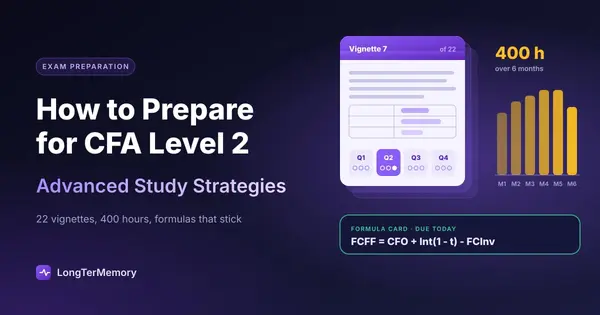
You need about 400 hours spread over six months, structured in three distinct phases, with heavy emphasis on practice and spaced review. This is more time than most Level 1 candidates invest, and the structure matters far more than the raw hour total.
The CFA Institute suggests 325 hours on average for Level 2, but that number includes candidates who fail and retake. In reality, most passing candidates report closer to 350 to 400 hours, especially if they are working full-time while studying. Six months gives you roughly 24 to 26 weeks, which means you need to average 15 to 17 hours per week. That is absolutely manageable for a working professional if you protect your study time aggressively and say no to distractions you would otherwise accept.
Here is a realistic 6-month plan:
Months 1 to 2: Foundation and First Pass
- Work through the curriculum topic by topic, starting with Financial Statement Analysis and Equity Valuation. These are the heaviest topics and they underpin much of the rest of the curriculum.
- For every reading, immediately follow up with practice questions on that specific topic. Do not let more than 48 hours pass between learning a concept and testing yourself on it. The testing effect is one of the most robust findings in learning science, and it applies double at Level 2.
- Keep a running log of every formula you encounter. Do not assume you will remember it later. Log it now.
- Target: 120 to 140 hours.
Months 3 to 4: Vignette and Mock Exam Phase
- Shift almost entirely to full vignette practice. This is where the real learning happens.
- Mix topics randomly the way the exam does. Do not cluster by subject.
- Take your first full mock exam at the start of month 3 to benchmark your weak areas. Expect it to hurt. That is the point.
- Take a second full mock exam at the end of month 4. Track your improvement by topic.
- Target: 140 to 160 hours.
Months 5 to 6: Review, Weak Areas, and Stamina
- Focus on the topics where your mock exam performance was weakest. Do not study what you already know. That is procrastination dressed up as productivity.
- Continue timed vignette practice daily, even if it is just one or two cases.
- Take one full mock exam every two weeks under exact exam conditions. No phone, no snacks, no music. Train your brain for the boredom and pressure of the real thing.
- In the final two weeks, shift to formula review and light vignettes rather than learning new material. Your goal is accessibility, not novelty.
- Target: 100 to 120 hours.
| Phase | Timeline | Focus | Hours |
|---|---|---|---|
| Foundation | Months 1-2 | Curriculum + topic questions | 120-140 |
| Application | Months 3-4 | Vignettes + mock exams | 140-160 |
| Review | Months 5-6 | Weak areas + stamina | 100-120 |
A few tactical notes on scheduling. If you are working full-time, front-load your weekday mornings rather than relying on evenings. Willpower depletes over the course of a day, and quantitative finance material demands sharp focus. Even 60 to 90 minutes before work is often higher quality than two hours after a long day at the office. Weekend blocks of four to five hours are where you will do your heavy lifting on mock exams and long vignette sessions. Treat those blocks like appointments you cannot cancel.
Also, do not treat Ethics as an afterthought. It represents roughly 10 to 15 percent of the exam depending on the year, and it can swing your overall result if you are borderline. The CFA Institute weights Ethics heavily in the pass-fail decision, even beyond its explicit topic weight. Study it consistently throughout your six months, not just in the final week. The ethical framework has specific, sometimes counterintuitive answers that require familiarity, not just common sense.
Spaced repetition and formula retention for Level 2
Level 2 contains an enormous volume of formulas: present value calculations, dividend discount models, free cash flow derivations, duration and convexity formulas, option pricing components, and countless adjustments for leases, pensions, currency translations, and intercorporate investments. You cannot hold all of this in working memory through brute force or last-minute cramming.
The evidence from learning science is clear. Spaced repetition, reviewing material at strategically increasing intervals, produces retention that is roughly double that of massed practice or cramming. For an exam where you need instant recall of a formula six months after you first learned it, this is the difference between passing and failing. The forgetting curve is real, and it is ruthless with quantitative material you do not revisit.
Set up a system where every formula you encounter gets logged into a flashcard app with an interval schedule. Review your flashcards daily for 20 to 30 minutes. This sounds like a small commitment, but over six months it compounds dramatically. The formulas you learned in month one will still be automatic in month six, which is exactly when you need them most. Do not wait until the final month to realize you have forgotten half the curriculum.
If building flashcards manually feels like too much overhead, LongTerMemory can automatically generate spaced repetition flashcards from your CFA notes and curriculum PDFs, so you spend your time studying instead of formatting cards. You can check it out at https://longtermemory.com.
Common mistakes that sink Level 2 candidates
Even smart, hardworking candidates make predictable errors. Here are the ones that show up again and again:
- Treating Level 2 like Level 1. Memorizing formulas without practicing application is the single most common failure mode. You need both memorization and execution, but application practice is the bottleneck.
- Starting timed practice too late. If your first timed vignette happens in the final month, you are behind. Pacing is a skill that requires months of rehearsal, not days.
- Ignoring Financial Statement Analysis. It is not the flashiest topic, but it underpins equity, fixed income, and alternative investments. Weakness here bleeds across the entire exam in ways you will not notice until mock exam day.
- Neglecting formula maintenance. Candidates who skip daily formula review find that their month-one knowledge has evaporated by month five. The forgetting curve does not care how well you knew it in January.
- Skipping mock exams. Some candidates avoid mocks because they feel demoralizing. That is exactly why you need them. They reveal gaps while you still have time to fix them. A bad mock score in month four is a gift. A bad mock score in your head on exam day is a disaster.
Conclusion
CFA Level 2 is widely considered the hardest exam in the entire CFA program. Not because the math is theoretically impossible, but because it forces you to shift from memorization to judgment under pressure. The candidates who pass are not necessarily the ones with the highest IQs or the most prestigious finance degrees. They are the ones who respected the format shift early, built a realistic 400-hour plan, and practiced vignettes until the timing felt automatic rather than frantic.
Start with the assumption that your Level 1 study habits are insufficient. Front-load your application practice, protect your formula retention with spaced repetition, and take mock exams seriously even when the scores bruise your ego. The exam is learnable, but it demands a different kind of preparation than almost any other test you have taken.
If you are ready to stop letting formulas fade from memory and start building a study system that actually sticks, give LongTerMemory a try. Turn your CFA readings into flashcards that show up exactly when your brain is about to forget them, so you walk into the exam with six months of knowledge still sharp, accessible, and ready to deploy under pressure.
Now go block out those 400 hours on your calendar. The vignettes are waiting, and with the right plan, you will be ready for them.