How to Prepare for Microsoft Azure Administrator AZ-104
A practical AZ-104 study guide covering the five exam domains, hands-on Azure lab practice, and the best resources to pass the Azure Administrator exam.
The Microsoft Azure Administrator Associate exam, AZ-104, sits right in the sweet spot of cloud certifications. It is broad enough to prove you can actually run Azure day to day, yet deep enough that a few weeks of casual reading will not get you across the line. If you are a sysadmin pivoting to cloud, a support engineer leveling up, or a developer who suddenly inherited a subscription, this guide will show you how to prepare efficiently without wasting weekends on topics the exam barely touches.
Passing AZ-104 is not about memorizing every Azure service. It is about understanding how the core pieces fit together: identity, compute, storage, networking, and monitoring. Get those five areas genuinely solid, add enough hands-on repetition that the portal and the CLI feel familiar, and the exam becomes difficult but very passable.
The Five Domains of the AZ-104 and Their Relative Exam Weight
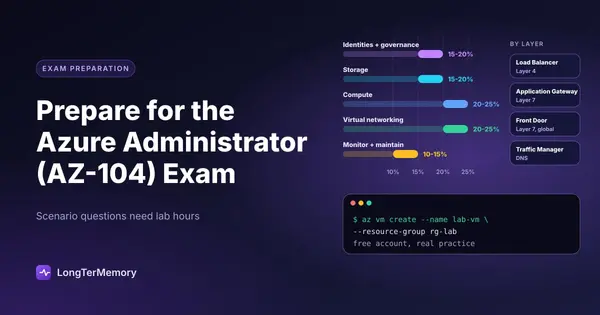
The exam is organized into five official domains, and the weighting tells you exactly where to spend your time. Microsoft publishes these percentages in the exam guide, and they are the closest thing you will get to a cheat sheet for prioritization.
| Domain | Approx. weight | What it covers |
|---|---|---|
| Manage Azure identities and governance | 20-25% | Entra ID users, groups, roles, RBAC, subscriptions, resource groups, policies, Microsoft Defender for Cloud |
| Implement and manage storage | 15-20% | Storage accounts, blobs, files, disks, replication, lifecycle management, SAS tokens |
| Deploy and manage Azure compute resources | 20-25% | VMs, VMSS, App Service, containers, availability sets, availability zones, extensions |
| Implement and manage virtual networking | 15-20% | VNets, subnets, NSGs, UDRs, VPN Gateway, ExpressRoute, private endpoints, DNS |
| Monitor and maintain Azure resources | 10-15% | Azure Monitor, Log Analytics, alerts, metrics, backups, Site Recovery, Automation |
Three things stand out here. First, identity/governance and compute together make up nearly half the exam. If your background is infrastructure but light on Entra ID and RBAC, that first domain deserves disproportionate attention. Second, no domain is negligible. Even the smallest one, monitoring, can easily account for eight to ten questions, so skipping it is not a strategy. Third, the exam loves hybrid and connected scenarios: a VM in one VNet that needs storage in another, a user who needs just enough permissions without overprovisioning, a backup policy that spans regions.
The practical takeaway is to study by weight, not by comfort. Many candidates spend too long on VMs because they are concrete and familiar, then panic through networking because it feels abstract. Reverse that. Networking and identity are where the exam separates people who understand Azure from people who have only read about it.
Hands-On Lab Practice: Why AZ-104 Requires More Than Reading
You cannot pass AZ-104 by reading alone. The questions are scenario-based, and the wrong answers are usually plausible options that fail on one specific detail. The only way to spot that detail reliably is to have done the work in the portal, the CLI, or PowerShell at least a few times.
Reading teaches you that Network Security Groups exist. Labbing teaches you that an NSG associated with a subnet behaves differently than one associated with a NIC, that rules are stateful, and that a deny rule higher in priority will silently override an allow rule below it. That kind of embodied knowledge is what the exam targets.
High-yield labs to build yourself:
- Deploy a VM and secure it end to end. Create a VNet and subnet, add an NSG with specific inbound rules, assign a managed identity, and connect via Azure Bastion instead of a public IP. Then break it on purpose: remove the Bastion rule, change the NSG priority, and troubleshoot why you cannot connect.
- Build a storage account and practice every access pattern. Create blob containers, upload files through the portal, the CLI, and Storage Explorer. Generate a shared access signature with limited scope and expiration, then try to access a blob with and without it. Turn on soft delete and versioning, then overwrite and recover a file.
- Configure RBAC from scratch. Create a custom role that lets a user restart VMs but not delete them, assign it at the resource group level, and verify it works. Compare Azure roles with Microsoft Entra ID roles until the distinction is automatic.
- Set up hybrid-style networking. Build two VNets, peer them, and deploy a VM in each. Test connectivity, then add a UDR that forces traffic through a third VM acting as a simple network virtual appliance. Watch how peering plus routing changes behavior.
- Automate a repeatable task. Write a small Azure CLI or PowerShell script that creates a resource group, a VNet, and a VM with one command. Then convert it into an Azure Resource Manager template or Bicep file so you understand Infrastructure as Code in the Azure context.
How to keep labbing affordable:
- Use the Azure free account if you are eligible. It gives you enough credit to run meaningful labs for several weeks.
- Build a daily tear-down habit. VMs, VPN gateways, and storage with large files will burn credits fast. Take screenshots and notes, then delete resource groups before you log off.
- Use the Azure pricing calculator before building anything expensive. It is a good habit and, incidentally, a useful exam skill.
- For services that are costly to run continuously, like ExpressRoute or large VM scale sets, lab them once, document heavily, and review your notes rather than leaving them running.
Labbing is also the best way to prepare for the performance-based questions that sometimes appear. These small interactive tasks ask you to complete a configuration in a simulated Azure environment. They reward muscle memory, so the more portal and CLI work you have done, the faster and more confidently you will handle them.
Study Resources and Practice Exam Banks for AZ-104
Good resources matter, but the order in which you use them matters more. Start with official material to learn what Microsoft actually wants you to know, then layer on third-party explanations and practice exams to fill gaps and build exam stamina.
Official and foundational resources:
- Microsoft Learn AZ-104 learning path. This is free, aligned to the exam objectives, and includes short sandbox labs. It is the best place to start if you are new to Azure administration.
- AZ-104 exam skills outline. Download the official PDF and use it as a checklist. Cross off each bullet only when you can explain it and, ideally, have done it once.
- Azure documentation and architecture center. The docs for Entra ID, Virtual Network, Storage, and Azure Monitor are not light reading, but they are the source of truth for the precise wording the exam expects.
- Azure free account sandbox. Use it alongside Microsoft Learn modules so you can experiment without touching your own subscription.
Video courses for structured explanation:
- Pluralsight AZ-104 path. Excellent for visual learners and for getting a coherent narrative across all five domains.
- Scott Duffy’s AZ-104 course on Udemy. Well-paced, practical, and frequently updated to match exam changes.
- John Savill’s Azure training on YouTube. Deep, technically rich, and free. His master classes are especially useful once you have a baseline.
Practice exam banks worth using:
- MeasureUp. The official practice test provider for Microsoft. The questions are harder than the real exam in useful ways, and the explanations are detailed.
- Whizlabs AZ-104 practice tests. Good value, with solid explanations and a large question bank for repetition.
- Tutorials Dojo practice exams. Highly regarded for scenario-based questions that mirror the real exam style. Use these in the final two weeks.
- ExamTopics. A free community bank, but treat it cautiously. Some answers are outdated or debated, so verify anything that feels off against the official docs.
Books and references:
- “Exam Ref AZ-104 Microsoft Azure Administrator” by Harshul Patel. A concise companion to the exam objectives, useful for review.
- “Mastering Azure Administration” by several Packt authors. More comprehensive than the exam ref, good for filling conceptual holes.
How to use practice exams effectively:
- Do your first full practice exam after you have finished one pass of all five domains. The goal is diagnosis, not a score.
- For every missed question, write down the why behind the correct answer and the why behind each wrong option. The exam rewards reasoning, not recall.
- Track misses by domain. If 60% of your errors are in networking, that is where your next three study sessions go.
- Take the final practice exam two to three days before the real test. Use it to confirm readiness, not to cram new topics.
A Realistic Study Timeline for AZ-104
For someone with a year or two of general IT experience and a few hours a week to study, a realistic AZ-104 timeline is 8 to 12 weeks. If you already work with Azure daily, you might compress that to 4 to 6 weeks. If Azure is entirely new, give it 12 to 16 weeks.
| Weeks | Focus |
|---|---|
| 1-2 | Microsoft Learn AZ-104 path; portal navigation; Azure CLI basics; identity and governance fundamentals |
| 3-4 | Compute resources in depth: VMs, VMSS, App Service, containers, availability, extensions |
| 5-6 | Storage and networking: accounts, replication, VNets, subnets, NSGs, UDRs, peering |
| 7-8 | Hybrid networking, private endpoints, DNS, monitoring, backup, and Site Recovery |
| 9-10 | First full practice exam; targeted review of weak domains; more hands-on labs |
| 11-12 | Final practice exams; scenario drilling; review of notes and flashcards; schedule the exam |
Whatever timeline you choose, front-load identity and networking. Those two areas take the longest to internalize because they are less about clicking through wizards and more about understanding how permissions and traffic flow across an environment. Compute and storage, while still deep, tend to click faster for people with traditional infrastructure backgrounds.
Also, schedule the exam while you still have momentum. Having a date on the calendar forces you to protect study time and cuts the temptation to keep reviewing indefinitely.
Retaining the Details Without Drowning in Notes
Here is the problem no lab or video fully solves: AZ-104 has a massive number of small but testable facts. Which RBAC role lets you manage VM sizes but not delete the VM? What is the default replication option for a storage account? Which PowerShell cmdlet creates a resource group? These details are easy to learn and even easier to forget three weeks later.
That is where spaced repetition becomes your secret weapon. As you move through each domain, turn the granular facts into short question-answer cards. Review them daily for a few minutes. The small time investment keeps the detail layer fresh while your deeper study hours stay focused on labs and scenarios.
If you have PDF study guides, lab notes, or exported documentation, you can upload them to LongTerMemory and let its AI turn the material into flashcards automatically. It handles the scheduling too, so the facts you are most likely to forget surface right when you need to review them. For an exam as fact-dense as AZ-104, combining hands-on labs with spaced repetition is the most reliable way to walk into the testing center with both intuition and recall sharp.
Final Thoughts
The AZ-104 is not a trivia test, and it is not a memorization sprint. It is a certification designed to show that you can administer a real Azure environment safely, securely, and efficiently. That means your preparation should mirror the job: read to understand, lab to internalize, test to diagnose, and repeat the facts until they stick.
Focus on the five domains in proportion to their weight. Build the labs that force you to make real decisions about networking, identity, and storage. Use practice exams as feedback loops, not as score trophies. And keep the fine-grained details alive with spaced repetition so they are still there on exam day.
Pass AZ-104 and you will have more than a certification. You will have a working administrator’s mental model of Azure, which is exactly what employers hiring for cloud roles are looking for. Put in the hands-on work, trust the process, and the score will follow.