
How to Build a Long-Term Memory for Professional Knowledge
Discover how to build a long-term memory system for professional knowledge so the skills and insights you earn throughout your career never fade away.
Table of Contents
- Why Professional Knowledge Decays Without Deliberate Maintenance
- Building a Personal Knowledge Retention System for Your Career
- Step 1: Capture What Matters
- Step 2: Convert Captures Into Retrievable Format
- Step 3: Build Review Into Your Week
- Using Spaced Repetition to Keep Years of Professional Learning Accessible
- What Professional Knowledge Looks Like in a Spaced Repetition System
- The Career-Length Payoff
- Practical First Steps
You spend years building expertise in your field. You read industry reports, complete certifications, sit through training days, and accumulate insights from every project you touch. Then, somewhere along the way, you notice something uncomfortable: a lot of it seems to be disappearing. A skill you once had feels rusty. A framework you mastered two years ago takes a minute to recall. A concept you read about six months ago is completely gone.
This is not a personal failing. It is how human memory works, and it affects every professional who has ever learned something important. The encouraging part? Once you understand why it happens, you can do something about it. Building a long-term memory for professional knowledge is absolutely possible, and it does not require heroic time investment. What it requires is the right system.
Why Professional Knowledge Decays Without Deliberate Maintenance
Before getting into solutions, it helps to understand what you are actually working against. The brain does not store information like a hard drive. It does not file things neatly in folders where they sit untouched until you need them. Memory is a living process, and anything that is not regularly accessed gets deprioritized and eventually faded.
The mechanism responsible for this is called the forgetting curve, a concept first described by psychologist Hermann Ebbinghaus in the 1880s and replicated by researchers ever since. The core finding is that memory decays exponentially after initial learning. Without any reinforcement, you might retain 60% of what you learned one day after learning it, 30% after a week, and less than 20% after a month. For practical professional knowledge, this is a serious problem.
What makes this especially tricky for working professionals is that the pattern of learning tends to be front-loaded. You do a course, you study for a certification, you read a book. Then life gets busy and you never return to the material. The information fades while your confidence in it stays higher than it should be, which is a phenomenon psychologists call the fluency illusion. You feel like you know something because it was once familiar, even when the actual memory traces have significantly degraded.
There is a second dynamic at play specific to professional environments: contextual dependency. A lot of what you learn at work is tied to a specific project, client, or situation. When that context disappears, so does easy access to the knowledge. You technically learned it, but without the cues that were present when you first encountered it, retrieval becomes difficult. This is different from never having known it, but in practice the effect is similar.
The good news: both of these issues have well-studied solutions, and they are not complicated.
Building a Personal Knowledge Retention System for Your Career
A personal knowledge retention system is simply a structured way of making sure the important things you learn in your career do not vanish. It does not need to be elaborate. The most effective systems are usually simple enough that you will actually maintain them when work gets busy.
Step 1: Capture What Matters
The first step is deciding what is worth retaining and capturing it in a form you can revisit. Not everything needs to go into a retention system. A quick Slack message you skimmed does not belong there. A key framework from a leadership training that genuinely shifted how you think about your work? That belongs there.
The capture mechanism can be almost anything: a dedicated notes app, a simple text file, a Notion database, a physical notebook. What matters is not the tool but the habit of capturing. When you finish a course, a book, or a significant project, spend ten minutes writing down the two or three most important things you learned. Be specific. Not “learned about negotiation” but “learned that anchoring first in a salary negotiation tends to set the reference point for the whole discussion, based on research by Adam Galinsky.”
The specificity matters because vague notes produce vague memories. When you return to this capture later, you want something that fires off the full memory, not just a faint reminder that you once learned something in this area.
Step 2: Convert Captures Into Retrievable Format
Raw notes are not yet in a form that supports long-term retention. The next step is converting what you captured into something you can actively test yourself on. The most efficient format for this is question and answer pairs.
Instead of a note that says “spaced repetition is effective because of memory reconsolidation,” you write:
- Question: Why does spaced repetition work from a neuroscience perspective?
- Answer: Because each retrieval attempt triggers memory reconsolidation, physically strengthening the neural pathway associated with that memory.
This format forces active recall, which is one of the most evidence-backed methods for building durable long-term memory. When you return to this card in the future, you are not passively reading information, you are testing whether you can retrieve it. The struggle of retrieval is precisely what makes the memory stronger.
Tools like LongTerMemory can automate much of this process by converting your notes, PDFs, and documents into spaced repetition flashcards automatically. This removes the friction of manual card creation, which is usually the reason professionals give up on retention systems, and replaces it with a workflow that keeps your knowledge active with minimal overhead.
Step 3: Build Review Into Your Week
The single biggest predictor of whether a knowledge retention system works is whether you actually use it. And the single biggest reason people stop using systems is that they treat reviews as optional extras rather than scheduled events.
The best approach is to treat knowledge review the same way you treat important recurring meetings: put it in your calendar, give it a fixed slot, and protect it. The time commitment is much smaller than most people expect. A fifteen-minute daily review session using spaced repetition covers an enormous amount of material over time because the algorithm handles prioritization for you. Items you know well appear infrequently. Items you are struggling with appear more often.
What you absolutely want to avoid is the pattern of long study binges followed by weeks of nothing. That approach is well-documented to produce poor retention because memory consolidation requires distributed practice over time, not intensity in one session. Fifteen minutes every day for a month will leave you with far more retained knowledge than two hours once a week.
Using Spaced Repetition to Keep Years of Professional Learning Accessible
Spaced repetition is the most powerful tool available for long-term retention of professional knowledge, and it is worth understanding why it works before explaining how to use it.
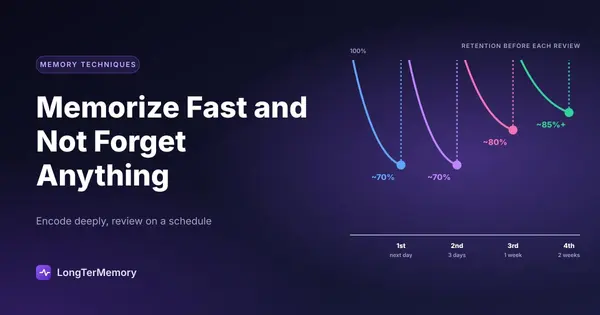
The core mechanism is spacing. Every time you successfully retrieve a memory, that memory becomes more resistant to forgetting, but only if you retrieve it at the right time. Too soon, and the retrieval is easy but does not strengthen the memory much. Too late, and you have already forgotten it and have to relearn from scratch. The optimal moment is just before you would have forgotten it, and a good spaced repetition algorithm calculates this for each piece of information based on your past performance.
Over time, as you consistently retrieve something correctly, the intervals get longer and longer. A fact you learned this week might be reviewed tomorrow, then in three days, then in a week, then in three weeks, then in two months. After a year of this treatment, it is effectively in permanent memory. The total review time is surprisingly small because the intervals expand dramatically for well-known material.
What Professional Knowledge Looks Like in a Spaced Repetition System
Not all professional knowledge translates directly into neat flashcard format, and it is worth thinking about how to handle different types of information.
Frameworks and models work very well. Turn each component of a model into a question. For a consulting framework like MECE, your questions might cover what MECE stands for, how to apply it in structuring problems, and a real-world example of using it. Review the cards until the framework is automatic.
Key principles and heuristics are also flashcard-friendly. Your industry probably has a set of well-established principles that should inform daily decision-making. These are perfect for retention review. A question might be: “What does the 80/20 principle suggest about prioritization?” with an answer you have written in your own words.
Procedural knowledge, meaning how to do specific things, is trickier. You cannot really flashcard a complex multi-step process the way you can a concept. For procedural knowledge, the best retention approach is periodic practice rather than flashcards. Schedule deliberate practice sessions where you actually do the procedure, not just recall that it exists.
Domain-specific vocabulary and terminology responds extremely well to flashcards. If you work in a technical field, regulatory area, or specialized domain, the vocabulary is foundational. If you lose the vocabulary, you lose access to everything built on top of it.
The Career-Length Payoff
One thing that distinguishes top performers in almost every professional field is deep, rapidly accessible knowledge. Not just knowledge they had at some point in their career, but knowledge they can still use right now. The people who seem to have everything at their fingertips, who can recall relevant research or frameworks on demand, who never seem to need to relearn things they have already mastered, are not necessarily smarter. They have usually just built better retention habits.
Over a career of twenty or thirty years, the compounding effect of a consistent knowledge retention practice is dramatic. Every year of experience adds a layer of knowledge that stays accessible rather than fading. By mid-career, you have access to a decade of insights rather than just the last six months. This changes what you are capable of. It changes the quality of your thinking, the depth of your expertise, and ultimately your professional value.
The investment required is genuinely modest. Fifteen minutes of daily review, a habit of capturing key insights, and a simple system for converting those insights into reviewable format. Compared to the hours you spend acquiring professional knowledge in the first place, the maintenance cost is tiny. The payoff is that everything you have learned stays with you.
Practical First Steps
If you want to start building your professional knowledge retention system today, here is a simple path forward:
Week 1: Spend fifteen minutes at the end of each workday writing down one thing you learned or encountered that is worth keeping. Do not worry about format. Just capture it.
Week 2: Go back through your week 1 captures and convert each one into one or two question and answer pairs. This is your first small flashcard deck.
Week 3: Start a daily review habit. Ten to fifteen minutes, every morning before your first meeting. Work through your flashcards. Notice which ones you get easily and which ones you struggle with.
Week 4 onward: Keep capturing, keep converting, keep reviewing. The system builds on itself. By the end of a month, you will have a tangible sense of how much you are retaining, and you will start to notice the difference in how quickly you can access what you know.
Tools like LongTerMemory make this even easier by handling the card creation from your documents automatically, so you can focus on the reviewing rather than the building. But even if you start with nothing but a notes app and a simple text file of Q&A pairs, you will be ahead of the vast majority of professionals who learn things, forget them, and learn them again in an endless cycle.
Your expertise is worth protecting. Start now, and give your future self access to everything you have spent years building.