How to Stay Current in Your Field Without Full-Time Studying
Learn sustainable micro-learning habits and smart curation strategies to keep your professional knowledge sharp without sacrificing your time.
Table of Contents
- The Trap: Passive Information Consumption at Scale
- The Principle: Less Volume, More Depth
- Sustainable Micro-Learning Habits
- The Curation Stack: Building a Signal-to-Noise System
- Retention: The Missing Piece in Most Learning Systems
- Making New Knowledge Connect to What You Already Know
- The Mindset Shift: Curation Over Consumption
- A System You Can Start This Week
There’s a particular anxiety that settles in after you’ve been out of school for a few years. The field you work in keeps moving. New research, new tools, new frameworks, new regulations. The things you learned when you were studying are partly outdated. And you’re busy, genuinely busy, with work, family, and everything else that fills a life.
The problem isn’t whether you want to stay current. Most professionals do. The problem is that the mental model most people carry for “staying current” is essentially “do more studying,” which is the last thing you have time or energy for after a full work week.
The good news: staying professionally current doesn’t require full-time studying. It requires a different approach to learning entirely, one built around sustainable habits, smart curation, and the kind of targeted retention that makes new information actually useful rather than just technically consumed.
The Trap: Passive Information Consumption at Scale
The default “keeping up” strategy for most professionals is some version of subscribing to a lot of things and occasionally reading them. A few industry newsletters. A handful of podcasts. LinkedIn articles that look interesting while scrolling. Maybe a business book every month or two.
Here’s the problem: most of this is passive consumption that doesn’t build durable knowledge. You read an article about a new methodology in your field, it’s interesting, you might even share it, and then two weeks later you couldn’t describe its core point in three sentences. The information flowed through you and left almost no trace.
This is not a personal failing. It’s how the brain works. Information that isn’t processed actively, tested, connected to what you already know, and reviewed at spaced intervals doesn’t consolidate into long-term memory. It stays in short-term memory, feels relevant for a few days, and then fades.
The result is that professionals who “keep up” passively through constant information consumption often have a feeling of currency, they’re aware of current debates and trends, but lack genuine command of the knowledge. Ask them to explain a methodology they read about, and the details have evaporated.
Genuine currency means being able to use and apply the knowledge, not just recognize it when someone else raises it. That requires a different kind of engagement.
The Principle: Less Volume, More Depth
The first shift is counterintuitive: consume less, but engage more deeply with what you do consume.
Most professionals are already at information saturation. Adding more sources, more newsletters, more podcasts doesn’t solve the retention problem. It usually makes it worse by increasing the volume of information you’re processing passively without giving you time to process any of it actively.
The professionals who genuinely stay current, the ones who can speak with real command about developments in their field, almost universally have fewer sources than you’d expect. They’ve curated down to the things that actually matter for their specific context, and they engage with those things seriously rather than skimming everything lightly.
The practical version of this principle is a source audit. Look at everything you currently subscribe to or follow, and ask honestly: when I engage with this, do I actually remember anything a week later? Does it improve my ability to do my job? Does it connect to what I’m working on right now?
Cut everything that doesn’t answer yes to at least one of those questions. What remains should be the signal sources: the publications, experts, or communities that actually move the needle on your professional knowledge. For most people, this is dramatically fewer sources than they currently follow.
Sustainable Micro-Learning Habits
Once you’ve reduced your sources to the genuinely valuable ones, the question is how to engage with them in a way that builds lasting knowledge without requiring large blocks of dedicated study time.
The answer is micro-learning: short, focused, regular learning sessions built into the flow of your existing day.
The research on distributed practice is consistent: multiple short sessions spread over time produce significantly better retention than the same total time spent in a single block. Fifteen minutes of focused engagement with new material five days per week will build more durable professional knowledge than a ninety-minute reading session on Sunday afternoon.
Here’s how to build this in practice:
Anchor learning to existing habits. The most reliable way to build a new behavior is to attach it to something you already do consistently. If you have a morning coffee ritual that reliably happens, that’s your reading window. If you commute, that’s your podcast or audiobook time. If you have lunch at your desk, that’s your article time. Don’t try to carve out new time; nest learning inside time that already exists.
Set a specific reading goal rather than a time goal. “I’ll read for 20 minutes” is less effective than “I’ll read one article and write two bullet points summarizing the key insights.” The specific goal focuses attention and creates a completion signal that the brain responds to.
Process what you read immediately. The highest-leverage habit you can add to your learning routine costs roughly five minutes per article or chapter: after reading, close the source and write, from memory, the one to three most important points. This simple act of retrieval dramatically improves how much of the content you retain.
The Curation Stack: Building a Signal-to-Noise System
Different types of sources serve different purposes in a professional learning system. The most effective practitioners combine a few types strategically.
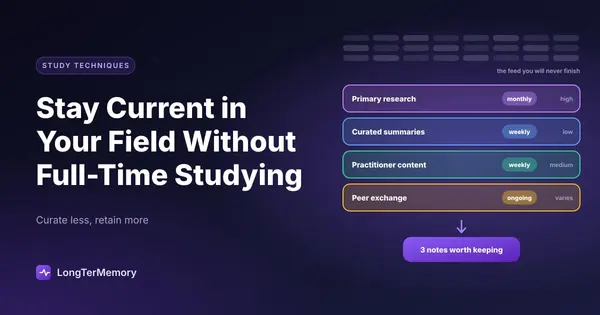
Primary sources: The original research, official documentation, or authoritative publications that define the state of your field. These are slow and dense but have the highest information quality. Budget one to two primary sources per month, not per week.
Curated summaries: Newsletters or digests that summarize primary sources and explain their significance. These give you breadth awareness at lower time cost. One or two high-quality curated newsletters is usually sufficient.
Practitioner voices: Blogs, podcasts, or conference talks from practitioners who are actively working in your field. These have the highest practical relevance because they address the gap between theory and application that primary research often doesn’t.
Peer exchange: Colleagues, professional associations, online communities. This is the most underrated source. Conversations with other practitioners surface what’s actually moving in your field, which doesn’t always match what’s being published. A good professional community is worth more than any newsletter.
| Source Type | Frequency | Time Investment | Value |
|---|---|---|---|
| Primary research | Monthly | High | Deep accuracy |
| Curated summaries | Weekly | Low | Breadth awareness |
| Practitioner content | Weekly | Medium | Practical relevance |
| Peer exchange | Ongoing | Variable | Field intelligence |
Retention: The Missing Piece in Most Learning Systems
This is where most professional development strategies break down. You find the right sources, you engage with them regularly, but six months later you can’t remember what you learned.
The solution is spaced review, applied to professional knowledge exactly the same way it’s applied to exam preparation.
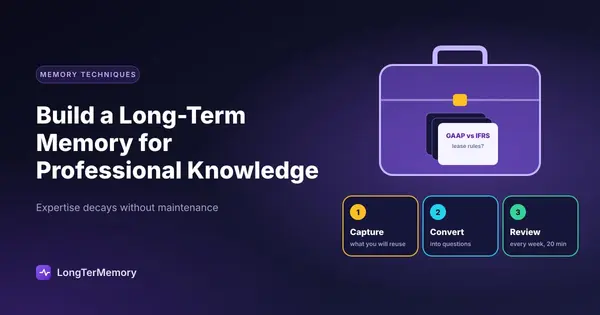
After you learn something valuable, write a brief note in a review system. This can be as simple as a dated note in a notebook, a card in a digital flashcard app, or a short summary in a knowledge management tool. The format matters less than the habit: capture the key insight immediately, then review it at increasing intervals.
The first review should happen within 48 hours. The second within a week. The third within a month. By that point, the information has been through enough retrieval cycles that it tends to stick for years.
LongTerMemory is designed exactly for this kind of use case. You can upload documents, articles, or notes from your professional reading, and the system automatically generates question-answer pairs and schedules them for spaced review. The result is that professional knowledge you encounter in your reading becomes knowledge you can actually recall and apply, rather than knowledge that felt interesting at the time and then faded.
This is the difference between professionals who feel perpetually behind (because they’re consuming but not retaining) and professionals who develop genuine depth over time (because they’re retaining what they consume).
Making New Knowledge Connect to What You Already Know
Retention of professional knowledge is substantially easier when you have a dense prior knowledge base to connect it to. This is called elaborative interrogation in the learning research: the more you can link new information to existing knowledge structures, the more retrieval pathways it creates and the more durable the memory becomes.
In practice, this means that when you encounter something new, you should spend a moment asking: “How does this relate to what I already know? What does it confirm, contradict, or extend?” This isn’t a major time investment. It’s thirty seconds of reflection after reading something. But that brief moment of connection-building significantly improves how well the information integrates into your long-term knowledge.
For professionals in rapidly evolving fields (technology, finance, medicine, law, data science), the landscape changes fast enough that this active connection-building is especially important. Not every new development represents a fundamental shift. Many represent incremental refinements on existing principles. Identifying which is which helps you calibrate how much attention and retention effort a given piece of information deserves.
The Mindset Shift: Curation Over Consumption
There’s a status game in some professional cultures around consumption volume. Reading more books than anyone else, listening to every major podcast in your field, following every key voice. This is mostly counterproductive if retention is your goal.
The professionals who are genuinely ahead in their fields tend to be more curated and more deliberate in their learning than their peers, not more voracious. They’ve identified the twenty percent of sources that generate eighty percent of the valuable insights in their field, and they engage deeply with those rather than spreading thinly across everything.
They also tend to do something with what they learn. Writing about a concept, applying it to a work problem, explaining it to a colleague, these active engagements are what convert professional reading from consumed-and-forgotten into genuine expertise.
A System You Can Start This Week
If you want to put this into practice immediately, here’s a minimal viable system:
- Audit your sources: Cut anything that doesn’t reliably deliver insights you actually use
- Set a daily anchor: Fifteen to twenty minutes of focused reading tied to a habit you already have
- Write post-reading summaries: After each piece, write two to three key points from memory
- Review weekly: Spend ten minutes at the end of each week reviewing what you captured
- Use spaced repetition for high-value insights: Anything worth knowing in three months goes into a review system
This system takes roughly twenty to thirty minutes per day and a ten-minute weekly review. That’s the investment required to stay genuinely current in a fast-moving field, not hours of unfocused reading and podcast listening that leaves nothing behind.
The professionals who build real expertise over time aren’t the ones who consume the most. They’re the ones who retain the most of what they consume, and who apply it consistently. Both of those things are habits, not talents. And habits are learnable.