How to Prepare for the SHRM Situational Judgment Items
SHRM exams test HR judgment, not just knowledge. Learn how to approach situational judgment items using SHRM competency standards and smart practice strategies.
Table of Contents
- What Situational Judgment Items Test in the SHRM Exam Context
- The SHRM Competency Model as Your Decision Framework
- Frameworks for Evaluating HR Scenarios Using SHRM Competency Standards
- The "Most Aligned HR Professional" Frame
- The Sequencing Frame
- The Ethics Filter
- The Avoid Extremes Rule
- Practice Strategies for Building Situational Judgment Fluency
- Use the SHRM Learning System
- Read SHRM Publications Actively
- Create Scenario-Based Flashcards
- Timed Practice Sessions
- Study Groups for Scenario Discussion
- Common Pitfalls to Avoid
- Pulling It All Together
If you’ve started preparing for the SHRM-CP or SHRM-SCP exam and you’ve encountered the practice questions, you’ve probably had at least one moment where you stared at a situational judgment item and thought: “All four of these answers look reasonable to me.” That’s by design. And it’s exactly why this exam trips up even experienced HR professionals who come in expecting a straightforward knowledge test.
The SHRM exam is not primarily a recall exam. Yes, there’s foundational HR knowledge you need to have. But the portion of the exam most people find challenging, the situational judgment items, isn’t testing whether you’ve memorized the right definition. It’s testing whether you can think like a senior HR professional operating within a specific ethical and competency framework.
That’s a different skill, and it requires a different kind of preparation. Here’s how to build it.
What Situational Judgment Items Test in the SHRM Exam Context
A situational judgment item (SJI) presents you with a realistic workplace scenario and asks you to evaluate a set of possible responses. Unlike pure knowledge questions where one answer is factually correct and the others are wrong, SJIs are designed so that multiple responses might be defensible in real life. The question is which response best reflects SHRM’s standards for professional HR practice.
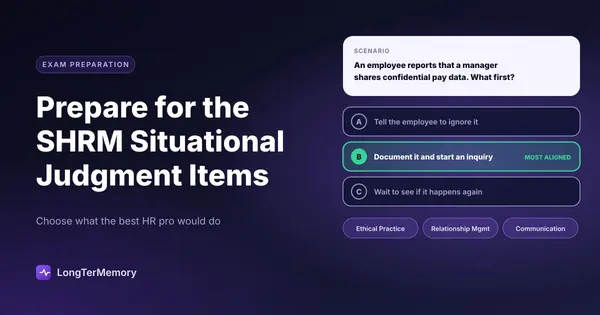
Here’s a simplified example of the format:
You are an HR manager at a mid-sized company. A line manager comes to you and says that one of his direct reports, an otherwise strong performer, has been arriving 30 minutes late every day for the past two weeks. He wants to proceed immediately to a formal written warning without any prior conversation with the employee. What is the most appropriate action for you to take?
(A) Draft the written warning as the manager requested and have him deliver it. (B) Advise the manager to first have a private conversation with the employee to understand the situation before taking disciplinary action. (C) Contact the employee directly to ask what’s going on before the manager takes any action. (D) Remind the manager that attendance issues require HR involvement and take over the conversation yourself.
In a real organization, you might see defensible arguments for B, C, or even D depending on context. On the SHRM exam, one answer is consistently preferred based on the SHRM competency framework. In this case, B reflects the principle that managers should be coached to handle direct conversations with their own employees before escalating, while HR supports rather than bypasses that relationship.
That’s the kind of judgment the exam is probing.
The SHRM Competency Model as Your Decision Framework
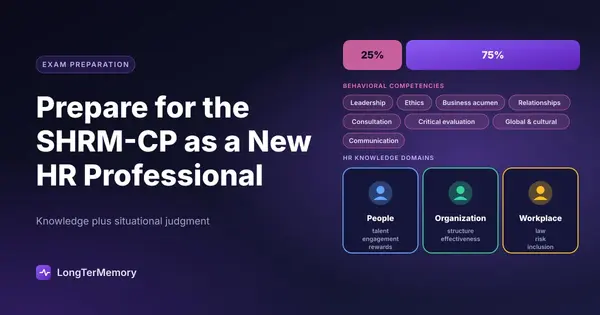
Every situational judgment item can be mapped back to one or more of the SHRM Competency Model domains. These are the nine competencies SHRM has defined as essential for effective HR practice:
| Competency | Brief Description |
|---|---|
| Leadership and Navigation | Navigating change, influencing strategy, guiding the organization |
| Ethical Practice | Acting with integrity, maintaining confidentiality, modeling standards |
| Business Acumen | Understanding business functions, financial literacy, organizational alignment |
| Relationship Management | Building networks, resolving conflict, fostering collaboration |
| Consultation | Analyzing situations, advising stakeholders, solving people problems |
| Critical Evaluation | Interpreting data, assessing programs, drawing evidence-based conclusions |
| Global and Cultural Effectiveness | Navigating cultural differences, inclusive practices |
| Communication | Active listening, messaging, persuasion, cross-functional communication |
| HR Expertise | The technical knowledge domains within HR practice |
When you’re sitting with a scenario and four answer options that all seem reasonable, the question to ask yourself is: which response best demonstrates the competency this scenario is testing?
If the scenario involves a conflict between two employees from different departments, that’s relationship management and consultation. If it involves an HR practice that seems to favor one group over another, that’s ethical practice. If it involves an executive pushing back on an HR initiative, that’s leadership and navigation.
Naming the competency being tested often helps you eliminate one or two options immediately.
Frameworks for Evaluating HR Scenarios Using SHRM Competency Standards
Knowing that scenarios map to competencies is useful in theory. But in practice, you need a way to evaluate options quickly and consistently under exam conditions.
Here are the frameworks that experienced SHRM candidates use.
The “Most Aligned HR Professional” Frame
Ask yourself: What would a thoughtful, senior HR professional with strong ethics and respect for organizational norms do here?
This is not the same as “What would I do in my organization?” Your current workplace practices might deviate from SHRM’s standards in various ways. The exam is testing SHRM’s model of professional HR practice, not your organization’s specific culture.
Common applications of this frame:
- SHRM generally favors proactive communication over delayed action in people issues
- SHRM generally favors coaching managers to handle their own employee relationships rather than HR stepping in unilaterally
- SHRM generally favors addressing root causes rather than applying procedural fixes that don’t resolve the underlying issue
- SHRM generally emphasizes data-informed decision-making over gut-feel or anecdote
The Sequencing Frame
Many SJIs involve a situation where the question is really about order of operations. What do you do first?
SHRM typically prioritizes:
- Gather information / understand the full situation before taking action
- Advise and coach the relevant stakeholder (usually the manager)
- Involve HR directly only when the manager genuinely cannot or should not handle the situation alone
- Escalate to senior leadership or legal counsel when the situation involves legal risk or ethical violations that go beyond routine HR practice
When you see a scenario asking what you should do “next” or “first,” apply this sequencing logic.
The Ethics Filter
Any scenario that touches on confidentiality, discrimination, retaliation, policy violations, or legal risk should immediately activate your ethics filter.
SHRM is very clear that HR professionals have a dual obligation: to the organization and to ethical standards that sometimes transcend organizational preferences. If an answer option requires you to cover something up, to favor a powerful stakeholder over a vulnerable employee without basis, or to take action that might expose the organization to legal liability, it’s almost certainly not the right answer.
The ethics filter catches a lot of wrong answers quickly, especially options that look pragmatic in the short term but cut ethical corners.
The Avoid Extremes Rule
In most SJI answer sets, you’ll find options that represent the extremes: do nothing at all, or take the most aggressive possible action. In the vast majority of cases, neither extreme is the SHRM-preferred answer.
HR practice, as SHRM models it, lives in the middle: thoughtful, proportionate, relationship-preserving, and legally sound. The extreme options are usually designed to test whether you recognize overcorrection and undercorrection as equally problematic.
When in doubt, the most balanced response that gathers information, respects relationships, and follows appropriate process is usually closer to correct than either extreme.
Practice Strategies for Building Situational Judgment Fluency
Knowing the frameworks is necessary but not sufficient. You need to practice applying them under exam-like conditions until the reasoning becomes fluent and automatic.
Use the SHRM Learning System
The official SHRM Learning System (the prep course SHRM offers) is the most direct source of exam-aligned practice questions. The SJIs in the Learning System are written to mirror the actual exam format and are aligned to the current SHRM Body of Competency and Knowledge (SHRM BoCK).
Don’t just answer the questions and check your score. For every question you get wrong, and for every question you got right but felt uncertain about, read the explanation carefully and identify which competency it was testing. Keep a running log of which competencies you’re struggling with. This is your personal weakness map.
Read SHRM Publications Actively
One of the best ways to internalize how SHRM thinks about HR situations is to read how SHRM writes about them. SHRM’s HR Magazine, their online articles, and their workplace policy toolkits all reflect the same competency-based perspective that SJIs test.
When you read a SHRM article about, say, handling a retaliation complaint or designing a return-to-work policy, you’re absorbing the professional norms that will later help you select the right SJI answer. This is passive preparation, but it compounds over weeks into genuine intuition about how SHRM thinks.
Create Scenario-Based Flashcards
This is less obvious but very effective: build flashcard decks around HR scenarios, not just definitions.
Front of card: “A manager asks HR to delay processing an employee’s accommodation request until after a big project deadline because accommodations are ‘disruptive to the team.’ What should HR do?”
Back of card: HR should advise the manager that the ADA’s interactive process cannot be delayed for operational convenience, explain the legal risk, and work with the manager to find an accommodation that meets the employee’s needs without waiting. This reflects Ethical Practice and Legal Compliance within HR Expertise.
Building these scenario cards yourself is more effective than passively reading them, because the act of writing the scenario and answer forces you to reason through the situation and articulate the principle clearly.
Timed Practice Sessions
The SHRM exam is timed, and the SJIs require more cognitive effort than straightforward recall questions. Build your exam stamina by doing timed practice blocks of 20-30 questions, checking your time discipline, and reviewing your reasoning afterward.
One common pacing mistake: spending too long on any single SJI because “all the answers seem good.” Give yourself a maximum of about 90 seconds per question. If you’re genuinely stuck, make your best judgment using the frameworks above, mark it for review, and move on. The review time at the end is better used than ruminating on one question mid-exam.
Study Groups for Scenario Discussion
Because SJIs are about judgment rather than pure recall, they’re particularly well-suited to group discussion. If you can find other SHRM candidates to study with, use this format:
- Present a practice SJI to the group
- Everyone commits to their answer silently before discussion
- Each person explains their reasoning
- Compare your reasoning to the official explanation
Where people’s reasoning diverges from each other and from the official answer is where the most learning happens. These discussions surface assumptions and intuitions that you might not even notice in solo study.
Common Pitfalls to Avoid
Relying on your current organization as your reference point. Your workplace may do things in ways that deviate from SHRM’s professional standards. If you answer based on “what we do at my company,” you’ll miss a significant number of SJIs.
Picking the answer that feels most comfortable, not most competent. SJIs often include an “HR takes charge” option that feels satisfying but bypasses appropriate manager accountability. Resist the impulse.
Ignoring the sequencing of actions. “What do you do next?” and “What is the most appropriate immediate action?” are different questions. Pay close attention to how the question is framed.
Underestimating how much practice matters. The SHRM SJIs are learnable. The judgment they test can be developed through deliberate practice. Students who do 200+ practice SJIs with careful review consistently outperform students who do far less.
Situational judgment rests on knowing the underlying HR knowledge cold. LongTerMemory can turn your SHRM BoCK notes and study guides into question and answer flashcards and schedule them with spaced repetition, so the competencies and laws behind each scenario stay fresh.
Pulling It All Together
The SHRM situational judgment items reward a very specific kind of preparation: deep familiarity with the SHRM competency model, a consistent framework for evaluating scenarios, and substantial practice with real SJI-format questions.
Factual HR knowledge is necessary but not the main differentiator on this exam. The candidates who pass, especially at the SHRM-SCP level, are those who have genuinely internalized how SHRM thinks about professional HR practice and who can apply that thinking quickly and consistently under exam conditions.
Use the frameworks here to approach every practice question with intent. Build your scenario flashcard deck. Read SHRM resources the way a competency-focused HR professional reads them. And practice until the judgment calls start to feel natural rather than effortful.
That’s what passing this exam looks like.