How to Prepare for the SHRM-CP as a New HR Professional
A practical guide for early-career HR professionals tackling the SHRM-CP. Study tips, exam strategy, and a realistic prep timeline.
Table of Contents
- What the SHRM-CP Requires From Early-Career HR Candidates
- Eligibility for New Professionals
- What the Exam Actually Covers
- The Situational Judgment Reality
- Building Foundational HR Knowledge for the SHRM-CP Exam
- Start With the SHRM Body of Competency and Knowledge
- The SHRM Learning System: Your Primary Resource
- Employment Law: The Area Where New Professionals Feel Most Behind
- Business Acumen: The Underrated Competency for New HR Professionals
- Study Plan for New HR Professionals Pursuing First Certification
- Phase 1: Foundation (Weeks 1-4)
- Phase 2: Core Study (Weeks 5-12)
- Phase 3: Practice and Refine (Weeks 13-16)
- Phase 4: Final Week
- Situational Judgment: The Practice That Makes the Difference
- Building a Support Network
- What Passing the SHRM-CP Does for an Early-Career HR Professional
If you’re early in your HR career and considering the SHRM-CP (Society for Human Resource Management Certified Professional), you’ve probably already noticed that most study guides are written for people who’ve been in the field for a decade. They assume you know what a competency model is, that you’re familiar with employment law at a working level, and that you have enough real-world context to make abstract scenarios click.
You might not have all of that yet. That’s okay. The SHRM-CP is absolutely achievable as a newer HR professional, and in some ways the fresh perspective of someone who’s still actively learning the field works in your favor. What you need is the right preparation strategy, not just more hours with the SHRM Learning System.
Let’s break down what you’re actually walking into, how to build the knowledge you’re missing, and how to structure your prep for a first-time pass.
What the SHRM-CP Requires From Early-Career HR Candidates
First, the basics. The SHRM-CP is a competency-based exam, which means it’s not primarily testing whether you can recall facts. It’s testing whether you can apply HR knowledge to realistic workplace scenarios. This is an important distinction, and it shapes how you should study.
Eligibility for New Professionals
As of recent SHRM guidelines, the eligibility requirements for the SHRM-CP have become more accessible to candidates who don’t yet have years of HR-specific experience. If you’re working in an HR role, even a junior one, you likely qualify. If you’re transitioning into HR from another field, check the current eligibility matrix on the SHRM website, as requirements vary based on education level and whether your role is “HR-related.”
What the Exam Actually Covers
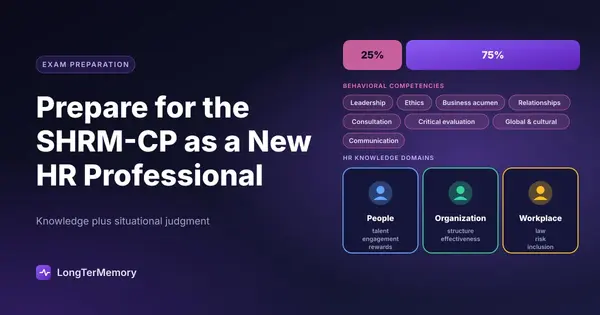
The SHRM-CP covers two broad categories:
Behavioral Competencies (25% of the exam):
- Leadership and Navigation
- Ethical Practice
- Business Acumen
- Relationship Management
- Consultation
- Critical Evaluation
- Global and Cultural Effectiveness
- Communication
HR Knowledge Domains (75% of the exam):
- People: Talent acquisition, engagement, learning, total rewards
- Organization: Structure, organizational effectiveness, technology
- Workplace: HR in the global context, risk management, diversity and inclusion, employment law
The knowledge domains are where most exam prep time gets spent, and where new HR professionals often feel most exposed. Employment law, compensation structures, benefits administration, organizational design, these are areas where experience teaches what textbooks summarize.
The Situational Judgment Reality
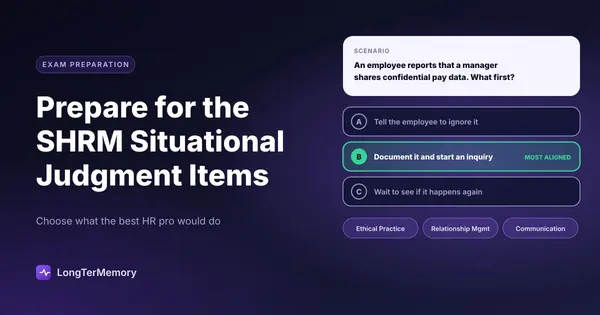
About 160 of the approximately 160 scored questions on the SHRM-CP are either knowledge-based or situational judgment items. The situational judgment questions present workplace scenarios and ask you to choose the “best” response from four options, often where multiple answers seem defensible.
What makes these hard for newer professionals is that they rely on practical HR judgment, the kind built through experience navigating real employee relations situations, organizational politics, and business tradeoffs. If you haven’t been in those situations yet, you need to build a mental library of them through case studies and practice scenarios.
Building Foundational HR Knowledge for the SHRM-CP Exam
For early-career professionals, the SHRM-CP prep is as much about building your HR foundation as it is about exam strategy. The two things reinforce each other.
Start With the SHRM Body of Competency and Knowledge
The SHRM BoCK (Body of Competency and Knowledge) is the official document that defines exactly what the exam covers. It’s free to download from the SHRM website. Read it before you do anything else.
The BoCK isn’t a study guide, but it is a roadmap. Go through it and honestly rate your comfort level with each topic. This gives you a personalized gap analysis without spending money on a test yet.
| Comfort Level | What to Do |
|---|---|
| Strong | Light review, prioritize practice questions |
| Moderate | Read the SHRM Learning System chapter + practice questions |
| Weak | Deep study, seek out supplementary resources |
| Unfamiliar | Start from scratch, add extra time in your schedule |
The SHRM Learning System: Your Primary Resource
Most SHRM-CP candidates use the SHRM Learning System as their primary prep tool. It’s expensive but comprehensive. It includes textbooks, online modules, and practice questions aligned to the actual exam format.
For new HR professionals, the learning system serves two purposes: exam preparation and professional development. The content on employment law, for example, is genuinely useful knowledge for your daily work, not just test prep.
Work through the material in module order, take notes, and complete every practice question before moving on. Don’t skip the sections you already feel comfortable with, because “comfortable” often means you understand the concept, not that you can apply it correctly under exam pressure.
Employment Law: The Area Where New Professionals Feel Most Behind
Employment law is the topic that intimidates newer candidates most. The SHRM-CP expects you to understand the major federal employment laws: Title VII, the ADA, FMLA, FLSA, ADEA, NLRA, and others, including when they apply, what they require, and how HR professionals are expected to respond to situations involving them.
If you’ve never administered FMLA leave or handled an ADA accommodation request, these laws can feel abstract. Here’s how to make them concrete:
- Use case studies. SHRM publishes HR case studies. Legal HR blogs and SHRM’s own tools present real-world scenarios. Read them and think about what you would do before reading the resolution.
- Link each law to a scenario. When you learn about the FMLA, picture an actual employee situation: a staff member needs surgery, their manager wants to deny the leave. Walk through the legal requirement and the correct HR response in your head.
- Flashcards work for the specifics. Employee count thresholds, coverage timelines, notice requirements, these are facts that benefit from spaced repetition. Use a tool like LongTerMemory to generate flashcards from your study notes and review them daily.
Business Acumen: The Underrated Competency for New HR Professionals
One area where early-career candidates often underestimate their preparation needs is business acumen. The SHRM-CP isn’t just testing whether you know HR. It’s testing whether you understand the business context HR operates in.
This means understanding basic financial concepts, how organizations make money, how HR decisions affect the bottom line, how to make the business case for HR initiatives. If you’ve never had exposure to profit and loss statements or organizational budget cycles, spend some time with business basics before your exam.
The SHRM Learning System covers this, but supplementing with a basic business fundamentals course or reading business-focused HR content (Harvard Business Review publishes excellent HR-relevant articles) can fill the gap faster.
Study Plan for New HR Professionals Pursuing First Certification
Here’s a realistic study timeline built specifically for candidates without deep HR experience. Most people prep for 3 to 4 months. New professionals may need 4 to 5 months to account for the extra foundational knowledge building.
Phase 1: Foundation (Weeks 1-4)
Goal: Understand the landscape. Build knowledge gaps awareness. Start on high-priority content.
- Download and read the SHRM BoCK. Rate every topic.
- Set up your study materials (SHRM Learning System or equivalent).
- Begin with the HR Knowledge Domains, starting with the areas you rated “unfamiliar” or “weak.”
- Start a daily flashcard habit using LongTerMemory or Anki for employment law specifics.
- No practice exams yet. Focus entirely on building knowledge.
Phase 2: Core Study (Weeks 5-12)
Goal: Cover all exam content. Build competency-based reasoning skills.
- Work through the SHRM Learning System systematically.
- Complete the practice questions at the end of each module.
- Add situational judgment practice: read two to three case studies per week and work through your reasoning before checking answers.
- Maintain your daily flashcard review (the vocabulary and law specifics you’ll need automatically under pressure).
- Take your first full practice exam around Week 10 to benchmark. Don’t be discouraged by the score; it’s diagnostic.
Phase 3: Practice and Refine (Weeks 13-16)
Goal: Identify remaining weak areas. Build exam-day confidence.
- Take one to two full practice exams per week.
- Review every question you got wrong, not just the answer, but your reasoning process.
- Focus remaining study time on your weakest domains.
- Reduce new learning. Consolidate what you know.
- Maintain daily spaced repetition review without adding many new cards.
Phase 4: Final Week
Goal: Confidence maintenance without burning out.
- Light review only. No cramming.
- One final practice exam for confidence.
- Review your most missed topics briefly.
- Focus on sleep, nutrition, and showing up calm.
Situational Judgment: The Practice That Makes the Difference
The thing most new HR professionals need to build explicitly is the ability to reason through situational judgment questions. Here’s a framework that helps:
- Identify the primary stakeholders in the scenario (employee, manager, organization, legal compliance).
- What does HR best practice say? What would a senior HR professional advise?
- What does the law require? Is there a compliance element here?
- What option best balances organizational need, legal compliance, and people-centered practice?
The “best” answer in SHRM-CP situations is usually the one that balances all of these, not the most aggressive, not the most lenient, not the most technically legal, but the most thoughtfully balanced.
Practice this reasoning out loud with a study partner if you have one. Explaining your thinking forces you to identify whether your logic is actually solid or just feels solid.
Building a Support Network
Don’t prepare in isolation. The SHRM-CP community is large and supportive. Options include:
- SHRM local chapters, which often have study groups for certification candidates
- LinkedIn groups for SHRM-CP candidates where people share study tips and practice questions
- Study partners, ideally one to two people at a similar level who can work through case studies together
Even a single weekly check-in with another candidate makes a difference in sustaining motivation through a four-month prep cycle.
What Passing the SHRM-CP Does for an Early-Career HR Professional
It’s worth pausing to think about why this certification matters before you invest months of your life into it.
The SHRM-CP signals to employers that you have a solid, formally evaluated foundation in HR practice and competencies. For early-career professionals, it often accelerates credibility. Instead of spending years building a track record before being taken seriously on HR strategy questions, the certification gives you immediate standing.
It also gives you something more personal: a structured, validated understanding of the field you’re working in. Many new HR professionals describe passing the SHRM-CP as the moment they felt like they actually knew what they were doing, not just learning on the job. That shift in self-perception is valuable independent of what it does for your resume.
The exam is genuinely hard, especially for newer professionals, but it’s not unpassable. Thousands of early-career HR professionals pass it every year. The ones who do treat preparation like a job, consistent, structured, and sustained over months, not crammed into the final two weeks.
You can do this. Build your foundation, give yourself enough time, practice the reasoning skills the exam actually tests, and show up prepared. The credential is worth the work.