How to Use Spaced Repetition in the Classroom
A guide for teachers on integrating spaced repetition and retrieval practice into classroom instruction to boost long-term student retention.
Table of Contents
- What Spaced Repetition Actually Means for a Classroom
- How Teachers Can Build Spaced Review Into Instructional Design
- Spaced Retrieval Practice as a Warm-Up Ritual
- Cumulative Tests and Quizzes
- Interleaving Across the Unit
- Low-Tech and High-Tech Tools for Classroom-Based Spaced Repetition
- Low-Tech Options That Work Right Now
- High-Tech Options Worth Exploring
- Research on Classroom Retrieval Practice and Student Outcomes
- The Roediger and Karpicke Study (2006)
- The Butler Study (2010)
- Real-World School Studies
- Making the Case to Students
- The Practical Starting Point
Most teachers are already doing something like spaced repetition without realizing it. The warm-up question at the start of class that revisits last Tuesday’s lesson, the cumulative quiz that covers the past three weeks, the review day before a unit test. These instincts are good ones. They are just usually inconsistent, and inconsistency is exactly what spaced repetition is designed to fix.
If you are a teacher who cares about whether students actually remember what you taught them, not just whether they can demonstrate it three days after you covered it, this guide is for you. Spaced repetition is one of the most robustly supported interventions in all of cognitive science, and it does not require abandoning your curriculum or buying expensive software. It requires rethinking how you distribute review across time.
What Spaced Repetition Actually Means for a Classroom
Spaced repetition is a learning technique in which material is reviewed at strategically increasing intervals. The foundational idea comes from Hermann Ebbinghaus’s forgetting curve, which describes how rapidly newly learned information disappears from memory without review. The curve is steep. After 24 hours, a typical learner retains only about 50% of new information without any review. After a week, that number drops further.
The solution is not more initial teaching time. It is distributed review. When students encounter material again just as they are about to forget it, the memory trace is strengthened and the next forgetting curve is flatter. Over several well-timed review sessions, information moves from fragile short-term recall into stable long-term memory.
For individual learners, spaced repetition tools like Anki can personalize review timing to each person’s forgetting rate. In a classroom, you cannot individualize to that degree, but you can absolutely build the structure of spaced review into how you design your instruction, and the research shows that even non-individualized spaced review produces major gains over massed practice.
How Teachers Can Build Spaced Review Into Instructional Design
The good news is that incorporating spaced repetition does not require a complete curriculum overhaul. It mostly requires deliberate planning around when and how you revisit content that you have already taught.
Spaced Retrieval Practice as a Warm-Up Ritual
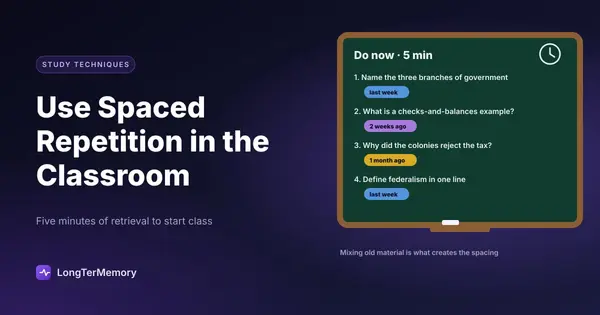
The most practical starting point for most teachers is turning the first five minutes of every class into a retrieval practice session. Instead of reviewing homework or jumping straight into new content, begin by having students answer two to five questions drawn from previous lessons.
Crucially, these should not be questions from yesterday’s class only. That is just checking short-term memory. Pull questions from last week, two weeks ago, and a month ago. The mix is what creates the spacing effect.
You do not need a fancy system to start. A simple Google Form, a paper slip, or even an oral question-and-answer round works fine. The key is that students are actively retrieving information, not being reminded of it. There is a meaningful difference between “do you remember that the mitochondria is the powerhouse of the cell?” and asking students to write down everything they know about cellular energy production without prompting.
Cumulative Tests and Quizzes
Many teachers shift to unit-based assessment where each test covers only the most recent unit. This is efficient for grading, but it gives students permission to forget everything after the test. Cumulative testing, where each quiz or exam includes questions from all previous units, is one of the most straightforward ways to build spaced retrieval into your assessment structure.
If cumulative testing feels overwhelming for students, start small. Add five to ten questions from previous units to each new quiz. Give students advance notice that this is how your class works. Research consistently shows that even when students know ahead of time that retrieval practice is coming, the learning benefit holds. This is not a trick you are playing on them. It is a system you are building with them.
Interleaving Across the Unit
Within a unit, most teachers teach topics in isolated blocks: first fractions, then decimals, then percentages. This is called blocked practice, and it feels intuitive because it mirrors how textbooks are organized. But research on interleaving, mixing up topics within practice sessions, consistently shows better long-term retention and transfer, even when students initially find it harder and rate it as less effective.
A practical version of interleaving: instead of spending the last ten minutes of class doing five more problems of the same type you just practiced, do two of the current type plus one from two weeks ago plus two from a month ago. The mix creates spacing and forces students to identify which strategy applies, which is a higher-order cognitive demand than just executing a familiar procedure repeatedly.
Low-Tech and High-Tech Tools for Classroom-Based Spaced Repetition
You do not need technology to implement spaced repetition in a classroom. But technology can make it easier to manage the scheduling and tracking, especially if you are working with large classes.
Low-Tech Options That Work Right Now
Index card decks by review date: Give each student a small box with dividers labeled by day or week. New cards go in the near-term section. As students get questions right, they move the card further back in the box. This is essentially a manual spaced repetition system and takes five minutes to set up.
The weekly review sheet: A one-page handout at the start of each week with ten to fifteen questions from previous weeks. Students complete it in the first five minutes of Monday’s class. You review answers together. No grading required if you frame it as a learning activity rather than an assessment.
Exit tickets with historical questions: End class with three questions. One from today’s lesson, one from last week, one from the unit before. Students write answers, you glance at them as they leave, and you get real-time data on what is sticking and what is not.
High-Tech Options Worth Exploring
Gimkit and Blooket: Both of these gamified quiz tools allow you to create question sets from past material and run them as engaging classroom review games. Students are motivated by the competitive format, and you control which content appears. The engagement is real and the review is effective.
Quizlet: Many teachers and students already use Quizlet. The spaced repetition built into the “Learn” mode is reasonably effective, though the algorithms are simpler than dedicated tools. More importantly, if students have a class Quizlet set, they can continue doing spaced review independently at home.
LongTerMemory: For teachers who want to give students a more powerful independent study tool, LongTerMemory allows students to upload their own notes and course materials, and the platform automatically generates Q&A flashcard pairs with built-in spaced repetition scheduling. Students do not have to spend time creating cards. They just upload their notes and start reviewing. This is particularly useful for courses with heavy content loads, where the bottleneck is not understanding but retention over time.
Google Forms with score tracking: Build cumulative review quizzes in Google Forms, set them to show correct answers after submission, and send them out on a schedule. It is not personalized, but it is free, scalable, and effective.
Research on Classroom Retrieval Practice and Student Outcomes
The evidence base behind spaced retrieval practice is one of the most consistent in all of educational research. Let me point to a few studies that are especially relevant for classroom teachers.
The Roediger and Karpicke Study (2006)
This study, now considered a landmark in the field, compared students who studied a text and then studied it again versus students who studied it once and then took a retrieval test. After a week, the retrieval practice group remembered 50% more than the re-study group. The implications are direct: testing students on material is not just a measurement tool. It is a learning tool.
The Butler Study (2010)
Researchers tested whether retrieval practice helped students learn not just the facts they were tested on, but related material they were not explicitly tested on. The answer was yes. Students who did retrieval practice showed better transfer of knowledge to new problems than those who restudied. This is a critical finding for teachers who worry that retrieval practice only helps with rote recall.
Real-World School Studies
Henry Roediger and Mark McDaniel, in their book Make It Stick, document several school-level implementations of spaced retrieval practice. In one example, a middle school history class that incorporated regular low-stakes retrieval practice outperformed comparison classes on end-of-year assessments by a wide margin, even though the retrieval practice students spent less time on content instruction overall, because review was built into every class.
The finding that consistently emerges across these studies is that spaced retrieval practice does not need to come at the cost of content coverage. Brief, frequent, low-stakes retrieval sessions at the start of class, integrated into existing instructional time, produce measurable and lasting gains.
Making the Case to Students
One challenge teachers face is that students often resist retrieval practice, especially at first. Blank-page recall feels hard. Getting questions wrong in class feels embarrassing. And students who are used to passive review often mistake the difficulty of retrieval for a sign that they have not learned enough, when it is actually the sign that learning is happening.
It helps to explain desirable difficulty explicitly. Tell students: “This is supposed to feel hard. The harder it feels to retrieve something, the more learning is happening. If I gave you the answer before you had to work for it, you would recognize it but not remember it. I am making you work for it because that is what builds actual memory.”
Framing retrieval practice as a cooperative system rather than a gotcha also matters. Make it clear that these early retrieval exercises are not punitive assessments. They are training sessions. Getting something wrong in a five-minute warm-up is infinitely less costly than getting it wrong on the final exam.
Over time, students who experience spaced retrieval practice tend to feel more confident, not less, because they start to notice that information is sticking. That positive feedback loop is powerful, and it tends to create students who adopt these strategies independently.
The Practical Starting Point
If you want to implement spaced repetition in your classroom starting next week, here is the simplest possible version:
- At the start of every class, ask three to five questions from previous lessons, not just the last class.
- Give students two minutes to answer independently, then review together.
- Do not grade it. Treat it as a warm-up.
- Keep a running list of topics you have covered, and rotate questions from across the full semester or year.
That is it. That single change, done consistently, will measurably improve long-term retention for your students. Everything else in this guide is about making that structure more systematic and scalable, but the core practice is genuinely that simple.
Spaced repetition is not a technology or a product. It is a principle. The principle is: distribute review across time, make students retrieve rather than recognize, and let difficulty be a sign of learning rather than a sign of failure. Everything else is implementation.