Tips to Memorize Things Quickly Without Forgetting
Discover why you keep forgetting, five techniques for faster encoding and slower forgetting, and how to build a review habit you'll actually maintain.
Table of Contents
- The Biggest Reason You Forget Things You Studied
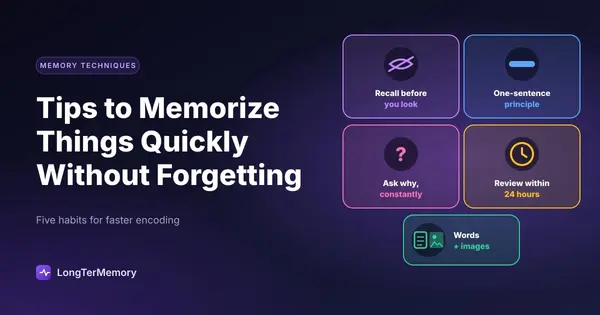
- Five Techniques for Faster Encoding and Slower Forgetting
- 1. The Recall-Before-You-Look Method
- 2. The One-Sentence Principle
- 3. Elaborative Interrogation: Ask "Why" Constantly
- 4. The 24-Hour Review Rule
- 5. Dual Coding: Combine Words With Images
- How to Build a Review Habit You'll Actually Maintain
- The Minimum Viable Review Session
- Friction Is the Enemy of Habits
- Progress Visibility Keeps You Going
- Review Is Not a Special Occasion
- A Simple System You Can Start Today
If you’ve ever walked out of a study session feeling like you understood everything , and then walked into an exam two weeks later and drawn a blank , you know how disorienting the gap between learning and remembering can be. You did the work. You read the material. You understood it in the moment. And then it was gone.
This isn’t a memory problem in the sense of having a “bad memory.” It’s a process problem: the techniques most people use for memorizing things are optimized for feeling productive in the moment, not for building memories that last. The good news is that the fix is specific, practical, and doesn’t require more time , just different time.
Here are the tips that actually make a difference, explained in a way that makes them easy to apply starting today.
The Biggest Reason You Forget Things You Studied
Before we get to techniques, let’s diagnose the actual problem , because if you’re applying the wrong solution to the wrong problem, even good techniques won’t help.
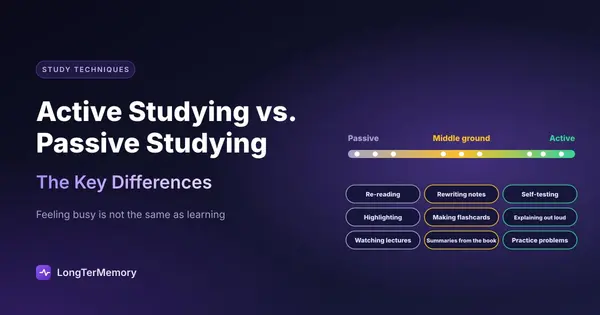
The most common reason people forget what they studied isn’t insufficient effort. It’s insufficient retrieval practice. They study by exposing themselves to material , reading, highlighting, watching videos, re-reading notes , and then discover later that exposure doesn’t equal encoding.
Here’s the mechanism: your brain distinguishes between things you’ve seen and things you need. When you passively re-read material, your brain registers it as “seen” and applies minimal encoding resources. The information passes through working memory but doesn’t get firmly written into long-term memory. When you need to retrieve it later, there’s very little trace to retrieve from.
Contrast this with what happens during active retrieval: you try to remember something, your brain searches for the trace, finds it (or struggles to find it), pulls it out, and in doing so, strengthens the neural connections associated with that memory. The act of retrieving is itself a memory-building act.
The research on this is extensive. A landmark review published in the National Library of Medicine summarizes what decades of learning science show: retrieval practice is one of the most effective strategies for long-term retention, yet it’s one of the least commonly used by students who instead rely on re-reading and highlighting.
The fix: replace passive review with active retrieval, every time. This one change will have a larger impact on your memory than any other single technique.
Five Techniques for Faster Encoding and Slower Forgetting
Once you understand that retrieval is the mechanism, these five techniques all make intuitive sense , they’re different ways to maximize encoding depth and build in retrieval from the start.
1. The Recall-Before-You-Look Method
Every time you sit down to study, before you open your notes or book, spend two to three minutes writing or saying aloud everything you already know about the topic. From memory. Without peeking.
This does two things simultaneously. First, it activates your prior knowledge, priming your brain to integrate new information with what it already has , which deepens encoding. Second, it shows you exactly what you actually know versus what you think you know. The gaps you discover are your study priorities.
After you’ve done your recall, then open your materials and compare. Note what you missed. Study those gaps specifically, then close the materials and try to recall again, including the newly added information.
This simple habit , recall first, study second , dramatically improves both initial encoding and retention, because every session starts with a retrieval attempt rather than a reading pass.
2. The One-Sentence Principle
For every concept, definition, or piece of information, practice expressing it in exactly one sentence in your own words. Not the textbook’s sentence , yours.
This constraint forces you to understand the concept rather than just recognize the phrasing. It also forces semantic processing (thinking about meaning) rather than surface processing (noticing words and visual patterns), which is where the encoding depth comes from.
Write the one-sentence versions in a notebook separate from your regular notes. This creates a compressed, personal summary that’s ideal for rapid review sessions , you can run through fifty key concepts in ten minutes when each one is reduced to your own single sentence.
3. Elaborative Interrogation: Ask “Why” Constantly
After learning any new fact or concept, immediately ask: Why is this true? What causes it? How does it work at a deeper level?
You don’t need to answer these questions completely or correctly. The cognitive activity of trying to generate explanations , even tentative ones , fires deeper associative processing than passive reading. When you retrieve an explanation you generated yourself, you’re also retrieving the concept it’s attached to.
Example: Learning that the hippocampus is involved in memory formation. Don’t just memorize the fact , ask why. What specifically does the hippocampus do? What happens when it’s damaged? How does this relate to the broader memory system? You don’t need to know all the answers. You just need to ask the questions and attempt the explanations.
4. The 24-Hour Review Rule
Commit to reviewing anything new within 24 hours of first learning it. Not for an hour , for ten minutes. Just a quick retrieval check: cover your notes and try to recall the key points.
This one habit intercepts the most damaging part of the forgetting curve. The steepest drop in retention happens in the first day after learning , by the end of day one, you may have lost 50-70% of what you learned if you don’t intervene. A ten-minute retrieval check within that first 24-hour window resets the curve and dramatically extends the memory’s lifespan.
After that first review, the next review can wait longer , three days, then a week, then two weeks. The intervals grow because each successful review stabilizes the memory further. But that first 24-hour check is the most critical and the most commonly skipped.
5. Dual Coding: Combine Words With Images
Dual coding is the practice of representing information in two different formats , typically verbal and visual , to build multiple retrieval pathways for the same piece of knowledge.
When you encode something both as words and as an image or diagram, your brain stores it in two separate but linked memory traces. When you try to recall it later, you have two routes to the information , if one route is temporarily blocked (common under stress), the other may still be accessible.
Practical applications:
- Sketch a rough diagram of any process or system you’re studying
- Create a simple flowchart for multi-step procedures
- Draw a relationship map between concepts , boxes for concepts, arrows for connections
- Make a mental image (however abstract) for any key term or definition
You don’t need to be a good artist. Stick figures and rough boxes work perfectly. The point is to encode the concept as a spatial and visual structure, not just a string of words.
How to Build a Review Habit You’ll Actually Maintain
Knowing the right techniques is only half the challenge. The other half is maintaining the habit of using them consistently, which is where most people fall short , not because they lack discipline, but because their review system isn’t set up for sustainability.
The Minimum Viable Review Session
The most common reason people skip reviews is that they feel like they need a long, comprehensive session to make it worthwhile. This is false. A five-minute review is dramatically better than no review, and in terms of maintaining the spaced repetition curve, it’s nearly as effective as a longer one.
Design your minimum viable review session:
- Five to ten minutes
- Flashcards or a quick recall exercise
- Done daily at the same time (tied to an existing habit , morning coffee, after lunch, before bed)
This is the session you do on busy days, tired days, days when motivation is low. Having an ultra-low-friction version of your review habit means you do it even when conditions aren’t ideal , which is most of the time.
Save longer sessions for weekends or dedicated study blocks. The minimum session maintains your review schedule and prevents the review queue from growing out of control.
Friction Is the Enemy of Habits
Every barrier between you and your review session costs you. If your flashcards are in a bag that’s in another room, if your study app takes thirty seconds to load, if you have to remember which deck to review , each of these frictions makes it slightly less likely you’ll actually do the review.
Remove them:
- App on your phone’s home screen, one tap away
- Physical cards in your pocket or on your desk
- Review queue automatically populated (as with LongTerMemory’s spaced repetition algorithm)
- A specific trigger (the moment you sit on the subway, when your kettle goes on) that starts the review automatically
The easier it is to start, the more often you will. That consistency is everything.
Progress Visibility Keeps You Going
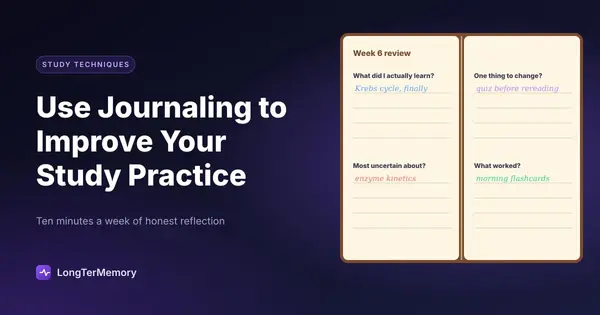
One of the most effective tools for maintaining any habit is seeing your progress. Tracking your reviews , even on a simple paper calendar where you mark each day you reviewed , creates a “chain” of completed days that becomes self-motivating. Breaking the chain requires deliberate choice; maintaining it is the path of least resistance.
Within spaced repetition apps, tracking is built in. You can see your review streak, your total cards mastered, your retention rate over time. This data provides both accountability and encouragement , watching your vocabulary deck grow from 50 cards to 500 over a semester, with 90%+ retention, is genuinely rewarding.
Review Is Not a Special Occasion
One important mindset shift: review is not something you do when you have extra time. It’s a daily activity that takes priority over adding new material.
Many students (and professionals) approach studying by constantly adding new material , new chapters, new topics, new content , while review sessions get pushed to “when I have time.” The result is a mountain of unreviewed material that’s steadily decaying, despite the continuous addition of new information on top.
Invert this. Every day, your primary study obligation is to complete your scheduled reviews. New material gets added at a rate that keeps your total review burden manageable. If your daily review load grows too large , more than 30-40 minutes , slow your pace of adding new content until the backlog shrinks.
This produces a steady, sustainable accumulation of well-retained knowledge rather than an ever-growing pile of half-remembered material.
A Simple System You Can Start Today
Here’s the whole thing simplified into a daily practice:
Morning (5 minutes): Open your flashcard app or pull your cards. Run through the day’s scheduled reviews. For each card you miss, note it and move on.
Study session (as long as needed): New material only after reviews are done. Use recall-first, then study. Generate explanations. Encode visually when possible. Write one-sentence summaries.
Before sleep (5 minutes): Quick recall pass on anything new from today. Write three things you want to remember from today’s session, from memory.
Weekly (15 minutes): Review your progress. Which topics need more attention? Are you adding material too fast or too slow? Adjust.
That’s it. Five minutes in the morning, five at night, more when you need to learn new material, and a quick weekly calibration. This system, applied consistently, will produce dramatically better retention than hours of passive study , because it’s built around the mechanism that actually makes memories last.
Start tomorrow. Your morning coffee deserves better company than your phone.