How to Use Spaced Repetition for Language Learning
Learn optimal SRS flashcard formats for language vocabulary, how to balance vocabulary and grammar, and the best apps with native audio.
Table of Contents
- Optimal Card Formats for Language Vocabulary Spaced Repetition
- Why Card Format Matters More Than You Think
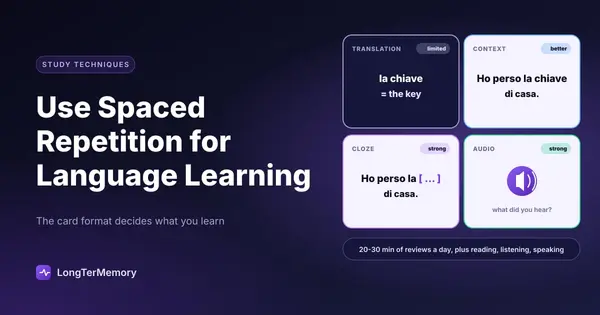
- The Translation Card (and Its Limitations)
- The Context Sentence Card
- The Cloze Deletion Format
- The Audio Card
- Balancing Vocabulary, Grammar, and Reading in a Spaced Repetition System
- The Vocabulary-Grammar Relationship
- The Right Balance Across Skills
- Managing Your Vocabulary Growth Rate
- Dealing With Vocabulary Plateaus
- Apps That Combine Spaced Repetition With Native Language Audio
- Anki: The Most Flexible Option
- Duolingo: Low Friction, Lower Ceiling
- Clozemaster: SRS for Intermediate and Advanced Learners
- LingQ: Spaced Repetition Embedded in Reading
- LongTerMemory for Course-Based Language Study
- Getting Started This Week
Language learning is one of the most rewarding things a person can do, and also one of the most reliably abandoned. Most people start with genuine enthusiasm, make visible progress for the first few weeks, and then hit a plateau that eventually convinces them they’re “just not a language person.”
The plateau is almost never about talent. It’s almost always about method, specifically, the point where vocabulary acquisition slows down because the learner doesn’t have a systematic way to review and retain what they’ve learned.
Spaced repetition is the method that solves this problem. Used consistently, it transforms language vocabulary from something that constantly fades into something that genuinely sticks, with a time investment that is surprisingly modest.
This guide covers how to actually use spaced repetition effectively for language learning: what formats to use, how to balance different aspects of the language, and which tools are worth your time.
Optimal Card Formats for Language Vocabulary Spaced Repetition
Why Card Format Matters More Than You Think
Most people who try language flashcards fall into one of two traps: they either make cards that are too simple to produce real recall, or they make cards so complex that reviewing them becomes tedious and they quit.
The format of your flashcards has a surprisingly large impact on how effectively they train your memory. A slightly wrong format can mean the difference between cards that build useful recall and cards that build recognition of the card rather than real language knowledge.
Here’s what works:
The Translation Card (and Its Limitations)
The most common language flashcard format is the simple translation: target language word on one side, native language translation on the other.
This works for building basic vocabulary, but it has a significant limitation: it trains you to translate through your native language rather than think directly in the target language. Advanced learners generally want to move beyond this, because the translate-first habit creates a cognitive bottleneck in conversation.
For beginners, translation cards are a reasonable starting point. The key is to use them with both directions: word-to-translation AND translation-to-word. These are two different cognitive skills, and training only one leaves a gap.
The Context Sentence Card
The format that most expert language learners recommend, and the research supports, is the context sentence card.
Instead of:
- Front: casa (Spanish)
- Back: house
You use:
- Front: Vivo en una ____ pequeña cerca del parque.
- Back: Vivo en una casa pequeña cerca del parque. (I live in a small house near the park.)
The sentence provides multiple memory hooks: the word’s meaning, its grammatical form in context, its collocational patterns (what words appear near it), and pronunciation cues. Over time, vocabulary learned in context transfers much more naturally to reading and listening than vocabulary learned as isolated translations.
How to create context sentence cards:
- Use example sentences from your textbook or course materials
- Pull sentences from graded readers or news sources in the target language
- Use AI tools to generate example sentences for words you encounter in the wild
- For words you look up while reading, copy the original sentence as the context
The Cloze Deletion Format
A cloze card removes the target word from its sentence context and asks you to fill in the blank. This is particularly effective because it mirrors a cognitive task you’ll actually perform in real language use, reading a sentence and processing what word must go there.
Example for learning Spanish:
- Front: El médico necesita mucha _____ para tratar a sus pacientes. (The doctor needs a lot of _____ to treat his patients.)
- Back: paciencia (patience)
Cloze cards work especially well for:
- Words with subtle meaning differences from near-synonyms
- Abstract vocabulary where translation doesn’t capture the nuance
- Phrases and collocations that need to be learned as units
The Audio Card
For speaking and listening skills, text-only flashcards are insufficient. Audio cards present the target word or sentence in audio format, either pre-recorded by native speakers or generated by text-to-speech, and ask you to comprehend and produce the meaning.
The most useful audio card types:
- Audio, forward: hear the target word or sentence, produce the meaning
- Audio, reverse: see the native language meaning, produce the spoken target word (either out loud or by recognizing the audio)
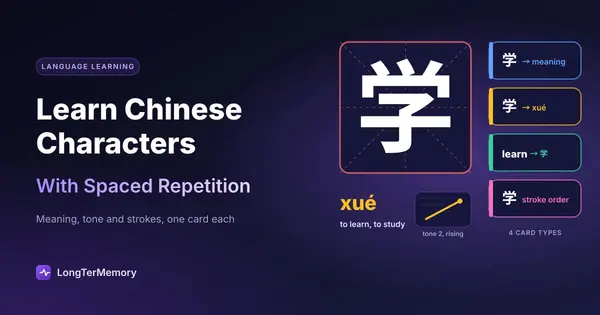
For tonal languages like Mandarin, Cantonese, or Vietnamese, audio cards are essentially mandatory for vocabulary learning. Tones cannot be correctly learned from text alone.
For non-tonal languages, audio cards are still highly valuable for developing the listening comprehension that allows you to understand natural speech speed.
Balancing Vocabulary, Grammar, and Reading in a Spaced Repetition System
The Vocabulary-Grammar Relationship
A common question from language learners building an SRS practice is: should I put grammar into flashcards too, or just vocabulary?
The answer is: yes, but differently. Grammar works best in flashcards when it’s framed around patterns in context, not abstract rules.
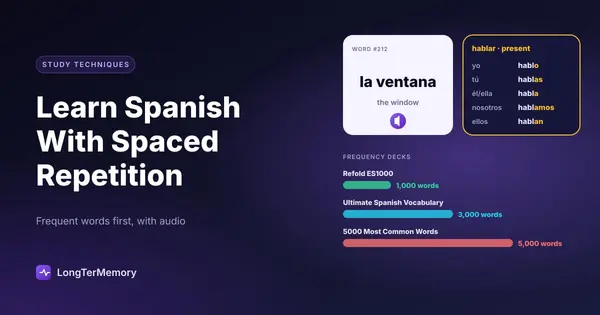
Rather than a card that says “conjugate hablar in the present tense,” try:
- Front: How do you say “I speak Spanish”?
- Back: Hablo español.
- Note: hablar, -ar verb, drop -ar, add -o for yo
This format links the grammar pattern to a real, usable utterance rather than to an abstract conjugation table. Over time, you build a bank of sample sentences that your brain learns to use as analogical templates rather than consciously applying grammar rules.
What doesn’t work well in SRS: long grammar explanations, exception lists, or anything that requires more than a few seconds to evaluate correctly. If a card takes more than 10 to 15 seconds to process, it’s too complex and should be broken into smaller items.
The Right Balance Across Skills
Vocabulary and grammar flashcards shouldn’t be your only language study activity. They’re highly effective for one thing, building the retrievable inventory of language knowledge, but they don’t directly train speaking, listening to natural speech, or reading extended text.
A balanced language learning schedule looks something like this:
| Activity | Purpose | Approximate Weekly Time |
|---|---|---|
| SRS review | Vocabulary and grammar retention | 20-30 minutes daily |
| Reading (graded reader or native content) | Context and comprehension | 3-5 hours/week |
| Listening (podcasts, audio content) | Comprehension and pronunciation | 3-5 hours/week |
| Speaking practice (tutor, language partner, or self-talk) | Production fluency | 2-4 hours/week |
SRS is the foundation, not the whole building. It keeps your vocabulary inventory solid and growing, so that when you do reading and listening practice, you recognize more of what you encounter and can build on existing knowledge rather than being constantly stuck on unknown words.
Managing Your Vocabulary Growth Rate
One of the most common SRS mistakes is adding new words faster than you can review existing ones. When your daily review queue starts taking 45 minutes to clear, it’s tempting to skip days, which compounds the backlog, which makes the system feel unmanageable, which leads to abandonment.
Sustainable new card rates for language learning:
- Beginners: 5 to 10 new words per day
- Intermediate learners: 10 to 20 per day
- Advanced learners targeting specific vocabulary domains: 20 to 30 per day
These numbers might seem low. But compound them over six months: 10 words per day is 1,800 new words reviewed and retained over half a year, which represents fluent conversational vocabulary in most languages. Vocabulary frequency research suggests that the 2,000 most common words in a language cover around 90% of everyday speech. At 10 words per day, you’re there in under seven months.
The discipline to add cards slowly is what keeps the system sustainable long-term. Fast addition leads to burnout. Slow and steady produces surprising fluency.
Dealing With Vocabulary Plateaus
After the initial rapid progress of the beginner phase, most language learners hit a plateau where new vocabulary feels harder to acquire and retain. This is normal, and it’s partly a function of frequency: you’ve already learned the most common words, and new vocabulary is less frequently reinforced by the media and conversations you’re exposed to.
Strategies for pushing through the intermediate plateau:
- Add more context sentences rather than isolated words. Richer context produces stronger encoding.
- Use native language media at the edge of your comprehension level. Encountering new words in meaningful context adds real-world reinforcement to your SRS practice.
- Mine your own reading and listening for new vocabulary. Words you encounter in the wild are more motivating than arbitrary frequency list words.
- Focus on word families. Learning teach, teacher, teaching, teachable as a cluster is more efficient than adding them separately.
Apps That Combine Spaced Repetition With Native Language Audio
Anki: The Most Flexible Option
Anki is the gold standard for customizable spaced repetition. It supports audio, images, text, and cloze deletion, and there’s a thriving ecosystem of pre-made language decks you can download for free.
For language learning, Anki’s main advantage is flexibility: you can build exactly the card format you want, use pre-recorded audio from native speakers (many popular decks include this), and sync across devices.
The main disadvantage is the setup time. Creating a well-organized Anki deck for a new language takes significant upfront work, and the interface, while functional, is not exactly elegant.
Best for: self-directed learners who want maximum control and are willing to invest time in setup.
Duolingo: Low Friction, Lower Ceiling
Duolingo uses spaced repetition principles under the hood and is the most accessible entry point for language learning. The gamification keeps beginners engaged, and the listening and speaking exercises are integrated throughout.
The limitation is ceiling: Duolingo’s vocabulary coverage tops out at intermediate level, and the sentence construction practice doesn’t build the kind of flexible grammar knowledge needed for genuine fluency. It’s an excellent supplement but not a complete system for serious learners.
Best for: complete beginners and casual learners who need motivation support more than advanced vocabulary.
Clozemaster: SRS for Intermediate and Advanced Learners
Clozemaster fills the gap above Duolingo and below Anki. It presents cloze-deletion exercises using frequency-ordered sentences from real text corpora, with audio for many languages. The sentences get progressively more complex as you advance through the frequency tiers.
It’s particularly good for learners who’ve finished a beginner course and need to expand vocabulary into the 2,000 to 10,000 most common word range, which is exactly where most “intermediate plateau” learners are stuck.
Best for: intermediate learners who want a structured, audio-supported vocabulary expansion program without building their own Anki decks.
LingQ: Spaced Repetition Embedded in Reading
LingQ takes a different approach: you import authentic content (articles, books, podcasts) in your target language, and the system automatically tracks which words you know and prompts review of new vocabulary. The SRS is embedded in the reading and listening experience rather than being separate flashcard sessions.
This approach has real advantages for motivation and retention: you’re always reading or listening to interesting content, and vocabulary is reviewed in natural context. The limitation is that review scheduling is less precise than Anki’s algorithm.
Best for: intermediate to advanced learners who want to use authentic native content as their primary study material.
LongTerMemory for Course-Based Language Study
If you’re studying a language through a formal course, textbook, or structured program, LongTerMemory can automatically convert your course materials, PDFs, and notes into flashcards with spaced repetition scheduling. This is particularly useful for academic language courses where you have specific vocabulary lists, grammar rules, and textbook content to master for exams.
Upload your course materials and get a ready-to-review flashcard deck without the setup overhead of building one manually. For language students who are also studying for formal assessments, this workflow can save hours of card creation time.
Getting Started This Week
Here’s a concrete starter plan for integrating spaced repetition into your language learning:
Day 1: Choose a tool. If you want maximum control, start with Anki. If you want fast results without setup, start with Clozemaster or LingQ.
Day 2 to 7: Add 5 to 10 new words per day, using context sentences wherever possible. Clear your daily review queue every day. This should take 15 to 20 minutes total.
After the first week: add reading and listening practice alongside your daily SRS review. Use authentic content at or slightly above your current level.
After one month: assess your retention on the earliest cards you added. If you’re getting them right, great. If you’re forgetting them, review your card format and consider adding more context to your cards.
The key word is consistency. Language vocabulary acquired through daily spaced repetition, even just 15 to 20 minutes a day, compounds remarkably over months. The learners who reach conversational fluency are almost universally the ones who found a sustainable daily practice rather than the ones who studied intensively for short bursts.
Start small. Review every day. Build from there. The language you’ve been meaning to learn is genuinely within reach.