How to Learn Spanish With Spaced Repetition
Discover how spaced repetition can supercharge your Spanish vocabulary and grammar. Science-backed strategies for lasting fluency.
Table of Contents
- Why Spaced Repetition Was Made for Language Learning
- The Most Effective Anki Decks and Frequency Lists for Spanish Vocabulary
- Frequency-Based Decks: Start Here
- Cards You Should Actually Use
- Don't Skip the Audio
- Building Spanish Grammar, Verb Conjugation, and Vocabulary Flashcard Decks
- Vocabulary Cards (The Foundation)
- Verb Conjugation: Tables vs. Sentences
- The Subjunctive Problem
- How Many Decks?
- Integrating Spanish SRS With Immersion, Speaking, and Reading Practice
- The Acquisition-Retention Loop
- What a Good Spanish Study Week Looks Like
- The Comprehensible Input Connection
- Speaking Practice: Don't Wait Until You're Ready
- Mining Real Content for Cards
- Setting Realistic Expectations
- The Tools That Make This Work
- The Bottom Line
If you’ve ever spent weeks grinding through Spanish vocabulary, only to blank on basic words the moment you actually need them, you’re not alone. Most people approach language learning the wrong way: they cram, they read, they watch shows, and they hope it sticks. Some of it does. Most of it doesn’t.
The good news is that there’s a method that actually works, and it’s been backed by cognitive science for decades. Spaced repetition is the most powerful tool available for language learning, and when applied specifically to Spanish, it can cut your study time dramatically while producing far deeper retention. Let’s break down exactly how to use it.
Why Spaced Repetition Was Made for Language Learning
Before we get into the Spanish-specific stuff, it’s worth understanding why spaced repetition is so well-suited to language acquisition in particular.
Language is fundamentally about massive vocabulary breadth combined with pattern recognition. Unlike, say, studying for a chemistry exam where you need to retain a finite set of concepts for a specific date, language learning is open-ended. You’re trying to build a mental library of thousands of words, dozens of grammatical structures, and hundreds of contextual uses, all of which need to stay accessible over years, not just weeks.
The forgetting curve, first described by Hermann Ebbinghaus in the 1880s, shows that we lose memories exponentially unless we actively review them. Spaced repetition works by scheduling reviews at precisely the right intervals, right before you’re about to forget, to drive information back into long-term memory with minimal repetition.
For Spanish, this is perfect. You might need to know the word for “however” (sin embargo) or the subjunctive trigger phrases or the difference between ser and estar, and you need all of those to be accessible automatically, not something you have to consciously recall. Spaced repetition builds that automaticity over time in a way that no other study method does.
The Most Effective Anki Decks and Frequency Lists for Spanish Vocabulary
When most people start with spaced repetition for Spanish, they reach for whatever Anki deck shows up first in a search. This is a mistake. The deck you choose shapes your vocabulary for months, so it’s worth spending five minutes on the decision.
Frequency-Based Decks: Start Here
The most efficient foundation for Spanish vocabulary is a frequency-based deck, one built around the words that actually appear most often in real Spanish text and conversation. The research on this is consistent: learning the most frequent 2,000 words in a language covers roughly 95% of everyday text. Everything above that follows diminishing returns.
The best options for Spanish:
| Deck | Word Count | Best For |
|---|---|---|
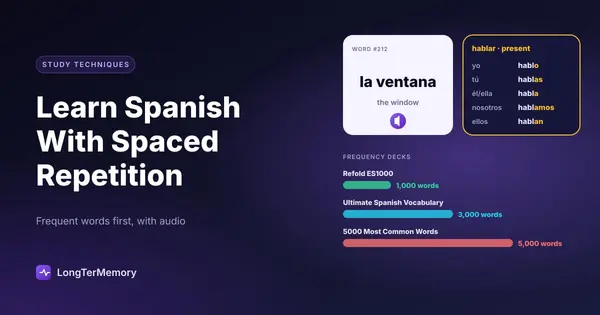
| Spanish 5000 Most Common Words | 5,000 | Serious learners, comprehensive |
| Ultimate Spanish Vocabulary | 3,000 | Intermediate to advanced |
| A Frequency Dictionary of Spanish | 5,000 | Authentic audio, context sentences |
| Refold ES1000 | 1,000 | Absolute beginners |
For most learners, starting with a 1,000-word core deck and completing it fully is far better than starting a 5,000-word deck and abandoning it halfway. Depth over breadth, always.
Cards You Should Actually Use
The format of your cards matters as much as the content. Most beginner decks show English on the front and Spanish on the back, which only trains one direction of recall. For real fluency, you want to eventually recognize and produce in both directions.
A better card format:
- Front: Spanish word + audio pronunciation
- Back: English meaning + an example sentence in context
The context sentence is crucial. Words learned in isolation are harder to retain and harder to actually use in conversation. When you see conseguir used in the sentence “Finally managed to get a ticket,” it becomes three-dimensional rather than just a word on a list.
Don’t Skip the Audio
Spanish pronunciation is genuinely phonetic once you know the rules, but getting that audio input early prevents bad habits. Any deck worth using should have audio for every card. If yours doesn’t, supplement with a text-to-speech generator, or better, with recordings by native speakers.
Building Spanish Grammar, Verb Conjugation, and Vocabulary Flashcard Decks
Here’s a question that trips up a lot of Spanish learners: should you put grammar in flashcards?
The short answer is: yes, but carefully.
Vocabulary Cards (The Foundation)
Your vocabulary deck should be your biggest and most active deck. Aim to add 10 to 20 new cards per day and review all due cards without skipping. This sounds like a lot, but it compounds: after six months at this pace, you’ll have a solid 2,000-word foundation with genuine retention, not just recognition.
Verb Conjugation: Tables vs. Sentences
This is where most people go wrong. They try to memorize conjugation tables: yo hablo, tú hablas, él habla… This creates what linguists call explicit grammatical knowledge, meaning you can reproduce the table, but you can’t actually use the verb naturally in conversation because the knowledge is stored separately from your actual language processing.
A better approach: create sentence-level cards that include the conjugation in context.
Instead of: hablar (to speak) -> yo hablo (I speak)
Try: Front: "I speak three languages" -> Back: "Hablo tres idiomas"
When you do this for hundreds of sentences across different verbs and tenses, you internalize the patterns through exposure rather than memorization. Your brain starts to recognize what “sounds right” in Spanish the same way native speakers do.
The Subjunctive Problem
The subjunctive is notoriously difficult for English speakers because English barely uses it. There’s no shortcut here, but spaced repetition makes it significantly less painful.
Build a dedicated subjunctive deck with trigger phrases and example sentences:
- Es importante que + subjunctive
- Quiero que + subjunctive
- Ojalá que + subjunctive
Each card pairs the trigger phrase with a complete sentence. Over dozens of exposures, the pattern becomes automatic. You stop consciously thinking “subjunctive trigger, therefore…” and just say it correctly.
How Many Decks?
Keep it manageable. Most serious Spanish learners maintain:
- Core vocabulary deck (your main daily work)
- Grammar/conjugation sentences deck (smaller, targeted)
- Personal mining deck (words you encounter in the wild and want to keep)
The personal mining deck is powerful because those words have context. You encountered them somewhere real, which gives them an emotional and situational anchor that random deck words don’t have.
Integrating Spanish SRS With Immersion, Speaking, and Reading Practice
Here’s the thing that a lot of people miss about spaced repetition: it is a memory maintenance system, not a language learning method on its own. You still need to actually use Spanish. The SRS ensures you don’t forget what you’ve learned, but the learning itself happens through exposure and use.
The Acquisition-Retention Loop
Think of it this way:
Input (reading, listening, watching content in Spanish) feeds you new words and grammar patterns. SRS locks those patterns into long-term memory. Output (speaking and writing) forces retrieval and reveals gaps.
These three things work together. If you do only SRS, you’ll have great flashcard performance but struggle to hold a conversation. If you do only immersion, you’ll pick up patterns but forget vocabulary faster than you acquire it. The combination is what produces real fluency.
What a Good Spanish Study Week Looks Like
You don’t need hours per day to make real progress. Here’s a realistic schedule that integrates SRS with other learning:
| Day | SRS Review | Input/Output |
|---|---|---|
| Mon | 20 min daily review | 20 min podcast in Spanish |
| Tue | 20 min daily review | 15 min reading simple articles |
| Wed | 20 min daily review | 30 min language exchange partner |
| Thu | 20 min daily review | 20 min podcast |
| Fri | 20 min daily review | 15 min writing journal entry |
| Sat | 20 min daily review | 45 min Spanish TV/film |
| Sun | 20 min daily review | Light review, no pressure |
The SRS review is non-negotiable every single day. The input and output components can flex. What you absolutely cannot do is skip reviews, because the algorithm schedules cards based on your history. If you miss two days, you return to a flood of overdue cards that takes hours to clear.
The Comprehensible Input Connection
One of the most powerful things you can do alongside your SRS practice is consume comprehensible input, Spanish content that’s slightly above your current level but still mostly understandable. Podcasts like SpanishPod101 or shows like Destinos are designed for learners. Later, authentic content like news radio, podcasts, or films becomes your material.
When you encounter a new word in immersion, add it to your personal mining deck immediately. This creates a feedback loop: immersion feeds your SRS, your SRS makes immersion easier, which leads to more effective immersion. Over time, the snowball effect is dramatic.
Speaking Practice: Don’t Wait Until You’re Ready
The biggest mistake Spanish learners make is waiting until they feel “ready” to speak. You will never feel ready. Start speaking as early as possible, even if it’s just talking to yourself.
LongTerMemory can help you build the vocabulary and grammar foundation through AI-generated flashcards from any study material, but the speaking practice is on you. Platforms like iTalki or Tandem connect you with native speakers for language exchanges. Even 30 minutes a week of actual conversation will expose gaps in your knowledge that flashcard performance will never reveal.
Mining Real Content for Cards
As you advance, shift away from premade decks toward mining your own cards from authentic content. When you read a Spanish article and encounter sin embargo (however) or a pesar de (despite) or cabe destacar (it’s worth highlighting), add those to your personal deck immediately.
This strategy has two advantages:
- You encountered the word in context, so it’s already partially encoded.
- Your deck evolves with your actual reading and listening interests, keeping the process engaging.
Setting Realistic Expectations
Learning Spanish with spaced repetition is not a sprint. It’s a slow, steady accumulation of knowledge that compounds over months and years. Here’s a rough timeline for most dedicated learners:
- Month 1-2: 500-1,000 words, basic sentence comprehension
- Month 3-6: 1,500-2,000 words, simple conversations possible
- Month 6-12: 2,000-3,000 words, real fluency emerging
- Year 2+: Native content comprehensible, spoken fluency strong
These timelines assume daily SRS practice plus regular input. If you’re inconsistent, everything slows down. If you’re consistent, the progress is genuinely remarkable.
The Tools That Make This Work
A few practical recommendations:
Anki is the gold standard for SRS, free on desktop, paid on iOS (but worth every penny). It’s less pretty than some alternatives, but the algorithm is excellent.
LongTerMemory is worth a look if you want to create flashcard decks automatically from Spanish study materials, textbooks, or articles you’ve saved. Instead of manually creating cards, the AI generates them for you, which saves hours and keeps your deck building in line with your actual study content.
Clozemaster bridges the gap between vocabulary flashcards and reading comprehension by presenting words in fill-in-the-blank sentences, all with spaced repetition built in.
SpanishDict is indispensable as a dictionary that includes conjugations, example sentences, and pronunciation audio for every lookup.
The Bottom Line
Spaced repetition is not optional for serious Spanish learners. Every hour you spend studying without it is an hour producing knowledge that will fade in days. Every hour with a well-maintained SRS deck is an hour building knowledge that lasts for years.
Start with a solid frequency deck. Add grammar sentences. Mine your own cards as you advance. Pair it with daily input and weekly speaking practice. Be consistent above all else.
Spanish fluency is genuinely achievable for anyone willing to show up every day. The system will do the heavy lifting if you let it.