Presentation Memorization Techniques: Active Recall + Spaced Repetition
Master presentation memorization techniques using active recall and spaced repetition. Learn to chunk, rehearse, and schedule practice for lasting recall.
Table of Contents
- Why Most Presentation Memorization Techniques Fail Under Pressure
- Breaking a Speech into Retrievable Chunks for SRS Review
- Designing Chunks Around Meaning, Not Length
- Creating Your Cue Cards
- Building the Sequence Map
- Active Recall for Speeches: Speaking From Memory vs. Reading
- The Retrieval Attempt Rule
- Rating Your Recall
- Reading vs. Speaking: Why the Difference Matters
- Combining Spaced Rehearsal With Delivery Practice for Presentations
- The Two-Phase Preparation Model
- Scheduling Your Rehearsal Sessions
- Practicing in Realistic Conditions
- Handling Blanks During Live Delivery
- Long-Term Retention: The Unexpected Benefit
Most people approach memorizing a speech the same way. They read through it a few times. They try to say it out loud. They stumble, check the script, try again. They do this over and over, usually for several hours crammed into the day or two before the presentation. By the time they stand up to deliver it, they are either over-rehearsed to the point of sounding mechanical, or under-rehearsed to the point of losing the thread entirely.
There is a better way. The presentation memorization techniques that actually hold up in front of an audience are built on two ideas from cognitive science: active recall and spaced repetition, the same principles that make flashcard-based study so effective.
Spaced repetition is the practice of reviewing material at increasing intervals over time. Instead of massing all your rehearsal into one long session, you spread it out strategically so that each rehearsal happens just as memory starts to fade. This approach, well-established for factual learning, works just as powerfully for the procedural memory involved in delivering a speech or presentation.
The result is not just a better-memorized speech. It is a speech that lives in your long-term memory, that you can deliver months later without needing to re-learn it from scratch, and that feels genuinely internalized rather than performed from a script.
Why Most Presentation Memorization Techniques Fail Under Pressure
Before getting into the spaced repetition method, it is worth understanding why the typical approach breaks down exactly when it matters most.
The standard rehearsal model, read-repeat-check, builds what psychologists call recognition memory rather than free recall. Recognition memory is the ability to recognize something when you see it. Free recall is the ability to produce it without a cue. These are different cognitive skills, and they are supported by different memory systems.
When you rehearse a speech by reading through it repeatedly, you are building recognition memory. The words feel familiar. They come easily when you have the script in front of you. But in front of an audience, with no script, the cue is gone. The memory that felt so accessible twenty minutes ago now refuses to surface.
The stress of performance makes this worse. Cortisol, the primary stress hormone, directly impairs the type of memory retrieval you need during a live speech. A rehearsal process that does not expose you to retrieval under pressure will not prepare you for retrieval under pressure.
Active recall combined with spaced repetition addresses both of these problems. The spaced schedule builds genuine long-term memory rather than short-term familiarity. The retrieval practice, speaking from memory rather than reading, trains the specific memory pathway you will need during delivery.
Breaking a Speech into Retrievable Chunks for SRS Review
The first step in applying spaced repetition to speech memorization is to break your speech into units that can be individually reviewed. This is not as simple as dividing it into paragraphs.
Designing Chunks Around Meaning, Not Length
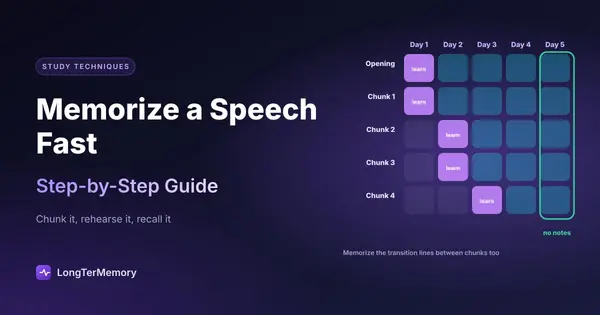
A chunk should be a complete thought, small enough to be retrieved in full from memory but large enough to represent a real unit of your speech. For most speeches, a chunk is somewhere between three and eight sentences.
The crucial test of a chunk is this: can you reproduce its essential content from a single cue, without needing to see what comes before or after it? If yes, it is a good chunk. If you can only recall it when you remember what came just before, you need to redesign the chunk or the cue.
For a prepared academic presentation, chunks might correspond to individual argument points. For a keynote speech, they might be stories or transitions. For a thesis defense, they might be the answer to each anticipated question. The unit is the same: a coherent piece of content you can recall and deliver independently.
Creating Your Cue Cards
Once you have identified your chunks, create a cue card for each one. The cue card is not a script excerpt. It is a minimal prompt that should trigger the full content of the chunk in your memory.
For narrative content, a cue might be the opening sentence of the story or a one-word trigger (the name of the person in the anecdote, the place where something happened). For argumentative content, a cue might be the one-line summary of the point (“Evidence for X: study by Karpicke 2008”). For transitions, a cue might be a single bridging word or phrase.
The minimal cue is important. If your cue card contains so much text that you are reading rather than retrieving, it is not building memory. It is providing a comfortable shortcut that will not be available when you stand in front of an audience.
Building the Sequence Map
In addition to the individual chunk cards, create a separate sequence card that lists all your chunks in order by cue word only. This is your navigation map. When you practice full delivery, you use this map to move from chunk to chunk rather than relying on one continuous chain of memory where forgetting one link breaks the whole sequence.
The sequence map is a safety net. Each chunk is individually anchored in memory, so forgetting the transition between two chunks does not mean you lose the rest of the speech. You can always consult the map to locate where you are and continue.
Active Recall for Speeches: Speaking From Memory vs. Reading
The core of spaced repetition for speeches is verbal retrieval practice. This means attempting to say the content of each chunk out loud from memory, before consulting your cue card or the original script.
The Retrieval Attempt Rule
The non-negotiable rule is this: attempt retrieval before checking anything. Look at your cue card. Read the cue. Now close or flip the card and speak the chunk from memory. Only check the original text after you have made a genuine attempt.
If you get the chunk right, great. If you stumble or miss something, check the original, note what you missed, and make a mental note that this chunk needs more practice.
This sounds simple, but most people violate this rule constantly. They glance at the cue, feel slightly uncertain, and immediately flip to the full text for reassurance. That reassurance feels helpful but accomplishes nothing for memory. The retrieval attempt is where learning happens, even when, especially when, it is imperfect.
Rating Your Recall
After each retrieval attempt, give yourself a rough rating:
- Easy: You recalled the full content smoothly and confidently
- Medium: You recalled the core content but missed some details or phrasing
- Hard: You recalled only partial content or needed significant prompting
Your spaced repetition schedule for each chunk should be based on this rating. Easy chunks can be reviewed less frequently. Hard chunks need to come back sooner. This is exactly how spaced repetition works for factual content, and it works the same way for speech chunks.
Reading vs. Speaking: Why the Difference Matters
There is a temptation to treat silent reading rehearsal as a lower-effort alternative to verbal retrieval practice when you are tired or in a public place. This is worth resisting.
Silent reading and verbal delivery use different memory pathways. You can become very good at recalling the text of your speech silently while still being unable to deliver it fluently out loud. Speaking activates the motor memory involved in producing speech, the timing, the breath control, the connection between thought and articulation. Only practice that involves actually speaking trains that memory.
If you genuinely cannot speak out loud, whispered delivery is better than silent reading. Lip movement and minimal articulation activate more of the right pathways than pure silent rehearsal.
Combining Spaced Rehearsal With Delivery Practice for Presentations
Spaced repetition is excellent for building the memory foundation of a speech, but memory alone is not the same as delivery. A speech that is perfectly stored but robotically delivered is not a success. The final layer of preparation integrates the memorized content with genuine performance practice.
The Two-Phase Preparation Model
A useful way to think about speech preparation is in two phases:
Phase one: memory building. This is where spaced repetition does its work. You are establishing the content in long-term memory through chunked review at increasing intervals. During this phase, you are not trying to sound polished. You are trying to build reliable retrieval. This phase typically spans one to two weeks before the presentation.
Phase two: delivery integration. Once the content is reliably in memory, you begin practicing full delivery with attention to pacing, emphasis, transitions, and response to the audience. During this phase, the spaced repetition schedule continues as a maintenance tool, but the primary practice focus shifts to how you say the thing rather than whether you can say it.
Mixing these phases too early is a common mistake. Trying to perfect delivery while still uncertain about content is like trying to add expression to piano performance while still reading the sheet music. Get the notes in your head first.
Scheduling Your Rehearsal Sessions
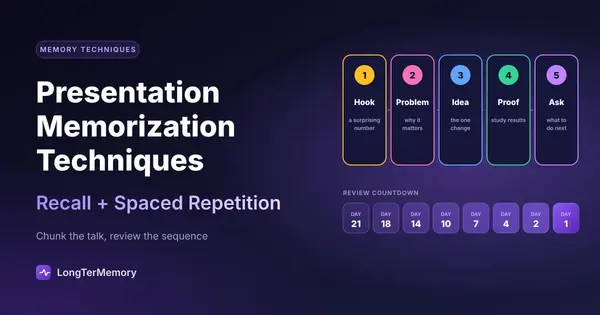
Here is a practical spaced repetition schedule for a presentation with three weeks of lead time:
| Time Before Presentation | Focus |
|---|---|
| Day 21 | Chunk the speech, create all cue cards, first retrieval attempt for each chunk |
| Day 18 | Full chunk review (likely hard, many failures) |
| Day 15 | Review hard and medium chunks only |
| Day 12 | Full chunk review, now with sequence map practice |
| Day 9 | Review hard chunks, brief full-run through |
| Day 7 | First full verbal delivery from memory only |
| Day 5 | Second full delivery, focus on weak sections |
| Day 3 | Third full delivery, work on transitions and pacing |
| Day 1 | Brief maintenance review of cue cards, one run-through |
| Day 0 | Short warm-up delivery in the morning |
This schedule front-loads the memory work and then gradually shifts toward integration practice. It also avoids the common trap of massed rehearsal, where you spend six hours practicing the day before and arrive exhausted and over-rehearsed.
Practicing in Realistic Conditions
Physical and environmental conditions matter more for speech performance than for written exam performance. Your brain and body associate memories with the context in which they were formed, a phenomenon psychologists call context-dependent memory.
This means that if all your rehearsals happen sitting quietly at your desk, some of that context-dependence will not transfer to standing in a room full of people. Include at least two or three rehearsal sessions where you practice under realistic conditions: standing, in a space with some ambient noise, dressed appropriately, for the full intended duration.
If you can practice in the actual room where you will present, do so. The environmental cues become part of the memory retrieval context, and having them available on the day reduces one potential source of failure.
Handling Blanks During Live Delivery
Even with thorough preparation, blanks happen. They are less likely with spaced repetition preparation than with massed rehearsal, but no memorization method eliminates them entirely.
The trained response to a blank is not panic. It is a brief, calm pause followed by consulting your mental sequence map rather than going blank entirely. If you know your speech is structured around five main points, and you know you just finished point two, you can locate yourself by asking “what is point three?” That cue is usually enough to unlock the content.
If a blank persists, the professional response is to pause confidently, take a breath, and say something that buys a moment: “Let me make sure I am being clear on this…” or “There are a few angles to this, so let me take the most important one…” These pivots give your retrieval system a moment to deliver and are entirely invisible to any audience that is not already watching for them.
Long-Term Retention: The Unexpected Benefit
One genuinely surprising benefit of using spaced repetition for speech memorization is how long the memory lasts. A speech memorized through massed rehearsal typically fades within days of the performance. The content that felt so vivid on presentation day is largely inaccessible six months later.
A speech memorized through spaced retrieval practice over several weeks, especially if followed by occasional maintenance reviews, tends to remain accessible for months or years. If you are delivering a presentation you expect to give repeatedly, whether a job interview answer, a sales pitch, a conference talk, or a teaching module, this durability compounds enormously over time.
LongTerMemory is built on this same principle for study material: information reviewed through spaced repetition is retained far longer than information reviewed through massed re-reading. The same scheduler that keeps your anatomy flashcards fresh six months later can maintain your speech chunks in memory between performance dates.
The investment of building a properly spaced rehearsal schedule for any speech you will give more than once is almost always worth it. You put in more deliberate effort upfront and spend far less time re-learning from scratch before each subsequent delivery.
Of all the presentation memorization techniques available, the combination of active recall and spaced rehearsal is the one most consistently supported by memory research, and the one that keeps working long after the applause ends.
That is the central promise of spaced repetition in any domain. More durable learning, less wasted re-learning, and the quiet confidence that comes from knowing the material is genuinely inside your head, not just familiar when you see the script.