How to Memorize Biology Fast Without Flashcards
Want to know how to memorize biology fast? Use diagrams, stories, active recall, and concept mapping to learn biology quickly without flashcards.
Table of Contents
- Why Biology Doesn't Play Well With Traditional Flashcards
- How to Memorize Biology Fast: A Simple Study Flow
- The Blank Diagram Method
- Teaching Biology Concepts Out Loud
- Using Case Studies and Diseases to Anchor Abstract Concepts
- Concept Mapping: Making the Connections Visible
- Spaced Retrieval Without Flashcards
- Before and After Each Study Session
- When to Use Diagrams vs. Narratives
- Making It Stick: The Long-Term Approach
Let’s be honest: at some point, every biology student has sat down with a towering stack of flashcards and thought, there has to be a better way. The good news? There is. The even better news? It works faster, sticks longer, and is a lot more interesting than drilling cards until your eyes blur.
If you’re wondering how to memorize biology fast, the answer isn’t more flashcards. Memorizing biology without flashcards isn’t just possible , for many students, it’s actually more effective. Biology is a subject full of interconnected systems, visual structures, and cause-and-effect relationships. That kind of material calls for techniques that honor its complexity, not reduce it to isolated question-answer pairs.
Here’s how to do it.
Why Biology Doesn’t Play Well With Traditional Flashcards
Before we get into the techniques, it’s worth understanding why flashcards often fall short for biology specifically.
Flashcards excel at discrete facts: vocabulary definitions, isolated names, a date, a number. But biology rarely works that way. Understanding cellular respiration means understanding how glycolysis feeds into the Krebs cycle feeds into the electron transport chain , it’s a chain, not a list. Memorizing the steps in isolation without understanding how they connect is like memorizing random words from a recipe without knowing how to cook.
The same goes for anatomy, ecology, genetics. These are systems, not inventories. Techniques that capture relationships between concepts will always outperform techniques that treat each concept as its own island.
How to Memorize Biology Fast: A Simple Study Flow
When you’re pressed for time, the fastest approach is to combine several techniques into one focused loop. Here’s a practical flow for last-minute biology exam prep:
- Triage your textbook chapters. Spend two minutes identifying the highest-yield topics , the ones that appear on every exam, underpin other concepts, or were emphasized by your instructor.
- Pick one high-yield visual. Choose a diagram, pathway, or structure from that topic and study it carefully.
- Reproduce it from scratch. Close your notes and draw or describe it without looking. This is the blank-diagram method in action.
- Explain it out loud. Use the Feynman method to teach the concept in plain language and catch the gaps.
- Anchor it to a disease or example. Attach the process to a concrete case so it becomes a story rather than an abstract fact.
- Schedule one review. Add a 24-hour and three-day retrieval check so the memory sticks.
This loop turns a dense biology topic into something you can actually remember under exam pressure. If you need to memorize biology fast, this sequence is one of the most reliable ways to do it. Each step builds on the next, so you spend your limited time on encoding, not just exposure.
The Blank Diagram Method
If there’s one technique that changes everything for visual biology topics, it’s this one.
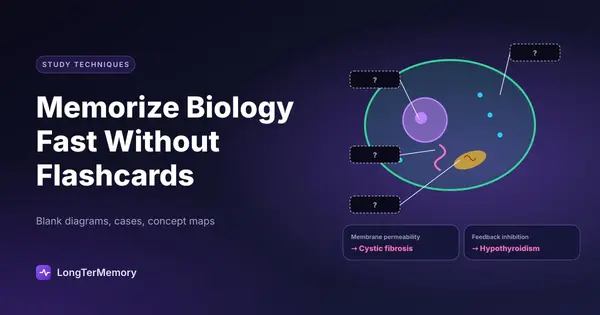
Find or draw a diagram of whatever you’re studying , a cell, a neuron, a metabolic pathway, an ecological food web. Study it carefully. Then close everything and try to reproduce it from scratch on a blank piece of paper. Label every part. Draw every arrow. Write in every process.
When you check your version against the original, every gap is a learning target.
This works for an almost ridiculous range of biology topics:
- Cell structure: Can you draw and label a eukaryotic cell from memory, including the rough and smooth ER, the mitochondria, the nucleus, the ribosomes?
- The heart: Can you trace blood flow from the vena cava to the aorta without peeking?
- Photosynthesis: Can you draw the light-dependent and light-independent reactions, including where ATP, NADPH, and glucose come in and go out?
- Muscle contraction: Can you draw the sliding filament mechanism step by step?
The act of generating a diagram , even imperfectly , is far more effective for memory than studying a completed one. Your brain engages at a deeper level when it has to produce rather than recognize.
Teaching Biology Concepts Out Loud
This sounds strange, but try it: explain a biology concept out loud as if you’re teaching it to someone who has never seen it before. Don’t use jargon , or if you do, define every term you use.
This technique is often called the Feynman method, and it’s brutally effective at exposing the difference between familiarity and actual understanding.
For example: close your notes and try to explain natural selection out loud in plain language. Most students can say “survival of the fittest” but quickly get stuck when they try to explain why some traits get passed on and others don’t, what “fitness” actually means in evolutionary terms, and how small changes accumulate across generations.
The gaps that appear when you try to explain out loud are your actual study targets , much more honest than the false sense of mastery you can get from re-reading your notes.
Here’s a practical format:
- Choose a concept (e.g. enzyme-substrate specificity, the lock-and-key model)
- Explain it out loud in plain language, as if to a curious friend with no biology background
- Identify the exact points where you hesitated or felt unclear
- Go back to the source material and fill in only those gaps
- Explain it again
This recursive process builds rock-solid conceptual understanding, not just surface-level familiarity.
Using Case Studies and Diseases to Anchor Abstract Concepts
Here’s a trick that top medical and pre-med students use constantly: attach every abstract concept to a concrete disease or example.
Abstract concepts like “enzyme deficiency” are hard to retain because they float , there’s nothing to grab onto. But “Tay-Sachs disease is caused by a deficiency in hexosaminidase A, leading to the buildup of GM2 gangliosides in nerve cells” is suddenly a story. Stories stick.
Some examples of this approach:
| Abstract Concept | Concrete Case |
|---|---|
| Cell membrane permeability | Cystic fibrosis (faulty CFTR channel) |
| DNA repair mechanisms | Xeroderma pigmentosum (UV damage goes unrepaired) |
| Feedback inhibition | Hypothyroidism (TSH stays high when T3/T4 are low) |
| Mitochondrial function | Leigh syndrome (mitochondrial energy failure in neurons) |
| Osmosis and cell volume | Sickle cell disease (altered cell morphology under low oxygen) |
When you understand why a biological process matters , what goes wrong when it fails , the concept becomes emotionally and intellectually anchored. You remember it not just as a fact, but as something that has consequences in the real world.
This approach is especially powerful for studying the endocrine system, the immune system, and cell biology , all areas where “what happens when this goes wrong” is both fascinating and extremely testable.
Concept Mapping: Making the Connections Visible
Concept maps are not the same as mind maps. A concept map explicitly labels the relationships between ideas. This is critical for biology, where the connections are often as important as the concepts themselves.
Here’s how to build one for a topic like cellular respiration:
- Write the central concept in the middle of a page: “Cellular Respiration”
- Connect it to its three main stages: Glycolysis, Krebs Cycle, Electron Transport Chain
- For each stage, add the key inputs and outputs: glucose in, pyruvate out, ATP produced
- Add connecting labels: “produces,” “feeds into,” “requires,” “releases”
- Connect across stages where relevant: “NADH from Krebs feeds electrons to ETC”
The labeling of relationships forces you to think about how things connect, not just what they are. And when you can explain the connections, you’ve truly learned the material.
After you build your concept map once, put it away and try to rebuild it from memory. This transforms a passive note-taking exercise into a powerful retrieval practice.
Spaced Retrieval Without Flashcards
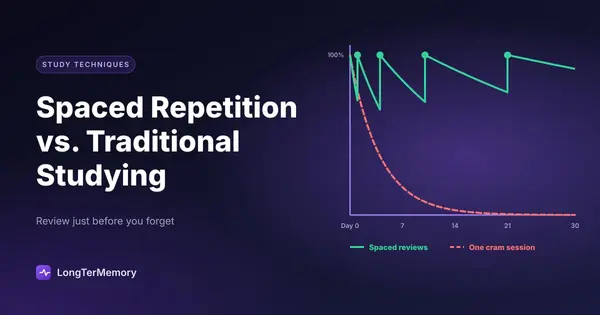
You don’t need flashcard apps to practice spaced repetition. You just need a schedule and some discipline.
Here’s a simple, low-tech approach:
- After studying a biology topic, immediately try to reproduce the key ideas from memory (write them, draw them, or speak them out loud)
- Review the same topic 24 hours later, again from memory first
- Review again 3 days later
- Review again 1 week later
- If you still nail it at 1 week, extend to 2 weeks
The spacing is what makes it work. Each time you successfully retrieve something, your brain decides it’s worth holding onto longer. The “struggle” of trying to remember , even when you almost fail , is exactly where the memory consolidation happens.
The key difference from flashcards is that you’re retrieval-practicing whole systems, not isolated facts. You’re asking yourself “can I reproduce the entire diagram of the nephron from scratch?” rather than “what does the Loop of Henle do?” Both have value, but the former builds richer, more connected memory.
Before and After Each Study Session
A habit that dramatically improves biology retention is bookending your study sessions with quick retrieval practice.
Before you start: spend 5 minutes trying to recall everything you remember about the topic you’re about to study. Don’t look at your notes. Just write or speak everything you can. This primes your brain for the incoming information and reveals what you’ve retained from last time.
After you finish: close everything immediately and spend 10 minutes doing a brain dump , writing everything you just learned, in your own words, without looking at your notes.
These two bookends sound simple, but they transform passive study sessions into active learning events. The material you process through active retrieval consolidates at 2-3x the rate of material you simply read.
When to Use Diagrams vs. Narratives
One practical question is: which technique for which topic?
| Topic Type | Best Technique |
|---|---|
| Cell and organ structure | Blank diagram reproduction |
| Metabolic pathways | Concept mapping + diagram |
| Evolutionary mechanisms | Teach out loud + case studies |
| Genetics (Mendelian, molecular) | Problem-solving practice |
| Ecology and food webs | Concept mapping |
| Immune response | Disease-based case studies |
| Enzyme kinetics | Diagram + Feynman explanation |
There’s no single technique that dominates all topics. The common thread is active engagement: generating, explaining, reproducing, and connecting , rather than passively re-reading.
Making It Stick: The Long-Term Approach
The students who ace biology exams and actually remember the content years later have one thing in common: they engage with the material, they don’t just read it.
That means drawing diagrams from scratch and checking them. Explaining feedback loops out loud. Connecting every concept to a disease, an example, a story. Building concept maps that capture relationships, not just lists. Spacing their reviews so they’re always retrieving, never just reviewing.
If you’re preparing for a biology exam and want to know how to memorize biology fast, whether it’s for high school, a university course, the MCAT, or a medical licensing exam, the techniques above are your highest-leverage study tools. Not because they’re clever tricks, but because they match how memory actually works.
Your brain remembers what it generates. It forgets what it merely reads.
Put down the flashcard stack. Pick up a blank piece of paper and start drawing.
Want to take your biology study to the next level? LongTerm Memory automatically turns your PDFs and notes into smart study material , applying spaced repetition scheduling so you review the right content at exactly the right time.