How to Study Artificial Intelligence Fundamentals
Learn how to study AI fundamentals effectively, from machine learning basics to deep learning and NLP, without needing a mathematics PhD.
Table of Contents
- Core AI Concepts: Machine Learning, Deep Learning, and Natural Language Processing
- The Three-Layer Structure of AI
- Key Concepts to Understand in Each Layer
- How to Build an AI Knowledge Base Without a Mathematics PhD
- The Two Paths Through AI Study
- Building the Conceptual Foundation
- The Trap of Linear Prerequisite Thinking
- Certification and Course Options for AI Fundamentals Study
- Starting Points (No Prior ML Experience)
- Intermediate Level
- Certifications Worth Considering
- Building a Study Plan Around a Certification
- Staying Current in a Field That Moves Fast
- Separate the Stable From the Rapidly Changing
- The Weekly Review Habit
- Putting It All Together
Artificial intelligence is everywhere, and the pressure to understand it is growing. Professionals in every field are being told they need AI literacy. Students are choosing AI specializations without necessarily knowing what they are signing up for. Career changers are wondering whether they can get up to speed without spending three years in a PhD program.
The honest answer is: yes, you can build a solid understanding of AI fundamentals without a mathematics PhD. But the path is not always obvious, and the amount of low-quality learning content in this space is extraordinary. Knowing how to study AI fundamentals, not just what to study, makes the difference between genuine understanding and the ability to use buzzwords convincingly.
This guide is about the study process itself, as well as the content.
Core AI Concepts: Machine Learning, Deep Learning, and Natural Language Processing
Before choosing resources or building a study plan, it helps to have a clear map of the territory. AI is not a single thing. It is a family of related fields, each with its own methods, vocabulary, and applications.
The Three-Layer Structure of AI
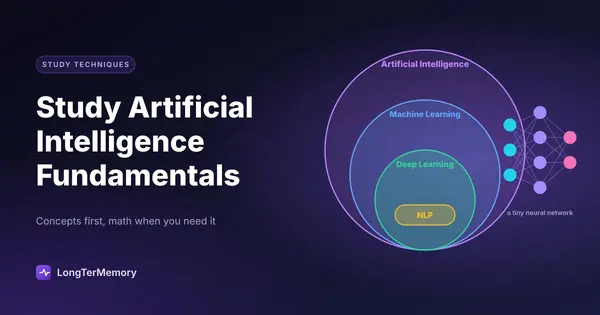
A useful way to think about the AI landscape is as three nested layers:
Artificial intelligence (outermost layer): The broadest category. AI refers to any system that performs tasks that would require intelligence if a human did them. This includes everything from chess-playing programs to recommendation algorithms to the voice assistant on your phone. It is the general term.
Machine learning (middle layer): A subset of AI that focuses specifically on systems that learn from data rather than following explicitly programmed rules. Instead of writing code that says “if email contains ‘free money’ then mark as spam,” a machine learning system learns from thousands of examples of spam and not-spam and develops its own internal rules. The defining characteristic of ML is that the system improves with experience.
Deep learning (innermost layer): A subset of machine learning that uses artificial neural networks with many layers, the “deep” refers to the depth of these layers. Deep learning is responsible for most of the dramatic AI advances of the past decade: image recognition, language models, speech synthesis. It requires significant computational resources and large datasets, but when those are available, it outperforms other ML approaches by a substantial margin.
Natural language processing (NLP) sits at the intersection of deep learning and linguistics. It is the field focused on enabling machines to understand, generate, and work with human language. NLP is why chatbots, search engines, and translation tools work as well as they do.
Understanding this structure matters because it tells you what you are actually studying when you study “AI.” Most of what people mean when they say AI today is machine learning, and most of what they mean when they say machine learning breakthroughs is deep learning. If you want to be current, deep learning and NLP are where the most active development is happening.
Key Concepts to Understand in Each Layer
| Layer | Core Concepts |
|---|---|
| Machine Learning | Supervised vs. unsupervised vs. reinforcement learning, training/validation/test splits, overfitting and regularization, gradient descent |
| Deep Learning | Neural network architecture, activation functions, backpropagation, convolutional networks (images), recurrent networks (sequences) |
| NLP | Tokenization, embeddings, attention mechanism, transformers, large language models |
You do not need to master all of these from day one. But you need to know what they are and roughly how they relate to each other. A map of the territory precedes deep exploration of any specific region.
How to Build an AI Knowledge Base Without a Mathematics PhD
Here is the thing that stops many motivated learners before they start: AI has a reputation for being mathematically inaccessible. You see equations involving derivatives, matrices, and probability theory, and you assume you need a deep mathematical background before you can understand anything useful.
That assumption is wrong, though it is understandable.
The Two Paths Through AI Study
There are genuinely two different ways to understand machine learning:
Conceptual understanding: You understand what the algorithms do, why they work, what their assumptions and limitations are, and when to use them. You can make good decisions about AI systems and communicate intelligently about them. You do not need to implement everything from scratch.
Mathematical understanding: You understand the formal mathematical foundations. You can derive algorithms, prove convergence, and analyze computational complexity. You can implement everything from scratch and extend it in novel ways. This is what researchers and AI engineers who build new models from the ground up need.
For most professionals, students of adjacent fields, and career changers, conceptual understanding is the appropriate target. This does not mean shallow understanding. A strong conceptual grasp of machine learning, including why it sometimes fails, what “training” actually means, and how to think about model evaluation, is genuinely sophisticated and genuinely useful.
The mathematical path is worth pursuing only if you plan to do original research or work in core AI engineering. And even then, most practitioners have found that building conceptual understanding first, then going back to fill in the math, is faster and more effective than starting with equations.
Building the Conceptual Foundation
Start with practical exposure before theory. Work through a hands-on introductory course where you actually run code, see data being processed, and observe what models do. The experience of watching a neural network train, seeing the loss decrease, seeing predictions improve, makes the abstract concepts concrete in a way that reading about them does not.
Python is the language of machine learning, and you need at least enough Python to read and modify code without being blocked. If you do not know Python, a short beginner course is worth the investment. You do not need to be an advanced programmer.
After that initial practical exposure, go back and deepen the conceptual foundations. This is where you read about how gradient descent works at a high level, what the key assumptions of different algorithms are, and why overfitting is such a persistent problem. Now that you have seen these things in practice, the explanations will make sense in a way they would not have earlier.
The Trap of Linear Prerequisite Thinking
A common mistake in studying AI is the belief that you need to master a long chain of prerequisites before you can understand anything: first linear algebra, then probability theory, then statistics, then machine learning basics, then deep learning. This chain can stretch on indefinitely and is one of the most common reasons people give up before they start.
A better approach is spiral learning. Start with enough background to understand the basics, then learn the basics, then when you need more background to understand something specific, go and learn exactly that piece. The path is motivated by curiosity and need rather than a theoretical prerequisite structure.
When you hit a concept that depends on math you do not know, do not go back to the beginning of a linear algebra course. Learn the specific piece of linear algebra or probability you need, just enough to understand the AI concept you are working through, and then continue.
Certification and Course Options for AI Fundamentals Study
The course and certification landscape for AI is enormous and of highly variable quality. Here is a map of the most reliable options at different levels.
Starting Points (No Prior ML Experience)
Google’s Machine Learning Crash Course is free, well-structured, and focuses on practical understanding over mathematical depth. It uses TensorFlow but the concepts transfer. Good for building the initial mental model.
fast.ai’s Practical Deep Learning for Coders takes a deliberate top-down approach: you build working models in the first lesson, and the theory is introduced as you need it. This mirrors the spiral learning approach described above and has produced genuinely strong practitioners from people with no prior ML background.
Andrew Ng’s Machine Learning Specialization on Coursera is probably the most widely known starting point. It is methodical, clear, and well-taught. It leans slightly more toward the mathematical path than fast.ai, but it remains accessible. The optional math components can be skipped without losing the core conceptual thread.
Intermediate Level
Stanford CS231n (Convolutional Neural Networks for Visual Recognition) lecture videos are available free online and are among the best explanations of deep learning concepts available anywhere. They assume some prior ML knowledge.
Hugging Face’s NLP course is the best free resource for learning modern NLP and transformer models. It is practical, current, and built around the tools that practitioners actually use.
Certifications Worth Considering
Certifications in AI vary widely in value. The ones recognized most broadly in the industry right now:
| Certification | Provider | Level | Focus |
|---|---|---|---|
| TensorFlow Developer Certificate | Intermediate | Deep learning implementation | |
| AWS Machine Learning Specialty | Amazon | Advanced | Cloud ML deployment |
| Azure AI Fundamentals (AI-900) | Microsoft | Beginner | AI concepts, Azure tools |
| Professional Machine Learning Engineer | Google Cloud | Advanced | Production ML systems |
The Azure AI Fundamentals exam is an accessible entry-level credential that validates conceptual AI knowledge without requiring implementation depth. It is worth considering for professionals who want a recognized certification with relatively modest technical prerequisites.
For anyone working toward roles that involve building or deploying ML systems, the TensorFlow Developer Certificate or AWS Machine Learning Specialty are more substantive and more respected.
Building a Study Plan Around a Certification
If you are targeting a specific certification, work backwards from the exam objectives. Every certification publishes a list of what it tests. Start there, identify your current knowledge gaps against that list, and build a learning plan around closing those gaps.
The study plan should include:
- A conceptual learning phase (courses, reading, video) where you build understanding
- A practical application phase where you work through hands-on exercises and projects
- A review and practice exam phase where you test your knowledge against exam-format questions
Spaced repetition is particularly valuable for the large vocabulary of AI concepts. Terms like gradient descent, regularization, batch normalization, attention mechanism, and transformer architecture need to be genuinely understood and quickly retrievable, not just vaguely familiar. Building a flashcard deck around the exam objectives and reviewing it consistently over your study period is one of the most effective preparation strategies available.
LongTerMemory is designed for exactly this kind of content. Upload your AI study notes or course materials, and it generates question-and-answer pairs automatically. You can build a comprehensive AI vocabulary deck without manually creating each card, and the built-in spaced repetition scheduler ensures you review each concept at the optimal interval for long-term retention.
Staying Current in a Field That Moves Fast
AI is one of the fastest-moving fields in technology. What counts as foundational knowledge shifts every two or three years. This creates a genuine study challenge that does not exist to the same degree in more stable fields.
Separate the Stable From the Rapidly Changing
The good news is that not everything in AI changes equally fast. Some things are stable:
- The fundamental distinction between supervised, unsupervised, and reinforcement learning
- The core concept of gradient descent and optimization
- The basic principles of neural network architecture
- The foundational ideas of probability and statistics that underpin ML
These are worth investing deeply in because they will remain relevant even as specific techniques evolve. The architecture of the most powerful NLP model in 2028 will be different from today’s, but the person who understands attention mechanisms and transformers deeply will be well-placed to understand whatever comes next.
What changes fast:
- Specific model architectures and their benchmark performance
- Tool and library ecosystems
- Best practices for production deployment
- State-of-the-art techniques for specific applications
Stay current on the rapidly changing layer through newsletters, podcasts, and brief review of key papers, not through attempting to master each new development in depth. The field is moving too fast for deep mastery of everything current, and that is not the goal anyway.
The Weekly Review Habit
One practical habit that keeps AI knowledge fresh and growing: set aside thirty to forty-five minutes per week to read about recent developments. There are several high-quality newsletters and aggregators (Import AI, The Batch by DeepLearning.AI, Papers With Code) that curate the most important developments. Reading one of these weekly, combined with the spaced review of your foundational concepts, keeps you current without requiring you to follow the research firehose in real time.
Putting It All Together
Studying AI fundamentals is entirely achievable without a mathematics PhD, but it requires a clear approach. The key principles:
- Understand the structure of the field before diving into any specific area
- Start with practical exposure, then deepen the conceptual foundations
- Use spiral learning rather than waiting to satisfy an endless prerequisite chain
- Choose a certification target to give your study direction and a measurable outcome
- Use spaced repetition to build genuine fluency with the large vocabulary of AI concepts
- Separate the stable foundational knowledge from the rapidly changing surface layer, and invest depth in the former
AI literacy is becoming as foundational as data literacy in professional environments, and the window where it is genuinely differentiating is still open. The person who understands not just how to use AI tools but why they work, what their limitations are, and how to think about them analytically will be better placed in almost every field than the person who can only describe them in marketing terms.
That understanding is entirely within reach. It just requires the right study approach.