How to Study Surgical Principles for Medical Licensing
A practical system for mastering surgical principles for USMLE and licensing exams: surgical anatomy, perioperative management, and active review methods.
Table of Contents
- Why Surgery Questions Feel Different (And Why That's Actually Good News)
- Surgical Anatomy and Indication-Based Thinking for Licensing Exams
- Stop Studying Anatomy in Isolation
- The "Does This Patient Need Surgery" Framework
- Pre- and Post-Operative Management: High-Yield Surgical Topics
- Preoperative Priorities
- Postoperative Complications by Timeline
- Fluid, Electrolyte, and Nutrition Basics
- Using USMLE-Style Surgery Questions for Active Review
- Question Banks Are Not Just for Testing, They Are for Learning
- Build Active Recall Into Every Review Pass
- Simulate the Vignette Under Time Pressure
- Pulling It All Together
If you are a non-surgical track student staring down a surgery block, there is a very specific kind of dread that comes with it. Internal medicine questions feel familiar, you have been building that vocabulary for years. Surgery questions feel like a different language entirely, full of eponyms, incision types, and management algorithms that seem to require you to already be a surgeon to answer correctly.
Here is the reassuring part: you do not need to think like a surgeon to pass the surgery portion of your licensing exam. You need to think like a test-taker who understands a fairly narrow set of decision-making patterns that show up again and again. Surgical principles on licensing exams are far more formulaic than actual surgical practice, and once you see the pattern, the questions stop feeling random.
This guide walks through how to build that pattern recognition efficiently, without trying to memorize a surgical textbook cover to cover.
Why Surgery Questions Feel Different (And Why That’s Actually Good News)
Most licensing exam surgery questions are not testing whether you can perform a procedure. They are testing whether you can answer three questions in sequence: does this patient need surgery, when do they need it, and what could go wrong afterward. That is a much smaller target than “know all of surgery.”
This matters because it changes how you should study. Instead of trying to absorb surgical knowledge the way you might absorb pharmacology facts, one item at a time, you want to build a small number of decision frameworks that you can apply across dozens of different clinical scenarios. A framework for “should this abdomen be operated on now” applies whether the vignette is about appendicitis, a perforated ulcra, or mesenteric ischemia. Learn the framework once, and the surgical knowledge becomes a matter of plugging in the right variables.
Surgical Anatomy and Indication-Based Thinking for Licensing Exams
Anatomy is where a lot of students lose confidence early, and it is also where a shift in approach pays off fastest.
Stop Studying Anatomy in Isolation
Memorizing the layers of the abdominal wall or the branches of the celiac trunk as a standalone anatomy exercise is inefficient for exam purposes. It is much more effective to study anatomy attached to a clinical decision. Instead of “what are the branches of the external carotid artery,” ask “which artery is at risk during this specific type of neck dissection, and what happens if it’s injured.” Anatomy that is tied to a consequence sticks. Anatomy that is tied to nothing sticks to nothing.
A useful habit: every time you encounter a piece of surgical anatomy in your review material, force yourself to answer “so what?” What decision does this anatomical fact change? If you cannot answer that, it is probably not high-yield for exam purposes, even if it is genuinely important for surgical practice.
The “Does This Patient Need Surgery” Framework
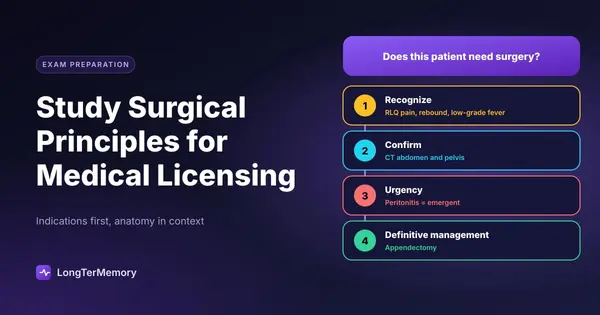
For most surgical topics tested on licensing exams, there is a repeatable structure to how the decision gets made:
| Step | What You’re Assessing | Example |
|---|---|---|
| 1. Recognize the presentation | Classic symptom cluster or exam finding | RLQ pain, rebound tenderness, low-grade fever |
| 2. Confirm with the right test | The single best next diagnostic step | CT abdomen/pelvis or clinical diagnosis if classic |
| 3. Determine urgency | Emergent, urgent, or elective | Peritonitis = emergent |
| 4. Identify the definitive management | Surgical vs. medical vs. watchful waiting | Appendectomy |
| 5. Anticipate the complication | What happens if untreated or post-op | Perforation, abscess, sepsis |
Once this five-step structure is second nature, you can run nearly any acute surgical vignette through it. The specific diagnosis changes, the structure of your reasoning does not.
Pre- and Post-Operative Management: High-Yield Surgical Topics
If surgical indications are one half of the exam’s surgical content, perioperative management is the other half, and it is arguably even more testable because it relies less on pattern recognition and more on protocol-level knowledge you can genuinely memorize.
Preoperative Priorities
Preoperative questions tend to cluster around a small set of recurring themes: risk stratification (cardiac risk indices, pulmonary risk factors), medication management before surgery (which medications get held, which get continued, anticoagulation bridging), and informed consent or capacity scenarios. These are highly learnable because the “correct” answer usually follows a defined guideline rather than clinical judgment. Treat these as memorization targets, not reasoning exercises. A flashcard-style approach works extremely well here precisely because the content does not change based on context the way indication-based reasoning does.
Postoperative Complications by Timeline
One of the most consistently high-yield postoperative concepts is the timeline of complications. Exam writers love this because it tests whether you actually understand what is happening physiologically, not just whether you memorized a list.
- Immediate (within hours): bleeding, anesthesia-related complications, airway issues
- Early (days 1 to 3): atelectasis is the classic cause of early postoperative fever, along with anesthesia reaction and the surgical stress response itself
- Intermediate (days 3 to 7): urinary tract infection, wound infection, pneumonia, deep vein thrombosis
- Later (after day 7): wound dehiscence, deeper abscess formation, other delayed infections
The mnemonic “Wind, Water, Walking, Wound, Wonder drugs” (or its many variants) exists for a reason: it maps almost perfectly onto this timeline, and licensing exams test this timeline relentlessly across nearly every surgical subspecialty. Learn it once as a general framework, then apply it to abdominal surgery, orthopedic surgery, cardiac surgery, wherever the vignette happens to be set.
Fluid, Electrolyte, and Nutrition Basics
Postoperative fluid management and electrolyte disturbances are dense but genuinely learnable content. Know the basics of postoperative fluid shifts (the stress response causes fluid retention in the first 24 to 72 hours), the signs of common electrolyte derangements, and when nutritional support becomes a clinical priority (generally when a patient is not expected to resume adequate oral intake within about a week). This is dry material, but it is tested consistently enough that skipping it is a real cost.
Using USMLE-Style Surgery Questions for Active Review
Here is where a lot of otherwise solid students undermine their own preparation: they read surgery content passively, feel like it makes sense while they are reading it, and then get blindsided by how differently the information is tested in question format.
Question Banks Are Not Just for Testing, They Are for Learning
Treat every practice question, right or wrong, as a mini case study. When you get a question wrong, do not just note the correct answer and move on. Work through why each wrong answer choice was wrong, not just why the right one was right. Surgery questions are notorious for including distractors that would be reasonable answers in a slightly different clinical context, and understanding that distinction is often exactly what separates a correct answer from a near-miss on test day.
Build Active Recall Into Every Review Pass
After finishing a block of surgery questions, close the explanations and try to reconstruct, from memory, the decision framework each question was testing. This is a form of retrieval practice, and it is dramatically more effective than simply re-reading explanations a second time. If you cannot reconstruct the reasoning without looking, that is useful information: it tells you exactly where to focus your next study session.
This is also where spaced repetition earns its keep for surgical content specifically. Perioperative protocols, complication timelines, and classic anatomical associations are exactly the kind of discrete, fact-based knowledge that benefits from being reviewed right before you would otherwise forget it, rather than being crammed once and left to fade. Turning your missed questions and high-yield surgical associations into spaced review cards, instead of a static list you never revisit, is one of the more reliable ways to make sure this content is still there on exam day and not just on the day you first learned it. Tools like LongTerMemory can take your question bank notes or surgery review documents and automatically generate a spaced review schedule from them, which removes a lot of the manual card-building that otherwise eats into your limited study time.
Simulate the Vignette Under Time Pressure
Finally, do not neglect timed practice. Surgical vignettes are often longer and more detail-dense than other subject areas, and part of what is being tested is your ability to extract the decision-relevant information quickly from a paragraph full of red herrings. Practicing under realistic time constraints trains that skimming-for-signal skill, which is genuinely different from the skill of understanding the content in an untimed setting.
Pulling It All Together
Surgical principles on licensing exams reward a specific kind of preparation: fewer sprawling facts, more repeatable decision frameworks, applied relentlessly across practice questions until the pattern becomes automatic.
Focus your energy on three things: anatomy tied directly to clinical consequence, the perioperative complication timeline as a near-universal template, and active, question-based review rather than passive reading. Do those three things consistently, and the surgery block stops feeling like a foreign subject and starts feeling like exactly what it is, a structured, learnable part of the exam like any other.
You do not need to think like a surgeon. You need to think like someone who has seen the pattern enough times to recognize it instantly. That comes from repetition, and repetition is entirely within your control.