How to Use Teaching as a Study Technique
Discover why teaching others is the most powerful study method and how to use peer teaching to lock information into long-term memory.
Table of Contents
- Why Teaching Produces Deeper Memory Than Reviewing
- The Protege Effect: Why Your "Student" Doesn't Even Need to Be Real
- Practical Ways to Teach Material When You Have No Willing Student
- The Rubber Duck Method
- Study Groups with a Teaching Rotation
- Forum and Online Community Teaching
- Voice Memos and Self-Recording
- Using Virtual Teaching Tools and Study Platforms
- What Happens When You Can't Explain Something
- Building Teaching Into Your Study Routine
- The Mindset Shift That Makes This Work
- The Bottom Line
Here’s a question that sounds almost too simple: what if the best way to learn something wasn’t to study it more, but to teach it?
Not in a metaphorical “explain it to yourself” kind of way. Actually teach it. To another person. Out loud. With their confused face staring back at you.
It sounds backwards. You’re the one who needs to learn, so how does teaching help you? But the research on this is surprisingly clear, and once you understand why it works, you’ll probably want to build it into every major study effort you take on.
Why Teaching Produces Deeper Memory Than Reviewing
When you sit down to review your notes, something comfortable happens. Your brain reads familiar words, recognizes concepts it’s seen before, and generates a quiet sense of understanding. This is the fluency illusion at work: your memory of having encountered something gets mistaken for genuine mastery of it.
Teaching breaks that illusion almost instantly.
The moment you try to explain a concept to another person, you need to translate it from internal recognition into external language. You need to answer questions you didn’t anticipate. You need to connect it to things your listener already knows. You need to get the order right. You need to know what it actually means, not just that you’ve seen it before.
This process, what researchers call elaborative interrogation and self-explanation, activates a much deeper form of cognitive processing than passive review. You’re not just retrieving information, you’re restructuring it, testing its internal logic, and connecting it to new anchors.
Several studies have found that students who expected to teach material later retained significantly more of it than students who expected to be tested on it. The anticipation of teaching alone changed how they encoded the information from the start. And students who actually did the teaching retained even more.
The mechanism here is worth understanding. When you teach, you’re forced to identify the core logic of an idea, strip away the things you don’t understand well enough to explain, fill in gaps you didn’t know you had, and organize information in a way that someone else can follow. That process is exactly what deep learning looks like from the inside.
The Protege Effect: Why Your “Student” Doesn’t Even Need to Be Real
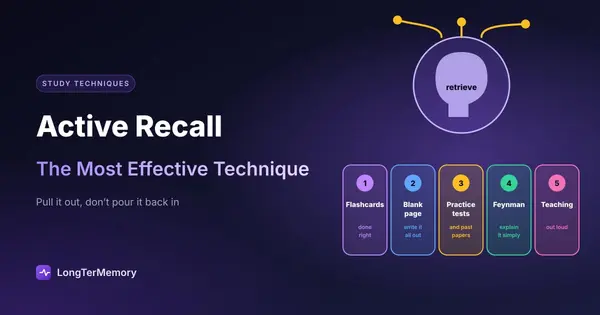
One of the more interesting findings in this space comes from research on what’s been called the protege effect: the phenomenon where preparing to teach, or imagining you’re teaching, activates similar cognitive benefits to actual teaching.
This means you don’t always need a willing human being sitting across from you. Some of the most effective forms of teaching-as-studying involve:
- Explaining a concept out loud to an empty chair
- Recording yourself walking through material as if you’re a tutor
- Writing a clear explanation in a forum post or blog comment, even if you never post it
- Imagining a specific confused friend who needs you to break it down
What matters is the mental commitment to explaining clearly and completely. The moment you shift from “I’m reviewing this for myself” to “I’m preparing to explain this to someone else,” your brain engages with the material differently. You become a translator. And translation, it turns out, is one of the best study activities there is.
Practical Ways to Teach Material When You Have No Willing Student
Most people’s immediate objection to teaching as a study technique is the same: “I don’t have anyone to teach.” It’s fair. But there are more ways to teach than most people realize.
The Rubber Duck Method
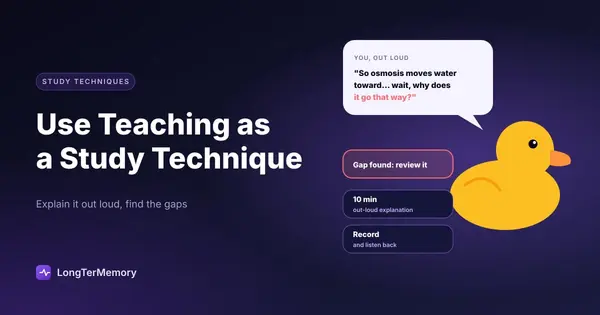
This one comes from software programming culture but works beautifully for any subject. Place an object in front of you, anything at all, and explain your material to it out loud as if it’s a person. The act of narrating your knowledge forces you to confront gaps you’d never notice on a silent review pass.
The reason this works is the same as all the other methods: saying things out loud engages different cognitive processes than reading silently. You have to organize your thoughts into complete sentences, decide what order to present things in, and notice when you lose the thread.
Study Groups with a Teaching Rotation
If you study with others, structure sessions so each person is responsible for teaching a different section. Not presenting a summary from notes, actually teaching it in their own words, fielding questions, giving examples. This creates genuine accountability. You cannot bluff your way through teaching like you can bluff through nodding during a lecture.
The person doing the teaching benefits more from the session than anyone else. That’s a useful fact to remember when you’re assigning sections to your group.
Forum and Online Community Teaching
Subject-specific Reddit communities, Discord servers, and study forums are full of people who have questions you can answer. Even if your answer is imperfect, the act of formulating a clear, useful response forces you to work through the material in a way that reading your own notes never will.
This has an added benefit: other people will correct you if you’re wrong. That feedback loop is incredibly valuable. Getting something wrong in a forum post, then having someone gently point out your error, is one of the fastest ways to lock in the correct understanding permanently.
Voice Memos and Self-Recording
Record yourself explaining a concept as if you’re making a study video. You don’t have to share it with anyone. The constraint of speaking clearly, covering everything, and not rambling forces you to organize your thoughts in a way that benefits retention.
When you listen back, you’ll immediately notice the points where you stumbled, where you qualified yourself with “I think,” or where you skipped over something that you actually don’t understand as well as you assumed. Those moments are your study agenda for next session.
Using Virtual Teaching Tools and Study Platforms
The internet has made it genuinely easy to find people who need what you know.
Study apps with peer features like some flashcard platforms allow you to share decks and answer other users’ questions. Answering even basic questions from others reinforces your own foundations in a subject.
Tutoring platforms are an underused option for advanced students. If you’re preparing for a professional certification, tutoring a younger student through the basics of the same field forces you to know those basics cold. It also pays, which is a nice side effect.
LongTerMemory is designed around this loop in a different way. When you generate Q&A flashcards from your study materials and review them through spaced repetition, you’re essentially becoming a question-asker for yourself. The app can serve as the “student” you’re teaching, surfacing what you actually know versus what you think you know. It’s a structured version of the same principle: you learn better when you’re actively producing answers rather than passively consuming material.
YouTube explainer videos, even private ones, are another option. The commitment to recording a clear explanation of a topic, even if nobody watches it, forces you to achieve the kind of clarity that only teaching demands.
What Happens When You Can’t Explain Something
This is the most valuable moment in any teaching session: the gap.
You’re explaining a concept, everything is going fine, and then you get to a certain point and the thread goes slack. You realize you can’t actually describe what happens next, or you don’t know why the thing is true, only that it is. Your explanation collapses into vague hand-waving.
That moment is a gift.
It’s a perfectly precise diagnosis of exactly where your understanding is incomplete. Not a general “I need to study more,” but a specific “I understand X up to this point, and then I lose it.” That specificity makes your follow-up studying dramatically more efficient. You don’t re-read the whole chapter. You go straight to the exact thing you couldn’t explain and you work on that.
Students who review without teaching rarely get this kind of specific feedback. Everything in a review session feels understood because everything is familiar. Teaching strips that comfort away and makes your actual knowledge visible.
Building Teaching Into Your Study Routine
You don’t need to restructure your whole approach to benefit from this. A few small additions can capture most of the advantage:
| After each study session | Quick practice |
|---|---|
| 10 minutes of out-loud explanation | Covers main concepts from the session |
| Rubber duck or phone recording | Forces complete sentences and organization |
| Forum post draft | Structures teaching for an external audience |
Weekly teaching sessions are even more powerful. Once a week, pick one topic from your current study material and commit to explaining it in full without notes. Time yourself. See how far you get before you have to stop and look something up. The gaps you find each week become your priority for the following week.
The students who use teaching as a study technique consistently describe a similar experience: it feels harder than regular reviewing, but the knowledge that comes from it feels different. Sturdier. More available when you actually need it.
That’s not a coincidence. Struggle is the signal that real encoding is happening. Easy review feels productive. Teaching that makes you uncomfortable actually is productive.
The Mindset Shift That Makes This Work
The biggest barrier to teaching as a study technique isn’t practical. Most people have ways to do it available to them. The barrier is psychological: it feels uncomfortable to teach something you’re not yet an expert in.
The reframe that helps most is this: you’re not teaching to demonstrate mastery. You’re teaching as a practice of mastery. The point is not to be perfect but to find out where you’re not perfect so you can fix it.
An imperfect explanation that reveals a gap is infinitely more valuable than a smooth review session that leaves the gap hidden.
Let yourself stumble. Let the explanation fall apart. Let the gaps show. That’s the whole point. When you go back to the source material and fill in what you couldn’t explain, the understanding you build is a different quality than anything passive review produces.
The Bottom Line
If you’re looking for a single change that would have the biggest impact on how well you learn and retain study material, teaching is a strong candidate.
It forces you to confront what you don’t know. It produces specific, actionable gaps rather than vague uncertainty. It organizes your thinking in a way that passive review never does. And the effort it requires is exactly the kind of desirable difficulty that makes memories last.
You don’t need a classroom. You don’t need students. You need a topic you’re trying to learn and the willingness to explain it out loud, imperfectly, until the gaps reveal themselves and the understanding deepens.
Start with your next study session. Pick one concept. Explain it to your coffee mug. Notice where you stumble. Go fix that thing. Then do it again.
That’s the whole technique. It’s simple, it’s uncomfortable, and it works better than almost anything else.