How to Prepare for the USMLE Step 3
A practical USMLE Step 3 study plan for busy residents: CCS strategy, clinical reasoning, and how to fit prep into residency.
Table of Contents
- What Step 3 Tests and How It Differs From Steps 1 and 2
- Fitting Step 3 Study Into Residency Year
- CCS Case Simulation Practice Alongside Multiple-Choice Prep
- How to Use UWorld for Step 3
- Spaced Repetition for Clinical Algorithms
- Managing Stress and Burnout During Step 3 Prep
- The Day Before and Day of the Exam
- How LongTerMemory Can Help With Step 3 Review
- Final Thoughts
By the time you sit for USMLE Step 3, you have already survived medical school, matched into residency, and passed two of the most demanding licensing exams in existence. Step 3 should feel like a victory lap. Instead, for many residents, it feels like one more mountain to climb while already exhausted.
The good news is that Step 3 is designed differently from Step 1 and Step 2 CK. It is less about isolated facts and more about clinical management over time. If you prepare strategically, you can pass without derailing your residency. The key is understanding what the exam actually tests and building a study plan that fits the reality of resident life.
What Step 3 Tests and How It Differs From Steps 1 and 2
Step 1 tested your foundation of basic science. Step 2 CK tested your clinical knowledge and decision-making. Step 3 tests something more practical: can you manage a patient safely and independently as an intern or early resident?
The exam is divided into two main days. Day 1 focuses on foundations of independent practice, which includes biostatistics, epidemiology, medical ethics, patient safety, and interpretation of clinical studies. Day 2 focuses on advanced clinical medicine, which includes diagnosis, management, and monitoring across all major specialties.
The biggest difference from earlier steps is the emphasis on sequential decision-making. Step 3 questions often ask what you would do next, then what you would do after that, then how you would follow up. The exam rewards a structured, safe approach to patient care more than rare diagnostic brilliance.
Here is a quick comparison:
| Exam | Main Focus | Question Style |
|---|---|---|
| Step 1 | Basic science mechanisms | Detailed recall and mechanisms |
| Step 2 CK | Clinical diagnosis and initial management | Vignette-based single best answer |
| Step 3 | Independent patient management and follow-up | Sequential clinical decision-making |
Understanding this shift changes how you study. You do not need to memorize every rare disease. You need to know the common diseases well, recognize danger, and manage patients over time.
Fitting Step 3 Study Into Residency Year
This is the hardest part. Residency does not leave much free time, and the time you do have is often fragmented and unpredictable. A traditional dedicated study period is usually not realistic, so your plan has to work around rotations.
The most effective approach is distributed study over several months. Aim for thirty to sixty minutes of focused review on most days, with longer blocks on lighter rotations or days off. This is far more effective than cramming in the weeks before the exam.
A realistic weekly structure might look like this:
| Day | Study Block | Focus |
|---|---|---|
| Monday | 45 minutes after work | UWorld questions, one block |
| Tuesday | 30 minutes | Review incorrect answers from Monday |
| Wednesday | 45 minutes | UWorld questions |
| Thursday | 30 minutes | CCS case practice |
| Friday | Light or off | Maintain Anki or spaced repetition deck |
| Saturday | 2 hours | Mixed review and weak area drilling |
| Sunday | 1 hour | Practice test or CCS cases |
Adjust based on your rotation. Inpatient months are brutal; accept lower daily volume and protect your weekends. Outpatient months offer more predictable schedules; use them to build momentum.
CCS Case Simulation Practice Alongside Multiple-Choice Prep
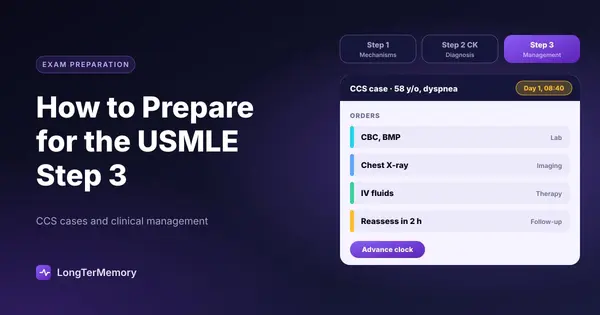
The Computer-Based Case Simulations, or CCS cases, are unique to Step 3 and cause anxiety for many residents. These cases present a patient scenario and ask you to order tests, treatments, and follow-up over simulated time. You manage the case as if you were the treating physician.
The key to CCS success is not knowing exotic treatments. It is knowing the routine workflow of common clinical scenarios. You need to know what orders to place initially, what to do with abnormal results, when to advance time, and when to change location.
Practice with the official USMLE Practice Materials and a commercial CCS case bank. Do not just watch videos. Actually click through cases yourself. The interface matters, and small mistakes like forgetting to advance time or not ordering follow-up labs can cost you.
Here are the most common CCS categories to master:
- Acute abdominal pain
- Chest pain and acute coronary syndrome
- Asthma or COPD exacerbation
- Diabetic ketoacidosis
- Hypertensive emergency
- Pregnancy complications
- Pediatric fever and common infections
- Psychiatric emergencies
For each category, know the initial workup, the immediate management, the monitoring plan, and the discharge criteria. If you can handle these common scenarios smoothly, you will be in good shape.
How to Use UWorld for Step 3
UWorld remains the gold standard question bank for Step 3, just as it was for Step 1 and Step 2 CK. Most residents benefit from doing one full pass, with a focused second pass on incorrect questions.
Do questions in timed, random mode when possible. This trains you to think under pressure and switch between topics, which is exactly what the exam requires. Read every explanation, even for questions you got right. The explanations are where the real learning happens.
Pay special attention to biostatistics and epidemiology. Step 3 tests these more heavily than Step 2 CK, and many residents feel rusty because these topics are not part of daily clinical work. Spend dedicated time on sensitivity, specificity, predictive values, number needed to treat, and study design interpretation.
Spaced Repetition for Clinical Algorithms
Spaced repetition is not just for medical school facts. It is also useful for Step 3, especially for algorithms, screening guidelines, and drug side effects that come up repeatedly.
Build or use a Step 3 deck that focuses on management algorithms. Cards should ask what to do next in a common clinical scenario, not just what a drug does. For example:
- “A 55-year-old man presents with stable chest pain. What is the next step in management?”
- “What are the current screening recommendations for colorectal cancer in average-risk adults?”
These cards force you to apply knowledge in a clinical context, which is what Step 3 rewards.
Managing Stress and Burnout During Step 3 Prep
Step 3 preparation happens during one of the most demanding periods of your medical career. It is normal to feel tired, overwhelmed, or behind. What matters is protecting your capacity over the long run.
Sleep is non-negotiable. Research consistently shows that sleep deprivation devastates memory consolidation and clinical reasoning. You are better off studying less and sleeping more than cramming into exhaustion.
Exercise, even briefly, helps manage stress and improves focus. Social connection matters too. Isolating yourself to study more often backfires because it increases anxiety without improving retention.
If your program offers study leave, use it strategically. A few days of protected time right before the exam, focused on review and CCS practice, is usually more valuable than trying to take large blocks of time months in advance.
The Day Before and Day of the Exam
The day before Step 3 should be light. Review your notes briefly, do a few CCS cases to stay familiar with the interface, and get to bed early. Do not try to learn new material. Your brain needs to consolidate what it already knows.
On exam day, trust your preparation. Step 3 is long and tiring. Take your scheduled breaks, eat real food, and stay hydrated. Many residents report that Step 3 feels harder than it is because of fatigue, not because of content difficulty.
How LongTerMemory Can Help With Step 3 Review
Finding time to create study materials during residency is genuinely hard. LongTerMemory can generate active recall cards from your UWorld notes, textbook chapters, or rotation guides automatically. This means you can spend your limited study time reviewing and applying knowledge instead of formatting flashcards.
For Step 3 specifically, the AI-generated cards can focus on clinical reasoning, management algorithms, and CCS-style scenarios. That matches the exam better than isolated fact memorization. If you are trying to fit Step 3 prep into an already packed schedule, automating the card creation step is a meaningful time saver.
Final Thoughts
USMLE Step 3 is the last major hurdle on the path to independent medical practice. It is not easy, but it is also not designed to trap you. The exam wants to know whether you can manage common clinical situations safely and follow patients over time.
Prepare consistently, prioritize the clinical reasoning skills the exam rewards, and protect your wellbeing during residency. Use spaced repetition for algorithms, practice CCS cases actively, and make UWorld your primary learning tool. With the right plan, you can pass Step 3 and move forward in your career without sacrificing your health or your sanity.