What Is Active Studying? Definition, Benefits, and Techniques
Active studying means producing information, not just consuming it. Here's what it is, why it works, and five techniques to start using today.
Table of Contents
- The Core Definition: Production vs. Consumption
- Why Passive Studying Feels So Convincing
- The Science Behind Why It Works
- Five Active Studying Techniques You Can Start Using Today
- 1. The Blank Page Method
- 2. Self-Quizzing and Flashcards
- 3. The Feynman Technique
- 4. Practice Problems and Past Exams
- 5. Teach It Out Loud
- How to Transition From Passive to Active Studying
- Active Studying vs. Active Learning: What's the Difference?
- A Note on Combining Active and Passive Study
- Frequently Asked Questions About Active Studying
If you’ve ever spent two hours reading a chapter and then realized you couldn’t summarize a single paragraph from memory, you already understand the problem with passive studying, even if you didn’t have a name for it yet.
Active studying is the opposite of that. It’s the practice of engaging with material in a way that forces your brain to work, rather than just glide over information and feel like something is sinking in. Once you understand the difference between active and passive study, you will look back at the way you used to study and wonder how you got anything done at all.
This article explains what active studying actually is, why it works so much better than passive review, and gives you five concrete techniques you can use immediately, whatever subject you’re tackling.
The Core Definition: Production vs. Consumption
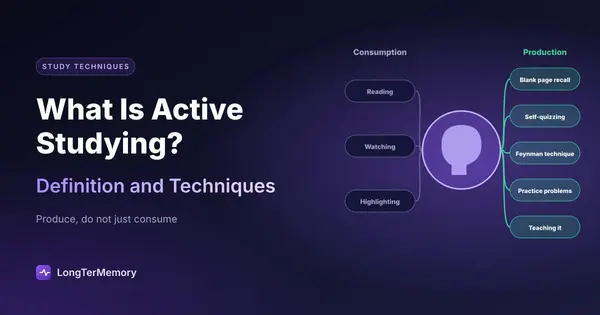
The simplest way to define active studying is this: it’s any study activity where you produce information rather than consume it.
When you read your textbook, you are consuming. When you re-read your highlighted notes, you are consuming. When you watch a lecture video, you are consuming. None of these activities require your brain to do much. You recognize things. You nod along. You feel like you understand. But recognition and understanding are not the same thing as knowing, and that distinction becomes painfully obvious the moment a blank exam page is in front of you.
Active studying forces production. You answer questions before you look at the answers. You write out what you remember without looking at your notes. You explain a concept out loud in your own words. You attempt problems without the worked solution visible. These activities require your brain to retrieve information, construct it, and output it. And that process, as frustrating as it can feel in the moment, is what actually builds durable memory.
Why Passive Studying Feels So Convincing
If passive studying works so poorly, why do most people default to it?
The answer is a phenomenon cognitive scientists call the fluency illusion. When you re-read something, it starts to feel familiar. That familiarity is pleasant and it reads as understanding. Your brain says, “I recognize this, so I must know it.” But recognition and recall are completely different cognitive skills.
You can recognize a face without being able to name the person. You can recognize a song without being able to hum it from scratch. You can recognize a concept in your notes without being able to explain it to anyone, or retrieve it on a test.
Highlighting has the same problem, arguably worse. Underlining important sentences requires almost no cognitive effort. It gives your hands something to do, which creates a feeling of engagement, but the mental work is essentially zero. Research on highlighting consistently shows it has minimal benefit for actual retention. You’re essentially creating an aesthetically pleasing version of your notes without learning anything from the process.
Active studying removes the fluency illusion because it doesn’t let you coast on recognition. You either know something well enough to produce it, or you don’t, and you find out immediately.
The Science Behind Why It Works
The cognitive science behind active studying is well-established and consistent. The two main mechanisms are retrieval practice and generation effect.
Retrieval practice refers to the act of pulling information out of your memory. Research going back over a century shows that the act of retrieval itself strengthens the memory trace in a way that passive review simply doesn’t. Every time you successfully recall something, you make it slightly easier to recall next time. The memory becomes more accessible, more durable, and more resistant to forgetting.
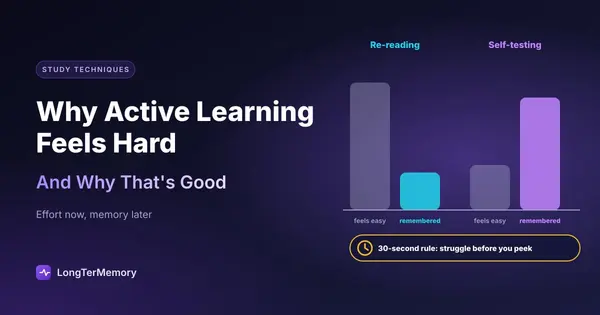
A landmark study by Karpicke and Roediger (2008) demonstrated this starkly. Students who studied using retrieval practice retained about 80% of the material a week later. Students who studied the same material by re-reading retained about 33%. Same study time, dramatically different outcomes. That kind of gap doesn’t happen by accident.
The generation effect is related but distinct. When you generate information rather than receive it, you remember it better. Writing your own question about a concept encodes it more deeply than reading a pre-written question. Explaining something in your own words creates a stronger memory trace than reading an explanation someone else wrote. The effort of construction is part of what makes it stick.
Together, these two mechanisms explain why active studying is not just marginally better than passive review. It’s categorically different in how it engages your brain.
Five Active Studying Techniques You Can Start Using Today
1. The Blank Page Method
After reading a section of material, close everything and write down everything you can remember. Not a summary, literally everything: concepts, definitions, examples, connections you noticed, anything your brain holds onto.
Then open your notes and check what you missed. The gaps you find are your study priorities for the next session.
This method is uncomfortable the first time you try it, because your mind goes blank faster than you expect. That blankness is exactly the point. Working through it, forcing your brain to search for what’s there, is where the real encoding happens. Resist the urge to peek before you’ve genuinely tried.
2. Self-Quizzing and Flashcards
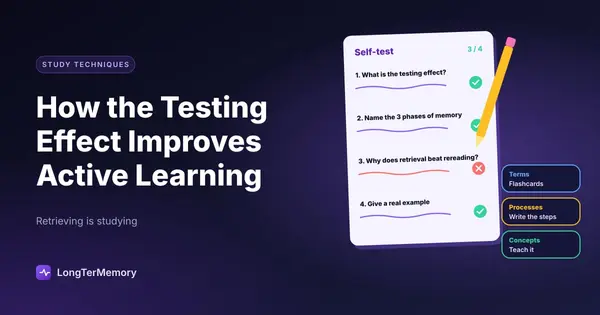
Turn your notes into questions. Every definition becomes a “What does X mean?” question. Every process becomes a “What are the steps of X?” question. Every cause-effect relationship becomes a “Why does X lead to Y?” question.
Then test yourself on those questions before looking at the answers. When using flashcards, commit to an answer in your head before flipping the card. Getting a question wrong is not failure, it’s data. You’ve just identified something your brain hasn’t consolidated yet.
LongTerMemory is particularly useful for this approach. You can upload your study notes as a PDF, and the platform automatically generates Q&A flashcard pairs from the content. It then uses spaced repetition to schedule when you see each card again, showing you things you got wrong more frequently and spacing out review of things you know well. For subjects with heavy conceptual vocabulary, this kind of automated scheduling is a significant time saver.
3. The Feynman Technique
Pick a concept. Grab a piece of paper. Explain it as if you’re teaching it to someone who has no background in your subject. Use plain language. Use analogies. Avoid jargon.
When you hit a point where you can’t explain something simply, you’ve found a gap in your understanding. That’s not embarrassing, it’s useful. Go back to the source material, fill in that specific gap, and then return to your explanation.
The Feynman Technique works because explaining forces a kind of intellectual honesty that passive review lets you avoid. Vague understanding sounds fine in your head. Vague understanding collapses immediately when you try to put it into plain words for someone else.
4. Practice Problems and Past Exams
For subjects with quantitative or applied components, nothing replaces doing problems. Not reading worked examples, not watching someone else solve them, actually sitting down with a blank problem and working through it yourself.
If your subject has past exam papers available, work through them under realistic conditions: timed, without notes, treating it as close to the real thing as possible. Then review every single mistake carefully. Don’t just check the correct answer and move on. Understand exactly why you went wrong and what concept the question was actually testing.
For subjects where you’re creating your own practice questions, the act of writing the question is itself an active studying technique. Figuring out what makes a good test question forces you to think deeply about the structure of the material.
5. Teach It Out Loud
Explain your material to someone else, or to no one in particular. Talk through a concept to a friend, a study partner, a family member, your pet. The specific audience matters less than the act of converting your understanding into spoken words.
When you have to speak something aloud, you have to organize it. You have to sequence ideas. You have to notice when your explanation is circular or unclear. All of that friction is the signal that active learning is happening.
If you explain something and the person you’re talking to looks confused, that’s feedback. If you explain something and lose the thread midway, that’s feedback too. Use it.
How to Transition From Passive to Active Studying
If you’ve spent years studying passively, shifting to active methods feels harder than it actually is. The discomfort is real at first, because active studying feels less productive than passive studying, even though the opposite is true.
Here’s a practical way to make the transition:
Start small. At the end of each reading session, spend five minutes doing a blank-page recall before you close your notes. That’s it to start. Once that becomes habitual, add a self-quizzing component. Then gradually extend your active practice time as the passive time shrinks.
Reframe discomfort as signal. When active studying feels hard, when you can’t remember something, when you struggle to explain a concept, that difficulty is not a sign that you’re studying poorly. It’s a sign that your brain is working. Cognitive scientists call this desirable difficulty: the kind of struggle that produces real learning.
Track your gaps explicitly. Keep a running list of concepts you consistently get wrong or can’t explain clearly. That list is your most valuable study resource. The material you know well doesn’t need your attention. The material on that list does.
Active Studying vs. Active Learning: What’s the Difference?
These terms are sometimes used interchangeably, but there’s a useful distinction.
Active learning typically refers to instructional approaches used in classrooms, group discussions, project-based learning, problem-solving in class, peer teaching, and similar structures.
Active studying is what you do on your own, outside of class, to prepare for exams or retain material. It’s the individual-level application of the same principles.
Both rely on the same cognitive science. Both work better than passive consumption. The distinction is mainly one of context: active learning happens in educational settings, active studying happens in your room at your desk or in the library with your notes.
A Note on Combining Active and Passive Study
Active studying doesn’t mean you never read. You have to acquire information before you can retrieve it. Passive input is necessary, it’s just not sufficient.
Think of it as a ratio. For every hour you spend reading and taking in new information, you should spend roughly equal time, or more, on active practice. The exact proportion depends on the subject and your current knowledge level, but a 50/50 split is a reasonable starting point.
The shift most students need to make is not to eliminate passive study, but to stop letting passive study dominate their time while convincing themselves they’re working hard. Reading feels like studying. Active recall actually is studying.
Frequently Asked Questions About Active Studying
What is an example of active studying? Closing your textbook after reading a section and writing down everything you remember on a blank page, then checking your notes for what you missed. Any activity where you produce an answer rather than recognize one counts.
Is active studying better than re-reading? Yes, and the research gap is large. In the Karpicke and Roediger study mentioned above, retrieval practice roughly doubled retention compared to re-reading after one week. Re-reading builds familiarity, not recall.
How long should an active study session be? Long enough to be uncomfortable, short enough to be repeatable. Ten to twenty minutes of focused retrieval practice per topic is a realistic starting point. Consistency across days matters more than any single marathon session.
Can you use active studying for any subject? Yes. For conceptual subjects, use self-quizzing and the Feynman Technique. For quantitative subjects, use practice problems and past exams. For language learning, use flashcards with retrieval before you flip the card. The format changes, the principle stays the same.
The definition of active studying is simple: produce, don’t just consume. The execution is a habit you build, one session at a time. Start with the blank page method after your next reading session. Write down what you remember. See what’s there. See what isn’t.
That gap between what you think you know and what you can actually recall is the most honest feedback your study practice can give you. And once you start closing it systematically, you’ll never go back to highlighting alone.