Why Active Learning Feels Hard (And Why That's a Good Sign)
Discover why the difficulty of active learning is evidence that real learning is happening, and how to use productive struggle to study smarter and retain more.
Table of Contents
- The Fluency Trap
- What Desirable Difficulty Actually Means
- The Testing Effect: Why Testing Yourself Is a Learning Act
- Why Blanking Feels Like Failure (But Isn't)
- How to Tell Productive Struggle from Genuine Confusion
- Practical Ways to Embrace Productive Difficulty
- Implement a 30-Second Rule
- Use Interleaved Practice
- Generate Before You Read
- Introduce Spacing When Material Feels Comfortable
- Reflect on What Felt Difficult
- Reframing Your Relationship with Difficulty
Here’s a frustrating experience that most students have had: you switch from re-reading your notes to actually testing yourself, and suddenly everything feels harder. You can’t remember things you were sure you knew. The process is slow and uncomfortable. You start to wonder whether you’re actually learning anything, or whether you’re just bad at this.
And then you go back to re-reading, which feels smooth and effortless and familiar. You feel productive again. You feel like the material is going in.
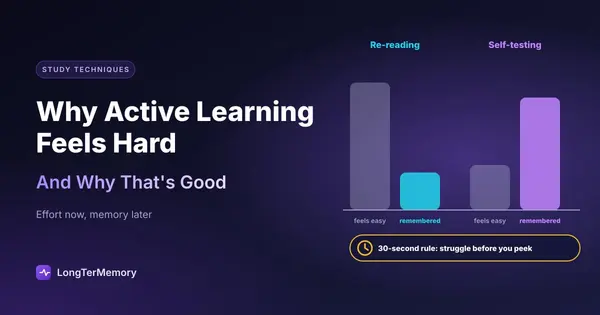
The problem is that your brain is lying to you. The smooth, effortless feeling of re-reading is not learning. The difficult, uncomfortable struggle of testing yourself is. And the frustrating experience of blanking on things you thought you knew is not evidence of failure. It’s evidence that real encoding is happening.
The difficulty is the point. Here’s the science behind why, and how to use it to your advantage.
The Fluency Trap
When you re-read material, especially material you’ve already seen once, it starts to feel familiar. That familiarity has a particular quality: it feels like understanding. Your eyes move smoothly over the text, recognition fires in your brain, and the whole experience has a pleasant “clicking into place” quality.
Cognitive scientists call this the fluency illusion, and it’s one of the most persistent and damaging biases in education. Fluency (how smoothly information is processed) is easy to confuse with mastery (whether you actually know it deeply enough to retrieve and use it). These two things feel similar from the inside but are completely different from a learning standpoint.
Recognition and recall are different skills. You can recognize the right answer when you see it on a multiple-choice test without being able to recall it independently. You can re-read a paragraph and feel like you “know” it without being able to reproduce its content on a blank page. Passive study builds recognition. Only active study builds recall.
And recall is almost always what matters. In an exam, you have a blank page and a question. In a real professional situation, you have a problem and need to retrieve relevant knowledge. Recognition ability doesn’t get you there. Recall does.
What Desirable Difficulty Actually Means
Robert Bjork, a learning psychologist at UCLA, introduced the term “desirable difficulties” to describe a counterintuitive finding: conditions that make learning feel harder in the short term consistently produce better long-term retention and transfer.
The key word is “desirable.” Not all difficulty is useful. Confusion about what you’re supposed to be learning is undesirable. A textbook written in incomprehensible jargon creates undesirable difficulty. Technological barriers that interrupt access to material create undesirable difficulty.
Desirable difficulty is the cognitive effort required to retrieve, organize, and apply knowledge. It’s the struggle of trying to remember something before you check. The discomfort of generating an answer rather than recognizing one. The friction of making connections between ideas rather than reading a summary of those connections.
These difficulties feel bad. They feel like you’re doing poorly. They can feel discouraging. But they are doing something extraordinarily valuable: they are forcing your brain to work harder, and that work is what produces durable memories.
The Testing Effect: Why Testing Yourself Is a Learning Act
The most well-supported finding in educational psychology is the testing effect, also called the retrieval practice effect. The research on this is unusually consistent for a social science: across hundreds of studies, across different ages, subjects, and contexts, the finding is the same. Testing yourself on material produces better long-term retention than spending the same time studying the material passively.
This surprises most people, because tests are typically thought of as assessments of learning, not as learning itself. You study, and then you’re tested to see if you studied well. But that’s not how it actually works in the brain.
Every time you successfully retrieve a piece of information, you don’t just demonstrate that it’s there. You strengthen the memory trace. You make it more durable, more accessible, more resistant to forgetting. The act of retrieval is itself a form of encoding.
And the effort matters. The harder the retrieval, the stronger the memory strengthening. A question you had to really work for before getting right produces a stronger memory than a question you got right instantly. This is why struggling with a flashcard and eventually getting it right is more valuable than breezing through one you already know.
This also explains why cramming the night before an exam produces such poor long-term retention. Cramming works on recognition: you flood yourself with material right before the test, so it’s all still in short-term memory when you sit down. But retrieval from short-term memory is easy and produces almost no strengthening of long-term memory traces. A week later, almost all of it is gone.
Why Blanking Feels Like Failure (But Isn’t)
One of the most psychologically difficult parts of active studying is the moment you try to retrieve something and go blank. Your mind reaches for the information and comes back empty. In that moment, every instinct says: “I haven’t learned this. I need to go back and re-read it.”
Here’s what’s actually happening in your brain when you go blank: your hippocampus is trying to locate a memory trace that is either very weak or not yet consolidated. The retrieval attempt, even if it fails, sends a signal: “This information is needed. Find it or strengthen it.” When you then see the correct answer, the contrast between the failed retrieval and the correct answer produces a particularly strong encoding event.
The German word for this is “generation effect”: information you try to generate, even unsuccessfully, is remembered better than information you simply read. The failed attempt followed by the correct answer is more effective than just reading the answer without the preceding effort.
Blanking is not a sign that you haven’t learned. It is an active part of the learning process. The discomfort of not knowing, followed by the relief of seeing the correct answer, is one of the most effective memory events your brain can have.
How to Tell Productive Struggle from Genuine Confusion
Not all difficulty is productive. The desirable difficulty research describes the difficulty of retrieval and generation, not the difficulty of trying to understand material that hasn’t been explained clearly enough.
Here’s a practical way to distinguish them:
Productive struggle looks like:
- You know you’ve encountered this material before, but you can’t immediately recall it
- You can identify the domain or category the answer belongs to, even if you can’t retrieve the specific answer
- When you see the correct answer, it “clicks” with existing knowledge
- The discomfort is about retrieval, not comprehension
Genuine confusion looks like:
- You genuinely don’t know what the question is asking
- When you see the correct answer, it doesn’t connect to anything you know
- The material feels foreign, not just hard to retrieve
- The difficulty is at the level of understanding, not memory
When you identify genuine confusion, the right response is to go back to the source material and build the understanding. Re-reading is appropriate here, because you haven’t yet understood the concept well enough to retrieve it. Active recall on concepts you’ve never understood in the first place is genuinely premature.
But if the difficulty is at the retrieval level, and most of the difficulty students experience falls into this category, push through it. The struggle is productive.
Practical Ways to Embrace Productive Difficulty
Knowing that struggle is good for learning is one thing. Actually tolerating it in practice is another. Here are concrete techniques for making productive difficulty a regular part of your study routine.
Implement a 30-Second Rule
When you hit a flashcard or a question and your mind goes blank, set a 30-second timer before you look at the answer. Most students wait about 3-5 seconds before peeking. The additional 25 seconds of retrieval effort dramatically increases the encoding benefit of seeing the correct answer.
This one change, just waiting longer before checking, can substantially improve the effectiveness of a flashcard session with zero additional time investment.
Use Interleaved Practice
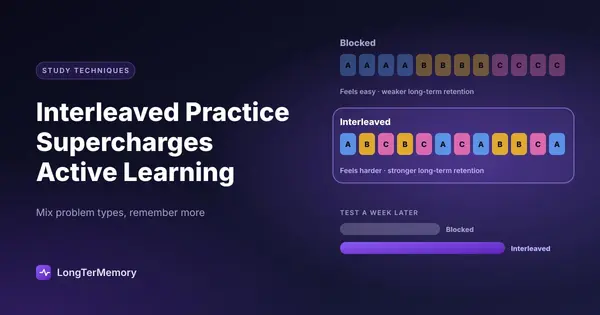
Instead of studying one topic until you feel comfortable and then moving to the next (blocked practice), mix topics together (interleaved practice). This is more difficult and produces less immediate performance, but it produces dramatically better long-term retention and transfer.
Why? Because when topics are mixed, you can’t rely on context cues to retrieve the answer. You have to actually identify what kind of problem this is before you can solve it, which is exactly the situation you face in a real exam.
Interleaving feels harder. Students often rate interleaved practice as less effective immediately after, but perform significantly better on delayed tests. If your practice feels almost too easy, you’re probably blocking too much.
Generate Before You Read
When you’re about to study a new concept, before reading the explanation, take 60 seconds to write down everything you already know or think you know about it. Even if your initial knowledge is wrong or minimal, the generation attempt primes your brain for the incoming information.
This is why the classic study advice of “preview the chapter before reading it” works: questions at the end of a chapter, skimmed before reading, activate retrieval attempts that make the subsequent reading more effective.
Introduce Spacing When Material Feels Comfortable
Spacing, studying material at increasing intervals rather than in concentrated blocks, introduces desirable difficulty by ensuring that memories have partially faded before you review them. Reviewing something you perfectly remember produces little benefit. Reviewing something you almost remember but have to work a bit to retrieve produces significant benefit.
Spaced repetition systems do this automatically. If you’re using a tool like LongTerMemory that schedules reviews based on your performance, you’ll naturally experience the pattern of reviewing material just as it starts to feel a little uncertain. That feeling of “I almost have this,” combined with the retrieval effort, is exactly where the memory strengthening happens.
Reflect on What Felt Difficult
After each study session, spend 3-5 minutes noting what felt most difficult. Not to beat yourself up about it, but to guide your next session. The material that felt hardest is the material that needs the most retrieval practice. The material that felt easy probably needs less attention.
Most students do the opposite: they spend more time on what they feel good at (because it’s pleasant) and avoid what’s difficult (because it’s uncomfortable). This is exactly backwards. Your study time should be weighted toward your weak areas, not your strong ones.
Reframing Your Relationship with Difficulty
One of the most important things you can do for your long-term development as a learner is to change how you interpret difficulty. Most people, trained by years of education that rewards smooth performance, interpret cognitive difficulty as a sign of poor learning. They feel bad when they blank on a question. They feel anxious when retrieval is slow. They interpret struggle as evidence that they haven’t studied enough or aren’t smart enough.
These interpretations are not just inaccurate. They’re actively damaging, because they push people toward easier, more comfortable, less effective study methods.
The reframe is simple but powerful: difficulty is a signal that learning is happening. The struggle to retrieve, to generate, to connect, is the mechanism through which memories are formed and strengthened. Easy retrieval means the work has already been done. Difficult retrieval is where the work gets done.
Students who internalize this reframe make very different decisions about how to study. They don’t reach for re-reading when testing gets uncomfortable. They push through the discomfort with the knowledge that the discomfort is the point. They set their 30-second timer and wait. They interleave their topics even when blocked practice feels better. They review material that has partially faded rather than material that still feels fresh.
These are the students who outperform on exams. Not because they’re naturally smarter, but because they’ve stopped avoiding the difficulty that produces learning and started deliberately seeking it.
If your study sessions feel hard, good. That’s the sound of your brain building something durable.