How Working Memory Capacity Affects Your Study Strategy
Working memory holds only about 4 chunks at once. Learn how that limit shapes studying, how to spot overload, and study designs that work within it.
Table of Contents
- What Working Memory Is
- How Your Mental Workspace Limits What You Can Process at Once
- The capacity limit: four, not seven
- The duration limit: seconds, not minutes
- What overload feels like
- Capacity varies, and it varies day to day
- Reducing Cognitive Load to Free Up Space for Learning
- 1. Offload to paper
- 2. Put related information together
- 3. Use two channels, not one
- 4. Remove distractions completely
- 5. Make the basics automatic
- Study Design Strategies When Your Capacity Is Limited
- Chunk the material before you study it
- Pre-train the vocabulary
- Start with worked examples, then fade them
- Space sessions and keep them short when the material is hard
- Turn lists into structures
- Adjust your strategy to your situation
- Can You Increase Working Memory Capacity?
- Frequently Asked Questions
- How many items can you hold in mind at once?
- How does this limit affect learning?
- What are signs of mental overload while studying?
- Do brain-training apps improve grades?
- Free Up Mental Space for the Hard Parts
- The Bottom Line
Working memory capacity is the small amount of information you can hold and manipulate at once, about four meaningful chunks for most adults, and it’s the bottleneck of every study session. When new material exceeds it, you stop learning and start copying. The fix is not to “try harder” but to design studying around the limit: break material into small pieces, write things down instead of juggling them in your head, use worked examples, build up the basics until they’re automatic, and remove anything that competes for attention, including your phone.
Have you ever read the same paragraph four times and still not been able to say what it was about? Or followed every step of a lecture, then stared blankly at the first homework problem? That’s not laziness or a lack of intelligence. It’s a full mental workspace.
Understanding this one limit changes how you study. It explains why some sessions feel productive and others feel like pouring water into a full glass, and it points directly to what to change.
What Working Memory Is
Working memory is your mind’s workspace: the system that holds information for a few seconds while you think with it. It’s different from long-term memory, which is vast and durable. It is tiny and temporary, and everything you learn has to pass through it first.
The most influential model comes from Alan Baddeley and Graham Hitch (1974), later updated by Baddeley (2000). It describes four components:
| Component | What it does | Study example |
|---|---|---|
| Phonological loop | Holds sounds and words, rehearsed like an inner voice | Repeating a definition to yourself |
| Visuospatial sketchpad | Holds images, positions and layouts | Picturing a diagram of the heart |
| Central executive | Directs attention, switches between tasks | Deciding which formula to apply |
| Episodic buffer | Combines information into scenes and links it to long-term memory | Connecting a new concept to an example you already know |
The two “storage” systems (sound and image) are partly separate. That matters, as you’ll see below, because it means you can sometimes use both at once without overloading either.
How Your Mental Workspace Limits What You Can Process at Once
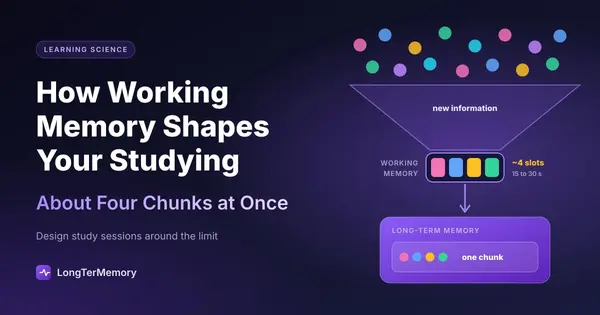
Most adults can actively hold about four chunks of information at once, and without rehearsal that information fades within roughly 15 to 30 seconds. These two limits, size and duration, shape everything about learning.
The capacity limit: four, not seven
George Miller’s famous 1956 paper suggested people can hold “seven, plus or minus two” items. Later research refined that number downward. In an influential 2001 review, Nelson Cowan concluded that when people can’t rehearse or group items, capacity is about 3 to 5 chunks, with 4 a common estimate.
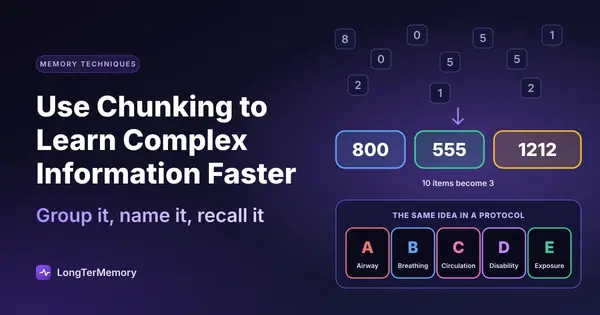
The key word is chunk. A chunk is any unit your long-term memory already recognizes. “F, B, I, C, I, A” is six letters for a child but two chunks for most adults (FBI, CIA). That’s why experts seem to have bigger working memories: they don’t, but their chunks are larger.
The duration limit: seconds, not minutes
In a classic 1959 experiment, Lloyd and Margaret Peterson asked people to remember three consonants while counting backwards to prevent rehearsal. After 18 seconds, recall dropped to about 10%. Information held this way either gets rehearsed, gets linked to long-term memory, or disappears.
What overload feels like
| Sign | What’s happening |
|---|---|
| Rereading the same sentence without absorbing it | Too many new terms in a row |
| Following a solution but unable to reproduce it | Each step occupied all your capacity, nothing was stored |
| Losing track of a long calculation | Too many intermediate results held in your head |
| Feeling foggy after 20 minutes of a dense chapter | Constant overload, not lack of motivation |
| Forgetting the question while reading the answer options | The question itself used up your capacity |
Capacity varies, and it varies day to day
Working memory capacity differs between people, and it’s linked to reading comprehension, reasoning and academic performance. But your available capacity also varies by situation:
- Stress and anxiety take up capacity with worry, which is one reason test anxiety lowers scores (Sian Beilock’s research on “choking under pressure” shows this clearly in math).
- Poor sleep reduces attention and working memory performance the next day. See our guide on taking an exam after poor sleep.
- Your phone. In a 2017 study by Ward and colleagues, participants with their phone on the desk, even face down and silent, performed worse on memory and attention tasks than those whose phone was in another room.
- ADHD and some learning differences are associated with lower working memory capacity, which makes the strategies below especially valuable.
Reducing Cognitive Load to Free Up Space for Learning
Every study activity uses this limited space, and the goal is to spend it on understanding the material, not on searching, decoding, multitasking or holding things you could write down. Researchers call this managing cognitive load.
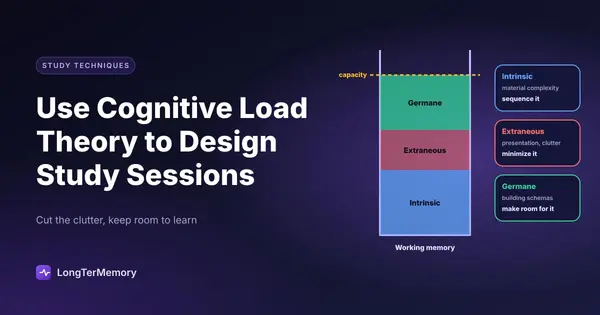
John Sweller’s cognitive load theory splits this mental demand into three kinds: the difficulty of the material itself (intrinsic), the waste created by poor presentation (extraneous), and the effort of actually building understanding (germane). We covered the full theory in our guide on using cognitive load theory to design better study sessions. Here, let’s focus on the practical moves that free up capacity.
1. Offload to paper
Anything you’re holding in your head “so you don’t forget” is using a slot. Write intermediate steps, keep a list of open questions, sketch the diagram. Paper is unlimited working memory.
2. Put related information together
When a diagram and its explanation sit on different pages, you spend capacity flipping and matching. Sweller called this the split-attention effect. Annotate the diagram directly, or rewrite notes so labels sit next to the parts they describe.
3. Use two channels, not one
Because sound and images are partly separate in working memory, a diagram with a spoken explanation can be easier to process than a diagram with a wall of text. This is the core of dual coding. But don’t read the same text you’re hearing; redundant information adds load instead of reducing it.
4. Remove distractions completely
Task switching is expensive. Every time you check a notification, the central executive has to reload the task. Phone in another room, one tab open, notifications off.
5. Make the basics automatic
The most powerful way to expand effective capacity is to move knowledge into long-term memory, where it no longer needs active effort to hold it. A student who has to recall what “derivative” means while solving a calculus problem has less room for the problem itself. This is exactly what spaced repetition is for: making vocabulary, definitions and formulas automatic so they become single chunks.
Study Design Strategies When Your Capacity Is Limited
When your mental workspace is the constraint, design sessions with smaller steps, fewer simultaneous new elements and more guidance early on. These strategies work for everyone, and they matter most for difficult new topics, tired days and students with lower capacity.
Chunk the material before you study it
Break a chapter into sections that introduce no more than three or four new ideas each. Learn one section, close the book, explain it from memory, then move on. Each closed-book recall moves the chunk into long-term memory and frees space for the next one.
Pre-train the vocabulary
Before a dense chapter, learn its 10 to 15 key terms on their own. Research on pre-training by Richard Mayer and colleagues shows that learning the names and characteristics of key components first makes later explanations easier to follow, because each term arrives as one chunk instead of an unknown.
Start with worked examples, then fade them
For problem-solving subjects, studying worked examples beats solving problems from scratch for beginners, a finding known as the worked example effect. Then fade the guidance gradually:
| Stage | What you do | Load on working memory |
|---|---|---|
| 1 | Study a complete worked example, explain each step | Low |
| 2 | Complete a partially worked example (last steps missing) | Medium |
| 3 | Solve a similar problem alone | Higher |
| 4 | Solve a mixed set of different problems | Highest |
Important twist: as you get better, worked examples stop helping and can even get in the way. This is the expertise reversal effect. Move on once the steps feel obvious.
Space sessions and keep them short when the material is hard
Overloaded working memory doesn’t recover by pushing through. For hard material, 25 to 45 minute blocks with short breaks usually beat a three-hour marathon. Spacing your reviews across days also helps, because each review is lighter once part of the material is already stored.
Turn lists into structures
A list of 12 unrelated facts is 12 chunks. The same facts in a table with 3 rows and 4 columns can be held as one structure. Concept maps, comparison tables and timelines all reduce load by giving facts a shape.
Adjust your strategy to your situation
| Situation | What to change |
|---|---|
| Brand-new, dense subject | Pre-train terms, worked examples, short sections |
| Tired, stressed or short on sleep | Review known material, don’t start new hard topics |
| Exam soon, lots of facts | Spaced flashcards to automate facts, then mixed practice |
| Problem-solving under time pressure | Practice until procedures are automatic, write every intermediate step |
| ADHD or attention difficulties | Smaller tasks, external checklists, body doubling, timers |
Can You Increase Working Memory Capacity?
Probably not in a general way: brain-training games make you better at the game but show little transfer to reading, reasoning or exam performance. A 2013 meta-analysis by Monica Melby-Lervåg and Charles Hulme found that working memory training produced short-term gains on similar tasks but no convincing transfer to broader skills, and later reviews reached similar conclusions.
What does work is increasing what each slot can carry. Experts don’t have a bigger workspace, they have richer chunks stored in long-term memory. Every definition you automate, every pattern you recognize at a glance, every formula you know cold frees capacity for the parts of the problem that actually need thinking. In practice, that means knowledge is the best working memory upgrade there is.
Frequently Asked Questions
How many items can you hold in mind at once?
Most adults can actively hold about 4 chunks when they can’t rehearse or group items. Miller’s classic “7 plus or minus 2” is now considered an overestimate for unrelated items.
How does this limit affect learning?
All new information passes through working memory before it’s stored. When the material exceeds its capacity, learners can follow along but fail to store or apply what they saw.
What are signs of mental overload while studying?
Rereading without understanding, following a solution but not being able to reproduce it, losing track of multi-step problems and feeling mentally foggy after a short time on dense material.
Do brain-training apps improve grades?
The evidence says no for most people. Training improves performance on the trained tasks, but transfer to academic skills is weak. Building knowledge through retrieval practice and spaced repetition is more effective.
Free Up Mental Space for the Hard Parts
Every fact you have to look up or reconstruct mid-problem steals a slot from the thinking the exam actually rewards. Automating the basics is the most reliable way to make room.
LongTerMemory does the heavy lifting. Upload your notes, slides or textbook PDFs, and it turns them into question and answer cards automatically, then schedules them with spaced repetition so definitions, formulas and key facts move into long-term memory and stay there. You skip the hours of manual card writing, and your attention gets to focus on understanding and problem-solving. Start the free trial with the subject that makes you feel the most overloaded.
The Bottom Line
Your working memory is small and fast-fading, and no amount of willpower changes that. What you can change is how you study: smaller chunks, notes on paper instead of in your head, worked examples before independent problems, no phone on the desk, and spaced review that turns new facts into automatic knowledge. Study within the limit, and the limit stops being the reason sessions feel impossible.
LongTerMemory Team
LongTerMemory editorial team
The team that builds LongTerMemory, the AI study app that turns your own PDFs, slides and notes into practice questions and schedules them with spaced repetition. We write about study methods and learning science, and we link the research behind our advice.