How to Review Today's Material Tomorrow Without Re-Reading
Skip the re-read. Learn why the first review matters so much, how to run a 15-minute next-day recall session, and how to make it part of your daily routine.
Table of Contents
- Why the 24-Hour Review Pays Off So Much
- Active Recall Is the Only Next-Day Review Worth Your Time
- Re-Reading vs Retrieving, Side by Side
- The 15-Minute Session, Step by Step
- Prepare Tonight So Tomorrow Is Easier
- What If You Remember Almost Nothing?
- Building Next-Day Review Into Your Daily Routine
- Attach It to Something You Already Do
- Do It Before New Material
- Give It Time to Become Automatic
- Connect It to Later Reviews
- Common Mistakes to Avoid
- Let the Schedule Take Care of Itself
- FAQ
- Can I do the review the same evening instead?
- How long should the session last?
- Is it ever okay to re-read?
- What if I missed a day?
- Does this work for math and problem-based subjects?
- Do I need flashcards?
- The Bottom Line
To review today’s material tomorrow without re-reading it, leave your notes closed, write down everything you remember for five minutes, answer a few questions from memory, and only then open the source to check. The whole thing takes about 15 minutes. It tells you exactly what stuck and what didn’t, and it strengthens the memory far more than another pass through the same pages.
Most of us do the opposite. We sit down the next morning, open yesterday’s notes and read them again. Everything looks familiar, we nod along, and we move on feeling prepared. Then the exam arrives and that familiarity turns out to be worth very little.
This guide explains why the first review deserves so much of your attention, why it has to be retrieval, and how to build it into a normal day, even a busy one.
Why the 24-Hour Review Pays Off So Much
The first review pays off because it comes when a memory is fading quickly but can still be recovered with some effort. That combination is hard to beat.
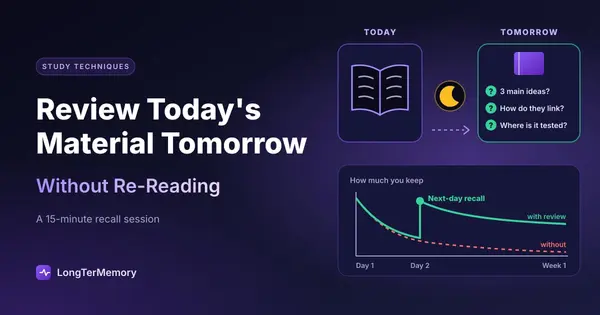
Forgetting isn’t a steady slope. Hermann Ebbinghaus showed in 1885 that it starts steeply and then levels off, and Murre and Dros replicated his curve in 2015. Their data also showed a small bump at the 24-hour mark, which they suggested could be related to sleep. Both experiments used meaningless syllables, so your biology notes will decay more slowly than that. The shape is what matters: a lot of loss happens early, unless you step in.
Three things line up by the next day:
| What’s happening | Why it helps your review |
|---|---|
| The memory has weakened | Retrieving it takes effort, and effortful retrieval strengthens it more |
| You’ve slept on it | Sleep supports memory consolidation (Diekelmann and Born, 2010) |
| You can still recover most of it | You get successes as well as useful gaps, not just a blank page |
A fair warning here: 24 hours isn’t a magic number. In a study of over 1,300 learners, Cepeda and colleagues (2008) found the best gap between study sessions depends on how long you need to remember something. For a test a week away, the ideal gap was around 20 to 40% of that time. For a test a year away, it was closer to 5 to 10%.
So why start with the next day? Because it’s the review you can actually protect. It’s short, the material is still recoverable, and it gives you the information you need to schedule everything that follows. The next-day session is the first step of a longer sequence, and a sequence that never starts doesn’t help anyone.
Active Recall Is the Only Next-Day Review Worth Your Time
A next-day session should be retrieval because re-reading mostly trains you to recognize the material, while an exam asks you to produce it. Those are two different skills, and they feel deceptively similar while your notes are open.
The evidence here is unusually clear:
- Roediger and Karpicke (2006): students who read a passage repeatedly remembered about 40% of it a week later. Students who read it once and then tested themselves three times remembered about 61%.
- Karpicke and Roediger (2008): continuing to test yourself on foreign vocabulary led to around 80% recall a week later, against roughly a third for students who only kept re-studying those words.
- Dunlosky and colleagues (2013): in a review of ten popular techniques, practice testing earned a “high utility” rating. Re-reading and highlighting were rated low.
- Kornell, Hays and Bjork (2009): even a failed attempt to retrieve an answer improves learning, as long as you see the correct answer afterwards.
That last finding matters most on a tired morning. You don’t have to remember everything for the session to work. If you can’t recall half of yesterday’s lecture, the attempt was still useful, and you now know which half needs attention. If the wider method is new to you, start with our guide to active recall, and see why re-reading doesn’t work for the longer version of the argument.
Re-Reading vs Retrieving, Side by Side
| Re-reading tomorrow | Retrieving tomorrow | |
|---|---|---|
| First move | Open the notes | Keep the notes closed |
| How it feels | Smooth and reassuring | Slow and a bit uncomfortable |
| What you learn | Very little about your gaps | Exactly what you’ve forgotten |
| Time needed | As long as the material | About 15 minutes |
| Benefit a week later | Small | Substantial |
The discomfort in that table isn’t a sign that something has gone wrong. Psychologist Robert Bjork calls this kind of effort a desirable difficulty. If the review feels effortless, you’re probably not retrieving anything.
The 15-Minute Session, Step by Step
Here’s the routine I recommend. It needs a blank page, a pen and yesterday’s material kept out of reach until step four.
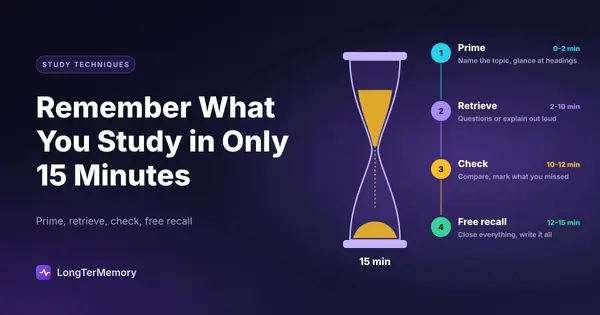
- Write the topic at the top (30 seconds). Just the lecture title or chapter name. That’s your only cue.
- Blurt (5 minutes). Write everything you can remember: terms, arguments, examples, a rough diagram. Messy is fine. This is the blurting method, and it’s the fastest way to see what survived the night.
- Answer your questions (5 minutes). If you wrote questions in the margin yesterday, answer them now. If you didn’t, ask yourself: what were the three main ideas, how do they connect, and where would an exam test them?
- Open the source and check (3 minutes). Compare, and mark what you missed or got wrong in another color. Only now do you look at the notes, and only at the parts your page says you need.
- Sort the gaps (1 to 2 minutes). Anything you missed goes on a list for your next review: a flashcard, a question, or a short note in tomorrow’s plan.
Prepare Tonight So Tomorrow Is Easier
Two minutes at the end of today’s study session will make tomorrow’s review much better. Write three to five questions the material answers, and put them on a separate page or at the back of your notes.
Good questions ask you to produce something:
- Weak: “Is the mitochondrion involved in energy production?”
- Better: “Walk through how a cell produces ATP, and where each stage happens.”
- Weak: “Did inflation rise after the policy change?”
- Better: “Why would this policy push inflation up, and what would prove that wrong?”
Writing them while the material is fresh also forces a small second pass through the ideas. If that’s the step you keep skipping, an AI quiz generator can draft questions from your notes for you to edit.
What If You Remember Almost Nothing?
It happens, especially with dense new material. Make the task easier without opening the notes: use the headings as cues, recall one section at a time, or start with what you do remember and build outward. If that still produces a blank page, read one short section, close it and try again straight away. That’s a small dose of reading in service of retrieval, which is very different from reading the whole thing again.
Building Next-Day Review Into Your Daily Routine
This habit sticks when it has a fixed trigger, a small size and a place in your plan. Don’t rely on feeling motivated at 7 a.m.
Attach It to Something You Already Do
Gollwitzer and Sheeran’s 2006 meta-analysis of 94 tests found that “if-then” plans have a medium to large effect on following through (d = 0.65). So write the plan in that exact form:
- “When I sit down with my first coffee, I blurt yesterday’s lecture.”
- “When I get on the train, I answer yesterday’s questions from memory.”
- “When I open my laptop at the library, I do my review before anything else.”
If you want more ideas, see how to use habit stacking to chain study actions together.
Do It Before New Material
Reviewing first also primes you for whatever comes next, and it protects the review from being squeezed out when a session runs long. A simple layout for a two-hour block:
| Time | What you do |
|---|---|
| 0:00-0:15 | Next-day review of yesterday’s material |
| 0:15-1:30 | New material, with questions written as you go |
| 1:30-1:50 | Older reviews that are due |
| 1:50-2:00 | Write questions for tomorrow and set up the next session |
Only have 30 minutes? Keep the first 15 and study something new with the rest. If you need a realistic weekly frame around this, here’s how to build a weekly study routine.
Give It Time to Become Automatic
Lally and colleagues (2010) followed people forming new daily habits and found a median of 66 days to reach automaticity, with a huge range from 18 to 254. Missing a single day didn’t derail the process. So if you skip Tuesday, don’t try to make it up by doing a double session. Just do Wednesday’s.
Connect It to Later Reviews
The next-day session only starts the process. To keep the material over the long term, you need further reviews at growing intervals. A sensible starting schedule for a new topic:
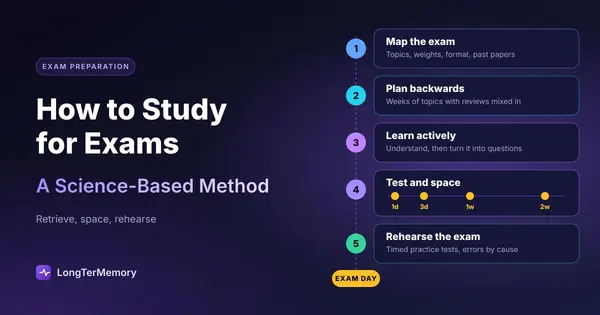
| Review | When | Format |
|---|---|---|
| First | Next day | Blurt plus questions |
| Second | About 3 days later | Questions only |
| Third | About 1 week later | Mixed with other topics |
| Fourth | 2 to 3 weeks later | Practice questions under time pressure |
Adjust it based on your exam date and how much you got wrong. This is the basic logic of spaced repetition, and it’s a core part of any plan for how to study for exams.
Common Mistakes to Avoid
- Peeking after ten seconds. Give yourself a proper chance to reach for the answer. The strain is where the benefit comes from.
- Skipping the check. Retrieval without feedback can cement your mistakes. Always compare with the source.
- Rewriting your notes neatly. It feels like studying, but it’s closer to copying. Your messy page has already done its job.
- Reviewing for 45 minutes. A long review won’t survive a busy week. Fifteen minutes done every day beats an hour done twice.
- Treating gaps as failure. A gap you found on Tuesday is one you won’t discover during the exam.
Let the Schedule Take Care of Itself
The review itself is simple. Keeping track of what’s due across several subjects is where it tends to fall apart, because every lecture starts its own sequence of reviews. LongTerMemory can handle that side of things: upload your notes or PDFs and it generates questions and answers from them, then schedules each one with spaced repetition. You save the hours of writing cards by hand, tomorrow’s questions are ready when you sit down, and items you get right come back later than the ones you miss. You can start free with the notes from today’s lecture and see what your first review looks like tomorrow.
FAQ
Can I do the review the same evening instead?
You can, and it’s better than nothing, especially if tomorrow is packed. But it’s easier to retrieve material you studied a couple of hours ago, so you’ll get less of the benefit of effort and you’ll miss the night of sleep in between. If you have the choice, wait until the next day.
How long should the session last?
Around 15 minutes per lecture or chapter is plenty. If you covered several subjects yesterday, you can give each one 5 to 10 minutes. Keep it short enough that you’d still do it on your worst day.
Is it ever okay to re-read?
Yes, once to understand the material the first time, and briefly to fix specific gaps after you’ve tried to retrieve them. It’s only a problem when it replaces retrieval as your main way of reviewing.
What if I missed a day?
Do the review whenever you get back to it. The material will be harder to recall, and that’s fine. You may need to check the source more often, but the retrieval attempt is still worthwhile.
Does this work for math and problem-based subjects?
Yes, but retrieval looks different. Instead of blurting facts, close the worked examples and solve a problem from yesterday’s lesson from scratch. Then check your method against the solution.
Do I need flashcards?
No. A blank page and a list of questions will do. Flashcards become useful when you have too many items to track by hand, which usually happens a few weeks into a course.
The Bottom Line
Tomorrow, don’t open yesterday’s notes first. Write the topic at the top of a blank page, pull out what you can, answer a few questions and then check. Fifteen minutes of that will teach you more than an hour of pleasant re-reading, and it’ll show you precisely what to do next. Pick your trigger tonight and write three questions before you close your books.