How to Perform in an Exam After a Bad Night's Sleep
Didn't sleep before your exam? Here's what sleep deprivation actually does to your brain, and the specific steps to protect your performance anyway.
It’s 6 a.m., the exam is in three hours, and you got maybe two hours of actual sleep. Maybe you were up finishing a practice set. Maybe anxiety kept you staring at the ceiling. Maybe a neighbor decided 2 a.m. was the perfect time for a conversation through a thin wall. Whatever the cause, you’re now facing one of the worst feelings a student can have: walking into a high-stakes exam running on empty.
Here’s the honest news first: sleep deprivation genuinely does hurt cognitive performance, and no amount of willpower fully cancels that out. But the situation is far from hopeless. There’s a real difference between how badly an unprepared, panicked, poorly-fueled sleep-deprived brain performs and how a sleep-deprived brain performs when you know exactly what to do in the hours that follow. This is about closing that gap as much as possible.
What Sleep Deprivation Actually Does to Exam Performance
It helps to understand specifically what’s degraded, because it’s not “everything equally.” Sleep loss doesn’t erase what you studied. Long-term memories you’ve built over weeks of preparation are largely still there, encoded in your brain’s structure. What sleep deprivation hits hardest is a specific, narrower set of functions.
Working memory takes the biggest hit. This is your ability to hold several pieces of information in mind at once and manipulate them, exactly what’s required for multi-step problems, complex reading comprehension, and questions that require you to juggle several conditions simultaneously. Expect multi-part problems to feel noticeably harder than usual.
Attention and focus become less stable. You’ll find your mind drifting more easily, needing to re-read sentences, and losing your place in longer passages. This isn’t a lack of effort, it’s a direct physiological consequence of an under-rested brain.
Processing speed slows down. Tasks you’d normally do quickly take longer, which matters enormously on timed exams where pacing is already tight.
Emotional regulation weakens, which means normal exam nerves can spike into something closer to panic more easily than they otherwise would.
What’s reassuring: recognition and well-consolidated recall, the kind of knowledge you’ve reviewed repeatedly over the preceding weeks, holds up comparatively well. If you did the work beforehand with real spaced review, that knowledge doesn’t vanish overnight. It’s the exam-specific cognitive demands, speed, working memory, complex integration, that suffer the most.
Pre-Exam Routines That Partially Compensate for Poor Sleep
You can’t manufacture the cognitive benefits of eight hours of sleep in three hours of morning prep. But you can meaningfully narrow the gap with the right routine.
Get bright light exposure immediately. Natural daylight, or a bright indoor light if it’s still dark out, suppresses melatonin and signals to your brain that it’s time to be alert. Even ten to fifteen minutes near a window or outside can noticeably shift your alertness level compared to staying in dim light.
Move your body. A short walk, some stretching, even a few minutes of jumping jacks increases blood flow and alertness far more effectively than sitting still with a coffee. You don’t need a workout, just enough movement to wake your system up.
Eat something with protein and complex carbohydrates, and avoid a sugar-heavy breakfast. A sugar spike followed by a crash is the last thing you want mid-exam. Something steady, eggs, oats, yogurt with fruit, keeps your blood sugar (and your focus) more stable for the next few hours.
Do a short, low-stakes retrieval warm-up. Spend ten minutes before the exam recalling a few things you know solidly, not cramming new material, but pulling up facts you’re confident about. This primes your retrieval system and can reduce the panic of a mind that feels foggy the moment you sit down.
Skip the temptation to cram new material. When you’re sleep-deprived, working memory is already compromised, which is exactly the resource cramming demands most. Trying to learn something brand new in the final hour is a poor trade against the anxiety and fatigue it adds.
Caffeine and Alertness Management for an Exam After a Bad Night
Caffeine is genuinely useful here, but the timing and dose matter more than people realize.
Caffeine takes roughly 20 to 45 minutes to reach peak effect. If you gulp coffee five minutes before walking into the exam room, you’ll likely be mid-spike during the first stretch of the test, when you actually want to be past the jittery phase and into the steady alertness phase. Aim to have your last dose 30 to 45 minutes before the exam starts.
Moderate is better than maximal. A large dose on top of sleep deprivation can push anxiety and jitteriness higher rather than simply making you sharper, which works against you on a test that already has enough nerves attached. One solid cup, or a moderate energy drink, tends to outperform doubling your usual intake.
If the exam is long, plan a small second dose for the midpoint rather than front-loading everything. A short break with a small amount of caffeine partway through a multi-hour exam can offset the dip that typically happens as the initial effect wears off.
Hydrate deliberately. Dehydration compounds fatigue-related cognitive decline, and it’s an easy thing to neglect when you’re stressed and rushed. Water alongside your caffeine, not instead of it.
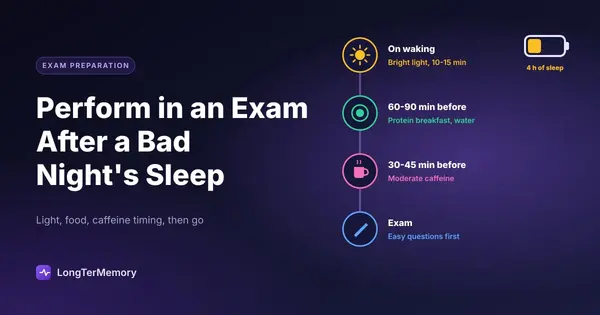
| Time before exam | Action |
|---|---|
| On waking | Bright light exposure, 10-15 minutes |
| 60-90 min before | Protein-forward breakfast, water |
| 30-45 min before | Caffeine dose (moderate, not maximal) |
| 15-20 min before | Short retrieval warm-up, light movement |
| Exam midpoint (if long) | Small second caffeine dose, more water |
During the Exam Itself
A few adjustments to your test-taking approach can help offset the specific deficits sleep loss creates.
Read questions more slowly and deliberately than usual. Attention lapses are more likely when you’re sleep-deprived, and misreading a question is a completely avoidable way to lose points on material you actually know. Slowing down your reading, even slightly, catches errors a rushed, tired brain would otherwise miss.
Break multi-step problems into explicit smaller steps on paper, rather than trying to hold every part in your head. Since working memory is what’s most degraded, offloading intermediate steps onto scratch paper compensates directly for that specific weakness.
Do your strongest section first if you have any choice in order. Early momentum and a few confidence-building correct answers can meaningfully help you manage the anxiety spike that sleep deprivation tends to amplify.
Watch your pacing more carefully than usual. Processing speed is slower today, so budget slightly more time per question than you normally would, and don’t panic if early questions take longer, that’s expected under these conditions, not a sign something’s uniquely wrong.
Managing Anxiety on Top of Fatigue
Sleep-deprived exam mornings tend to come with a second problem stacked on top of the first: anxiety about the sleep deprivation itself. Lying awake at 3 a.m. doing math about how many hours you have left before the alarm, and then walking into the exam already worried that you’re doomed, adds a layer of stress that makes everything else worse. Emotional regulation is already weaker when you’re sleep-deprived, so this spiral can escalate faster than it would on a normal day.
A short, deliberate reframe helps more than it sounds like it should. Remind yourself specifically that recognition and well-consolidated knowledge, the material you actually reviewed repeatedly over the past weeks, holds up far better under sleep deprivation than people assume. The deficit is concentrated in speed, working memory, and multi-step integration, not in whether you know the material at all. Reminding yourself of that distinction, explicitly, tends to lower the panic enough to think more clearly.
A brief breathing exercise, four seconds in, hold for four, six seconds out, repeated for a minute or two right before the exam starts, can also measurably reduce the physiological arousal that compounds fatigue-related fog. It won’t undo the sleep debt, but it can prevent anxiety from adding a second, avoidable layer on top of it.
If you are still deciding how to spend tonight before an exam, our guide on how to study for exams in one night explains why protecting sleep usually beats an all-nighter.
The Longer-Term Fix
None of this is a substitute for actual sleep, and it’s worth being honest that these strategies manage the damage rather than eliminate it. The best version of this article is one you never need, because your preparation didn’t leave you cramming until 2 a.m. in the first place.
That’s really a scheduling and review problem more than a willpower problem. Cramming the night before typically happens when material wasn’t reviewed consistently in the weeks leading up to the exam, forcing a last-minute scramble that costs you both the review itself and the sleep that would have helped you use it. If this is a recurring pattern for you, it’s worth looking at how your review schedule is built well before exam week, not just how you survive the morning after a rough night.
The Bottom Line
A bad night’s sleep before an exam is a real setback, not an imaginary one, and pretending otherwise doesn’t help. But the size of that setback depends heavily on what you do in the hours that follow. Bright light, movement, a steady breakfast, well-timed caffeine, a short retrieval warm-up, and slower, more deliberate pacing during the test itself can meaningfully close the gap between a sleep-deprived brain that panics and one that still performs close to its normal level.
The material you studied over the preceding weeks is still there. Your job this morning is simply to give yourself the best possible shot at accessing it.
Building a study routine with consistent spaced review, rather than late-night cramming, is the surest way to make sure you never have to rely on this article in the first place. LongTerMemory schedules your review sessions automatically across the weeks before an exam, so the material stays fresh well ahead of test day and the night before can actually be spent sleeping.