How to Use Case-Based Learning for Professional Fields
Prepare for professional exams with real scenarios. Learn to analyze clinical, legal and business cases and write your own to test applied knowledge.

Table of Contents
- How Case-Based Learning Differs From Textbook Studying
- Where the Method Came From
- What the Research on Comparing Cases Shows
- Why Your Exam Probably Rewards It
- Analyzing Clinical, Legal and Business Cases for Exams
- A General Five-Step Analysis
- Clinical Cases
- Legal Cases
- Business Cases
- Compare Cases on Purpose
- Creating Your Own Case Scenarios to Test Applied Knowledge
- The Five-Step Case Builder
- From Fact to Case: Before and After
- Use "What If" Variations
- Keep Yourself Honest
- A Weekly Plan for Case-Based Study
- Common Mistakes
- Keep Your Foundations Ready for Every Case
- FAQ
- When should I start using cases?
- Where can I find good cases?
- How many cases should I do each week?
- Does this work for fields outside medicine, law and business?
- Can I use AI to generate cases?
- The Bottom Line
Case-based learning means studying through realistic scenarios: you read a situation, decide what matters, apply what you know and justify a decision, then compare your reasoning with an expert’s. To use it for a professional exam, learn the core concepts first, work through cases with a fixed analysis framework, compare similar cases and write your own scenarios. It trains exactly what most licensing and certification exams test, which is applying knowledge rather than repeating it.
If you’ve ever known a textbook chapter cold and then stared helplessly at a long exam scenario, you’ve already met the problem. Memorized knowledge is filed under its chapter. Real problems, and the exam questions based on them, don’t come with chapter labels.
Here’s how case-based study differs from textbook study, how to analyze cases in medicine, law and business, and how to build your own.
How Case-Based Learning Differs From Textbook Studying
Textbook study moves from a rule to an example, while case study moves from a messy situation to the rule that applies. That reversal makes you practice recognizing which knowledge you need, the skill that textbooks quietly do for you by telling you what chapter you’re in.
| Textbook studying | Case-based study | |
|---|---|---|
| Starting point | A concept or rule | A realistic situation |
| Main question | ”What is this?" | "What’s going on, and what should I do?” |
| Information | Organized and relevant | Mixed, with some details that don’t matter |
| Skill trained | Understanding and recall | Selecting and applying knowledge |
| Typical trap | Feeling of familiarity | Solving cases without enough foundation |
Where the Method Came From
It has deep roots. Christopher Columbus Langdell brought the case method to Harvard Law School in the 1870s, and Harvard Business School later made it the core of its own teaching. In health professions, Thistlethwaite and colleagues (2012) published a systematic review of 104 papers on case-based learning. Students generally enjoyed it and felt it helped, but much of the evidence relied on weak study designs, and most papers measured outcomes only after the teaching. So there’s good reason to use it, but we shouldn’t oversell it.
How does it compare with problem-based learning? They’re close relatives. Problem-based learning is usually more open and self-directed, with students deciding what to research. Case-based learning is typically more guided. Srinivasan and colleagues (2007) reported that medical students and faculty at two California schools generally preferred the guided format after switching from problem-based learning.
What the Research on Comparing Cases Shows
There’s stronger evidence for one specific technique: comparing cases.
- Gick and Holyoak (1980, 1983): People struggled to apply a solution from one story to an analogous problem unless they were given a hint. Comparing two analogous stories helped them extract the underlying principle.
- Gentner, Loewenstein and Thompson (2003): Management students who compared two negotiation cases were more likely to use the underlying strategy later than those who studied the same cases separately.
- Alfieri, Nokes-Malach and Schunn (2013): A meta-analysis of 57 experiments found a moderate learning advantage for case comparison over other methods (d = 0.50), particularly when learners looked for similarities and received the principle after comparing.
This is why we’ll put so much weight on comparison below. One case teaches you a story. Two or three cases can teach you a principle.
Why Your Exam Probably Rewards It
Many professional exams are built around applied scenarios. Formats change, so always confirm the details with the official exam provider.
| Exam | How it uses cases |
|---|---|
| USMLE Step exams | Clinical vignettes, where you interpret findings and choose a next step |
| Next Generation NCLEX | Unfolding case studies built on a clinical judgment model |
| NextGen bar exam | Integrated question sets combining legal knowledge and lawyering skills |
| CFA Level II | Item sets with a vignette followed by multiple-choice questions |
| PMP | Situational questions about what a project manager should do next |
Specific guidance for these exams is available in our posts on USMLE Step 2 CK, the NCLEX, the Uniform Bar Exam, CFA Level 2 and the PMP.
Analyzing Clinical, Legal and Business Cases for Exams
Use the same five-step process in any field: find the question, sort the facts, identify the principle, apply it and justify your decision. Then adapt the framework to your profession.
A General Five-Step Analysis
- Read the final question first. It tells you what kind of decision you’re looking for.
- Sort facts by importance. Which facts change the answer? Which are noise?
- Name the governing principle. Write it down in a single line.
- Apply it to these specific facts. That’s where most marks are won and lost.
- Say why the closest alternative fails. If you can’t do this, you’ve probably only got a guess.
Clinical Cases
Framework: presenting problem, key findings, differential diagnosis, next best step.
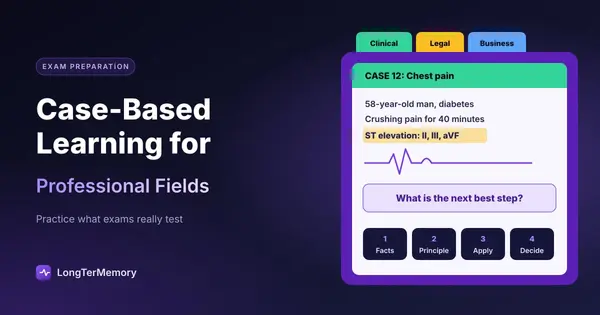
Here’s an example, simplified for study purposes:
A 58-year-old man with diabetes has had crushing chest pain for 40 minutes, along with sweating and nausea. His ECG shows ST elevation in leads II, III and aVF.
| Step | Your reasoning |
|---|---|
| Key findings | Crushing chest pain, risk factor, ST elevation in the inferior leads |
| Leading diagnosis | Inferior ST-elevation myocardial infarction |
| What else to consider | Aortic dissection, pericarditis, and right ventricular involvement |
| Decision logic | Time-critical reperfusion, following current guidelines |
| Why not the alternatives? | Diffuse ST elevation would make you think more about pericarditis |
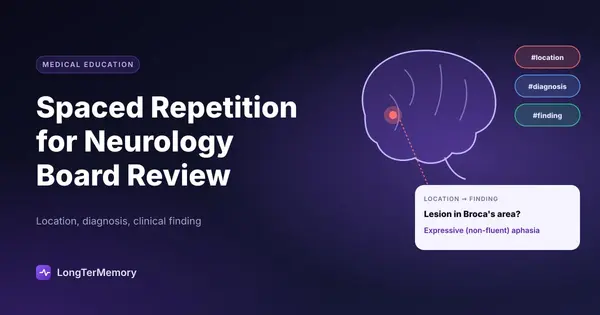
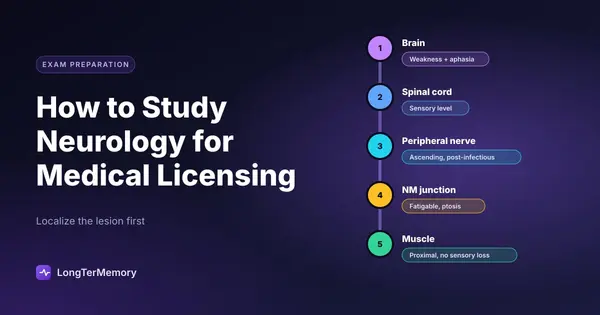
Study tip: after each case, ask yourself which one detail, if changed, would alter the diagnosis or management. Those details are what vignette writers test. Clinical educators call the mental patterns you’re developing here illness scripts, and comparing similar presentations is one of the fastest ways to build them. There’s more on that in our post on board review for neurology.
Legal Cases
Framework: IRAC, which stands for Issue, Rule, Application and Conclusion.
A contractor emails a homeowner offering to repaint the house for $5,000. The homeowner replies, “I accept, but for $4,500.” The contractor doesn’t respond and takes another job. The homeowner sues.
| Step | Your reasoning |
|---|---|
| Issue | Was a binding contract formed? |
| Rule | Under the common law’s mirror image rule, acceptance must match the offer’s terms; a change generally acts as a counteroffer |
| Application | The reply changed the price, so it rejected the offer and made a counteroffer, which the contractor never accepted |
| Conclusion | Probably no contract, so the homeowner likely loses |
To test yourself further, change one fact. What if this were a sale of goods, not services? Then the UCC would apply, and it treats additional or different terms differently. That one change shows you whether you’ve learned the rule or only this particular story. If you need the supporting detail, see how to memorize legal cases or use flashcards for legal cases.
Business Cases
Framework: situation, core problem, options, evidence, recommendation.
A subscription software company has grown 30% a year, but customer churn has risen from 5% to 9% since it raised prices. The CEO wants to spend more on advertising to offset the losses.
| Step | Your reasoning |
|---|---|
| Situation | Growth is continuing, but existing customers are leaving faster |
| Core problem | Is this a pricing, product or customer-fit issue? Advertising doesn’t address any of these directly |
| Options | Segment the churn data, test pricing tiers, improve onboarding or adjust the target customer |
| Evidence needed | Who’s leaving, when and why, and acquisition cost compared with lifetime value |
| Recommendation | Diagnose churn by segment before raising ad spend |
Business cases rarely have a single correct answer, so your reasoning carries much of the weight. State your assumptions and what would change your mind. Our guide on case study interview prep and this one on marketing and MBA exams go deeper on this kind of thinking.
Compare Cases on Purpose
After you’ve worked through a few, line them up. For example, take three patients with chest pain and three different causes:
| Case A | Case B | Case C | |
|---|---|---|---|
| Pain | Crushing | Sharp, better when leaning forward | Tearing, radiating to the back |
| Key clue | Localized ST elevation | Diffuse ST elevation | Unequal arm blood pressures |
| Likely cause | Myocardial infarction | Pericarditis | Aortic dissection |
Then ask: what’s the same? What’s different? What single feature would you check first? Writing that out creates something more durable than three separate stories. It’s also a natural fit for concept tables.
Creating Your Own Case Scenarios to Test Applied Knowledge
Writing your own cases is one of the best ways to study, because it forces you to work out which facts really matter. You don’t have to be an expert. You just need a concept, a realistic setting and a decision.
The Five-Step Case Builder
- Pick one principle. Take a single rule, mechanism or concept from your notes.
- Create a realistic setting. Who’s involved, what’s happening, and what do they want?
- Add the deciding facts. Include the details that determine the answer.
- Add one or two distractors. Include something plausible that doesn’t change the outcome.
- Finish with a decision. Ask what to do next, what’s most likely or who wins, rather than asking for a definition.
From Fact to Case: Before and After
| Plain recall question | Case version |
|---|---|
| What’s the first-line treatment for anaphylaxis? | Minutes after eating at a restaurant, a woman has hives, wheezing and low blood pressure. What should be given first? |
| What’s a hearsay exception? | A witness testifies about what a bystander shouted just as a car crash happened. Is the statement admissible? Why? |
| What’s an example of critical path? | A task on your project is delayed by two days, and it has no float. What happens to the end date, and what do you do first? |
Use “What If” Variations
Once you’ve got a case, change one detail at a time. What if the patient were pregnant? What if the contract had been signed by a minor? What if the delay were on a non-critical task? It’s a quick way to get five practice scenarios out of a single idea, and it trains the discrimination that exams reward.
Keep Yourself Honest
Your own cases can go wrong, so check them:
- Verify them against a reliable source. Check the answer against your textbook or official guideline. A wrong case will teach you the wrong thing with great confidence.
- Swap with a study partner. They’ll spot ambiguities and shortcuts you can’t see in your own writing.
- Attempt them days later. You’ll have forgotten enough for it to be real retrieval.
A Weekly Plan for Case-Based Study
Don’t start with cases on day one. As with most study methods backed by research, it works best when you’ve got a foundation to draw on.
| Day | Activity | Time |
|---|---|---|
| Monday | Learn the core concepts for a topic and quiz yourself | 60 min |
| Tuesday | Work through 3 to 4 published cases using your framework | 60 min |
| Wednesday | Compare your cases and write down the shared principle | 30 min |
| Thursday | Write 2 of your own cases and their variations | 45 min |
| Friday | Timed exam-style vignettes, mixed from different topics | 60 min |
| Saturday | Review mistakes and log why each one happened | 30 min |
If you’re also working full-time, reduce the time rather than the sequence. A case or two on your lunch break still counts. Then use your mistakes to decide what to study next, as this guide on how to learn from your practice test mistakes explains.
Common Mistakes
- Reading cases like stories. If you read the discussion before you commit to an answer, you’ve only got recognition practice.
- Skipping the foundation. You can’t reason from knowledge you haven’t got. If a case feels like guesswork, return to the concepts.
- Remembering the case, not the principle. Knowing the answer to a case you’ve seen before proves very little. Change the facts and try it again.
- Only doing your favorite types. Mix topics, because exams won’t tell you which chapter a question comes from.
- Never practicing under time pressure. Real exam vignettes require you to read and decide quickly, so train for that in the weeks before your test.
Keep Your Foundations Ready for Every Case
Good case reasoning depends on facts you can recall instantly: criteria, rules, formulas and definitions. LongTerMemory handles that side of your preparation: upload your study guides or PDFs and it generates question-and-answer pairs, then schedules each one for review with spaced repetition. That saves you the hours you’d spend making flashcards by hand and leaves more time for working through cases. Try it free with a chapter from your exam syllabus. For the bigger picture, here’s our step-by-step guide on how to study for exams.
FAQ
When should I start using cases?
Once you’ve got a basic understanding of the topic. A good test is whether you can explain the core concepts from memory. Short, simple cases can come early, and you can increase the difficulty as your knowledge grows.
Where can I find good cases?
Start with official sample questions from your exam provider, followed by reputable question banks, textbook case sections and past papers. Business schools and professional bodies also publish teaching cases, and your own work experience can be a rich source once you’ve removed any confidential details.
How many cases should I do each week?
Quality beats quantity. Three to four cases analyzed thoroughly, plus one comparison, will teach you more than twenty you’ve skimmed. Closer to the exam, you can add larger timed sets to build speed and stamina.
Does this work for fields outside medicine, law and business?
Yes. Engineering failures, teaching scenarios, cybersecurity incidents and accounting judgment calls all work well. If your exam asks what you’d do in a particular situation, this approach will help.
Can I use AI to generate cases?
It can be a helpful way to get a first draft and more variations, particularly when question banks run out. Always verify the details against an authoritative source, though, because a fluent scenario can still contain errors.
The Bottom Line
Professional exams want to know what you’d do, and you won’t find that out by rereading a chapter. Learn the concepts, analyze cases with a fixed framework, compare them until the principle comes into view and write your own to find out what you truly understand. This week, take one concept from your notes and turn it into a single scenario with a decision at the end. It’ll take ten minutes, and it may well be the most useful ten minutes of your day.
LongTerMemory Team
LongTerMemory editorial team
The team that builds LongTerMemory, the AI study app that turns your own PDFs, slides and notes into practice questions and schedules them with spaced repetition. We write about study methods and learning science, and we link the research behind our advice.