How to Use Problem Sets to Study for Science and Math
Solving beats reading in STEM. Learn to work through problem sets with the answers hidden, use hints wisely and turn wrong answers into your best material.
Table of Contents
- Why Solving Problems Is the Real Work in Science and Math
- How to Approach Problem Sets With the Answer Sheet Hidden
- Step 1: Translate the Problem Before You Calculate
- Step 2: Name the Principle
- Step 3: Solve in Full, With Words
- Step 4: Check Before You Check
- Step 5: Rate Your Confidence
- What to Do When You're Stuck
- Working Together Without Fooling Yourself
- Error Analysis: Turning Wrong Answers Into the Deepest Learning
- Sort Every Mistake by Cause
- Keep a Simple Error Log
- Redo Without Looking
- Getting More From Each Practice Session
- Mix Your Topics
- Quality Over Quantity
- A 90-Minute Problem Session
- Don't Neglect the Facts Underneath
- Simulate the Real Exam
- Keep the Concepts Fresh Between Sessions
- FAQ
- How many problems should I do per topic?
- Should I read the textbook before starting problems?
- Is it cheating to look at the solution?
- What if my course doesn't provide solutions?
- How is this different from problem-based learning?
- The Bottom Line
The best way to use problem sets is to solve each problem with the answers hidden, write down your full reasoning, check only after a serious attempt, and log every mistake by its cause. Then redo the problems you got wrong a few days later and mix in different topics. That’s what separates students who improve from those who complete every assignment and still freeze in the exam.
Many capable students follow along with a solution, understand every line and walk away convinced they could do it themselves. Then the test gives them a blank space and no first step. Following a solution and producing one are completely different skills, and only the second one gets you marks.
Let’s go through why solving matters so much, how to work with the answer sheet hidden, and how to get the most out of each wrong answer. For where problem sets fit in a full plan, see our guide on how to study for exams.
Why Solving Problems Is the Real Work in Science and Math
Science and math exams test whether you can choose and carry out a method on an unfamiliar problem. The only way to train that is to practice doing it. Reading builds familiarity with solutions, which is useful at the start but stops being enough very quickly.
The research backs this up from several angles:
| Study | What it found | What it means for you |
|---|---|---|
| Freeman et al. (2014), 225 STEM studies | Active learning raised exam scores by about 0.47 standard deviations; failure rates were 21.8% vs 33.8% with traditional lectures | Doing beats watching, across STEM fields |
| Dunlosky et al. (2013) | Practice testing rated “high utility”; re-reading and highlighting rated low | Solving is a form of testing |
| Rohrer et al. (2020), 54 math classes | Mixed practice scored 61% vs 38% for blocked practice on a surprise test a month later | How you arrange problems matters a lot |
| Sinha and Kapur (2021), meta-analysis | Trying problems before instruction led to better conceptual understanding (g = 0.36) | Struggling first can pay off |
There’s one important nuance. Complete beginners do learn better from worked examples than from jumping straight into problems, a result going back to Sweller and Cooper (1985). When you know nothing about a topic, trying to solve hard problems can overload you. As your knowledge grows, that advantage reverses, and problem solving becomes the better option.
So the sequence matters:
- Learn the basic idea from a lecture or chapter.
- Study one or two worked examples, explaining each step to yourself.
- Cover the solution and reproduce it from memory.
- Move on to new problems, with the answers hidden.
That second step is worth a closer look. Chi and colleagues (1989) found that stronger students were more likely to explain examples to themselves, asking why each step followed from the last. Ask yourself: why this equation? Why substitute here? What would change if this value were negative? If you can’t say, you’ve just found the gap.
How to Approach Problem Sets With the Answer Sheet Hidden
Hide the answers physically before you start. Put the solutions in another room, or close the tab. Many of us can’t resist a glance, and a glance is enough to turn real practice into recognition.
Here’s a process that works for nearly any quantitative subject. It builds on George Pólya’s classic four steps from How to Solve It (1945): understand the problem, make a plan, carry it out and look back.
Step 1: Translate the Problem Before You Calculate
Write down what you’ve got and what you need, and draw a diagram if there’s any physical situation involved. Many errors come from solving a slightly different problem from the one on the page.
Step 2: Name the Principle
Before doing any math, write one line: “This is conservation of energy” or “This needs integration by parts” or “This is a limiting reagent problem.” Choosing the method is often the hardest part, and it’s exactly what students never practice when problems are grouped under a chapter heading.
Step 3: Solve in Full, With Words
Show every step, and add a few words beside any step that isn’t obvious. Writing “the net force is zero because velocity is constant” gives you a record of your reasoning that you can check later. A bare string of numbers won’t tell you where your thinking went wrong.
Step 4: Check Before You Check
Before you look at the answer, test your own result:
- Are the units right?
- Is the size reasonable? A car shouldn’t weigh 3 grams.
- What happens in an extreme case, like when a variable goes to zero?
- Can you solve it another way?
Step 5: Rate Your Confidence
Write “sure”, “unsure” or “guess” beside your answer. This small habit reveals the most dangerous gap of all: things you got wrong while feeling sure.
What to Do When You’re Stuck
Getting stuck is part of the process, but you shouldn’t sit in it for hours. Use this hint ladder, and move one rung at a time:
| Time stuck | What to do |
|---|---|
| 0-10 minutes | Reread the problem, redraw it and list what you know |
| 10-15 minutes | Try an easier version with simpler numbers or fewer variables |
| 15-20 minutes | Go back to your notes, but only for the relevant concept, not this solution |
| 20+ minutes | Look at only the first line of the solution, then close it and continue |
| Still stuck | Mark it, move on and ask a classmate or instructor |
These timings are my rule of thumb, so stretch or shrink them based on the problem. What matters is that you make a real attempt. Kornell, Hays and Bjork (2009) showed that even failed attempts improve later learning once you see the right answer.
Working Together Without Fooling Yourself
Group work can be great, but it can also hide what you can’t do alone. Try every problem on your own first. Then meet up to compare approaches, and take turns explaining them. Afterwards, redo any problem you needed help with, on your own and without notes, at least a day later.
Error Analysis: Turning Wrong Answers Into the Deepest Learning
Error analysis means finding out why you got a problem wrong, classifying that cause and doing something specific to prevent it next time. Just reading the right answer and saying “oh, I see” changes very little.
Janet Metcalfe’s 2017 review of the research on learning from errors concludes that making mistakes can help learning, provided you get corrective feedback. The feedback is the part many students rush through.
Sort Every Mistake by Cause
Different errors need different fixes. Here are the five categories I use, with examples from real topics:
| Error type | Example | The fix |
|---|---|---|
| Conceptual | Saying a ball thrown upward has zero acceleration at the top (it’s still about 9.8 m/s² downward) | Revisit the idea, then explain it out loud |
| Wrong method | Trying to integrate by substitution when parts are needed | Practice choosing methods using mixed problems |
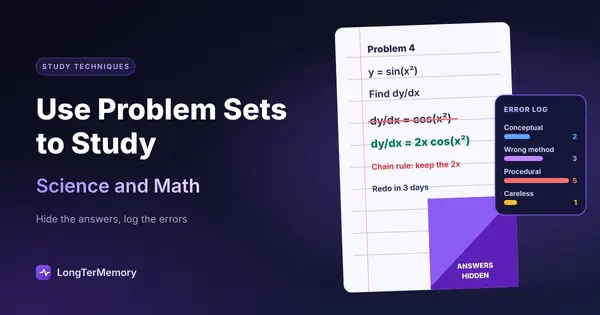
| Procedural | Differentiating sin(x²) as cos(x²), forgetting the chain rule’s factor of 2x | Do 5 to 10 focused drills |
| Setup or reading | With 4 mol H₂ and 1 mol O₂, predicting 4 mol of water by ignoring that O₂ runs out first (the answer is 2 mol) | Translate the problem before calculating |
| Careless | Dropping a minus sign or mixing up units | Add a specific check at the end |
Be honest about that last one. “Careless” is a tempting label because it lets you off the hook, but if you make the same slip three times, it’s a pattern and needs its own fix.
Keep a Simple Error Log
A notebook or spreadsheet is enough. For each mistake, record:
- Topic and problem number
- What you did (one line)
- Why it was wrong (your error type and the reason)
- The rule to remember (“Check for a limiting reagent before using mole ratios”)
- Redo date
After a couple of weeks, count your categories. If most of your mistakes are procedural, you need more drills. If most are conceptual, more problems won’t help until you go back to the idea. We’ve got more detail in how to learn from your practice test mistakes.
Redo Without Looking
This is the step that actually closes the loop. Three days after a mistake, solve the same problem again from a clean page. Then do a similar problem with different numbers or a different setup. If you get it right, push the next attempt back a week or two. If you can’t, your fix hasn’t worked yet, and you’ll want to go back to the concept.
Getting More From Each Practice Session
Good process is half the story. How you plan and arrange your practice makes up the rest.
Mix Your Topics
Textbook exercises normally give you 20 problems on the same method, so you never have to work out which method to use. The Rohrer trial cited above found a huge benefit from mixing them, though students reported that it took more time. You can do this yourself: once you’ve learned a few topics, pull problems from different chapters, remove the headings and shuffle. See how interleaving improves practice test performance for a closer look.
Quality Over Quantity
Thirty problems of a type you’ve mastered will teach you little. Stop when you’ve solved three or four in a row, without hints, and move on to something harder. Your error log, rather than the assignment list, should decide what you do next.
A 90-Minute Problem Session
| Time | What you do |
|---|---|
| 0-10 min | Redo yesterday’s wrong answers from memory |
| 10-55 min | Attempt new problems, with the answers hidden |
| 55-75 min | Check, classify errors and update your log |
| 75-85 min | Do similar problems for your most common error |
| 85-90 min | Write down which problems to redo, and when |
Don’t Neglect the Facts Underneath
You can’t apply formulas and definitions that you can’t remember, so slow recall drags down your problem solving. Put key formulas and their conditions on a spaced review schedule. There’s a full guide on how to memorize formulas for math and science. Your notes matter too: Cornell notes for STEM can capture worked examples in a way that makes them easy to test later.
Simulate the Real Exam
In the final weeks, do timed sets under exam conditions: no notes, no calculator if it’s not allowed, and the real time limit. These sessions test pacing and choice of method together. Exams like the GRE Quantitative section and the PE exam are a good example of how much time pressure can change your performance.
Keep the Concepts Fresh Between Sessions
Problem practice needs a base of concepts, definitions and formulas you can recall in seconds. LongTerMemory can take care of that layer: upload your textbook PDF or lecture notes and it generates questions and answers, then schedules each review automatically with spaced repetition. You won’t lose hours typing out cards, so you’ve got more time for actual problems, and you can add your error-log rules to your materials too. Try it free with a chapter you’re working on now. If you want an extra source of questions, you can also use an AI quiz generator for concept checks, though it won’t replace working full problems by hand.
FAQ
How many problems should I do per topic?
There isn’t a magic number. Keep going until you can solve three or four new problems in a row without help, including at least one that looks different from the examples. Then mix that topic into later sessions, instead of doing more at once.
Should I read the textbook before starting problems?
Usually a short overview first, not a deep reading. Learn the basic idea, go through a worked example and then try problems. Going back to the book when you get stuck is often more efficient, because now you know what you’re looking for.
Is it cheating to look at the solution?
No, as long as you’ve made a serious attempt. The solution is a learning tool. Just make sure you close it and solve the problem again on your own afterwards, or you’ll only have practiced following along.
What if my course doesn’t provide solutions?
Check textbook companion sites, past papers, office hours and study groups. Tools like Wolfram Alpha can verify answers for many math problems. Compare answers with a classmate, too, and work out any disagreement together.
How is this different from problem-based learning?
Working through exercises is an individual study method for practicing specific skills. Problem-based learning is a broader teaching approach, in which a realistic open-ended problem drives what you learn in the first place.
The Bottom Line
Your problem sets are more than homework to get through. They’re the closest rehearsal you’ve got for the exam. Hide the answers, name the principle, write your reasoning and keep a log of why things went wrong. Then come back to your mistakes a few days later and solve them cold. Start tonight with one set and one rule: nothing gets checked until you’ve given it a real attempt.