How Active Learning Changes Your Brain Over Time
Science shows active learning physically reshapes your brain. Learn the neuroplasticity research behind long-term cognitive gains from deliberate study.
Table of Contents
- What Neuroplasticity Actually Means
- The Testing Effect at the Neural Level
- How the Hippocampus Mediates Learning
- Active Learning Changes Gray Matter Density
- The Role of Sleep in Consolidation
- Long-Term Cognitive Benefits of Active Learning Habits
- Working Memory Expansion
- Processing Speed
- Resistance to Cognitive Decline
- What This Means for How You Study
- Building a Brain-Science-Aligned Study Routine
- The Compounding Returns of Deliberate Practice
There’s a sentence that should change how you think about studying, and it comes from neuroscience rather than education research: every time you successfully retrieve something from memory, you physically alter your brain.
Not metaphorically. Not in some vague motivational sense. Literally, at the level of synapses and neuronal connections, retrieving a memory and engaging actively with material makes structural changes to your brain that passive exposure simply doesn’t. And those changes compound over time in ways that affect not just what you remember, but how you think.
This is what the neuroscience of active learning is actually about , and understanding it should shift how you approach your study sessions in a fundamental way.
What Neuroplasticity Actually Means
“Neuroplasticity” has become a buzzword in self-improvement circles, sometimes used so loosely that it’s lost its meaning. Let’s be specific about what it actually refers to.
Your brain contains roughly 86 billion neurons, each of which connects to thousands of others through synapses , tiny gaps across which chemical signals travel. A thought, a memory, a skill: these are all patterns of activation across networks of neurons, paths that electrical signals take through your brain.
Neuroplasticity is the brain’s ability to change the strength and structure of these connections in response to experience. This happens in several ways:
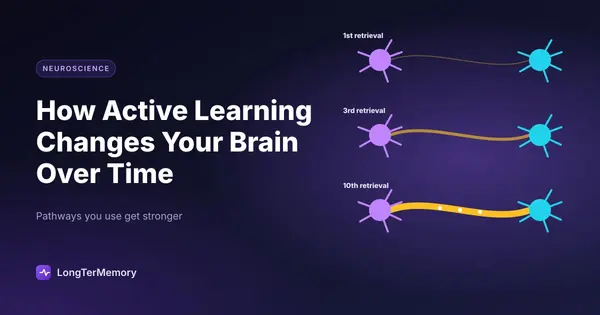
- Synaptic strengthening (long-term potentiation): Synapses that fire together repeatedly become more efficient , the signal travels faster and stronger. This is the cellular basis of learning.
- Synaptic pruning: Connections that are rarely used get weakened or eliminated. The brain is constantly editing itself toward efficiency.
- Neurogenesis: In some brain regions, particularly the hippocampus , which is central to memory formation , new neurons can actually grow. Exercise and cognitively demanding activity both promote this.
- Myelination: The axons (signal-sending extensions of neurons) become coated in myelin, a fatty substance that dramatically speeds up signal transmission. Skills practiced repeatedly become literally faster to execute.
The critical insight is that these changes are experience-dependent. Your brain changes differently in response to passive exposure versus active engagement. And the difference is not subtle.
The Testing Effect at the Neural Level
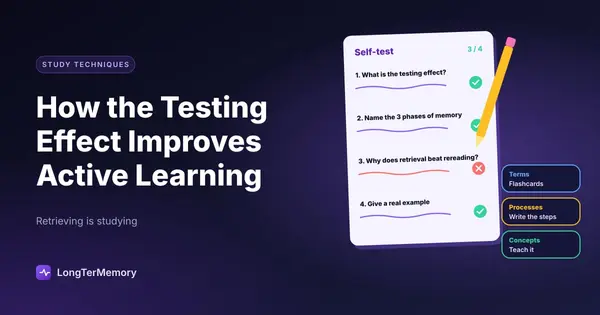
You may have heard of the testing effect , the well-established finding that retrieving information from memory improves retention far more than restudying the same material. But why does this happen at the neural level?
When you successfully recall something, you’re not just accessing a stored memory , you’re reconstructing it. Memory retrieval is an active, generative process that recruits a broad network of brain regions. During a successful retrieval, the synapses involved in that network get strengthened through long-term potentiation. The next time you try to retrieve the same information, the path is clearer, faster, and more stable.
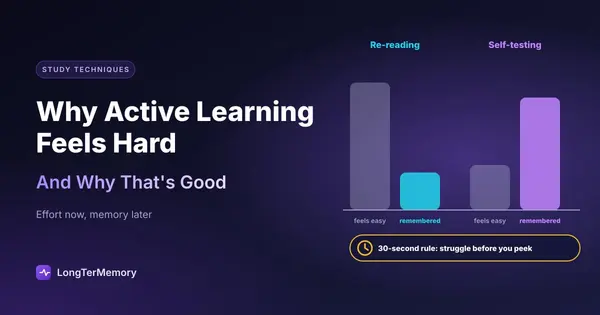
Restudying, by contrast, primarily activates visual processing and working memory , it feels like learning, but it doesn’t trigger the same depth of network reinforcement. This is why re-reading your notes feels productive but often isn’t.
Research published in the journal Science by Karpicke and Blunt (2011) demonstrated that students who used retrieval practice retained 50% more material after a week than students who used concept mapping , one of the most cognitively demanding passive study strategies available. The testing group wasn’t smarter. They were using a strategy that aligned with how memory consolidation actually works at the cellular level.
How the Hippocampus Mediates Learning
The hippocampus is the brain region most critical for forming new declarative memories , facts, concepts, and events that you can consciously recall. It sits in the medial temporal lobe and acts as a kind of relay station: new experiences are initially encoded here before being consolidated into longer-term storage across the cortex.
Active learning engages the hippocampus more deeply than passive learning, for a straightforward reason: novelty and prediction error. The hippocampus is especially responsive to situations where what happens differs from what was predicted. When you attempt to retrieve something and struggle , or when you’re wrong , your hippocampus is highly activated. That struggle, and the subsequent correction, is one of the most powerful learning signals the brain has.
This is sometimes called desirable difficulty in the educational literature. The harder you have to work to retrieve something, within limits, the stronger the resulting memory. Easy, frictionless review produces weaker memories. Effortful retrieval produces stronger ones.
The implication for study design is counterintuitive: if your practice sessions feel too easy, they probably aren’t producing much durable learning. If they feel genuinely challenging , where you have to reach for answers and sometimes fail , you’re generating exactly the neural conditions that promote consolidation.
For a practical breakdown of how to build study sessions around retrieval, see our guide on active studying.
Active Learning Changes Gray Matter Density
One of the more striking findings from neuroimaging research is that sustained learning changes not just the strength of existing connections, but the actual physical structure of the brain , measurable in MRI scans.
Studies of musicians, who undergo years of intense deliberate practice, consistently find differences in the structure of motor and auditory cortices compared to non-musicians. London cab drivers, who memorize an extraordinarily complex street map, show measurably larger hippocampal volume than average. Medical students in the months before their board exams show increases in gray matter density in regions associated with memory and spatial learning.
These aren’t people with unusual brains to begin with , the structural differences emerge from the learning itself. The pattern across many studies is clear: cognitively demanding, active engagement over extended periods reshapes brain structure. Passive exposure does not produce the same effects.
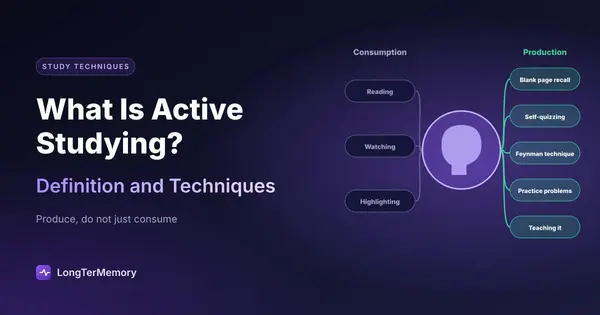
For students, the practical implication is that the intensity and type of cognitive engagement during study matters as much as the volume of time spent. Ten hours of passive re-reading produces very different neural effects than ten hours of active retrieval practice, self-testing, and teaching-back , even if both feel like “studying.”
The Role of Sleep in Consolidation
Active learning during waking hours is only half of the picture. The other half happens while you’re unconscious.
During slow-wave sleep and REM sleep, the brain consolidates memories formed during the day. The hippocampus “replays” recent learning events, gradually transferring representations from short-term hippocampal storage into more stable long-term storage distributed across the cortex. This isn’t a passive process , it’s metabolically demanding and essential.
Research by Matthew Walker and others at UC Berkeley has shown that sleep deprivation before learning impairs the hippocampus’s ability to encode new information by up to 40%. Sleep deprivation after learning impairs consolidation of what was learned, even if the encoding itself went fine. In both directions, sleep is not optional for learning , it’s the biological mechanism through which learning becomes permanent.
This is why distributed practice over multiple sessions consistently outperforms cramming , not just because spaced repetition aligns with the forgetting curve, but because each night of sleep between sessions allows for consolidation that makes subsequent learning more efficient. Cramming overwrites this process by trying to encode everything without the sleep gaps that make consolidation possible.
Long-Term Cognitive Benefits of Active Learning Habits
Here’s the part that should motivate any long-term learner: the cognitive benefits of active learning are not limited to the specific content you’re studying. They extend to general cognitive capacity in ways that are measurable and durable.
Working Memory Expansion
Working memory , the ability to hold and manipulate information in mind , is not fixed. Regular cognitively demanding practice, including activities like active recall and problem-solving, is associated with improvements in working memory capacity. This is one of the reasons that students who study actively tend to perform better on novel problem-solving tasks, even those unrelated to their study material.
Processing Speed
Repeated retrieval and effortful cognitive engagement promotes myelination in the relevant neural pathways. Because myelinated axons transmit signals faster, trained cognitive processes become genuinely faster over time , not just more automatic, but physiologically speedier.
Resistance to Cognitive Decline
Perhaps most significant for long-term planning: sustained intellectual engagement appears to be one of the most robust protective factors against age-related cognitive decline. Large longitudinal studies consistently find that people who engage in cognitively demanding activities throughout adulthood , especially learning new material and solving novel problems , maintain cognitive function better into old age.
The concept of cognitive reserve captures this finding: people who build denser, more complex neural networks through active learning over their lifetimes have more buffer against the cellular-level damage that aging brings. The damage may still occur, but they have more network redundancy to compensate with.
What This Means for How You Study
Understanding the neuroscience of active learning translates directly into practical study recommendations:
| Passive Study Method | Active Alternative | Why It’s Better |
|---|---|---|
| Re-reading notes | Self-testing from memory | Triggers LTP, strengthens retrieval pathways |
| Highlighting key phrases | Writing summaries without looking | Engages reconstruction, not just recognition |
| Watching lecture recordings | Pausing to recall what was said | Creates prediction error, activates hippocampus |
| Reviewing before sleep | Reviewing after sleep, fresh | Leverages overnight consolidation |
| Massed study sessions | Distributed sessions over days | Allows sleep-mediated consolidation between sessions |
The pattern across all of these is the same: effortful retrieval beats passive exposure, and distribution over time beats concentrated massing. This isn’t a learning style preference , it reflects the underlying biology of how memory formation works.
The same principles apply to fact-dense subjects like biology, where active retrieval paired with diagrams and case studies is especially effective. See our guide on how to memorize biology fast for a subject-specific workflow.
Building a Brain-Science-Aligned Study Routine
To put this into practice:
Space your sessions. Instead of one 4-hour block, aim for four 1-hour sessions spread over four days. Each sleep period in between does biological work that the continuous session can’t replicate.
Test before you review. At the start of each study session, attempt to recall what you studied last time before opening your notes. This retrieval attempt , even imperfect , strengthens consolidation and identifies real gaps.
Make it hard. If your practice sessions feel effortless, add difficulty: increase the time between reviews, test yourself on harder application questions, try to explain concepts without referring to notes. The discomfort of difficulty is a signal that real learning is occurring.
Protect sleep. This one isn’t negotiable. Sacrificing sleep to study more is a bad trade that the neuroscience simply doesn’t support. You will retain more from 6 hours of study with 8 hours of sleep than from 9 hours of study with 5 hours of sleep.
Track what you don’t know. The hippocampus is especially activated by prediction errors , moments when reality doesn’t match expectation. Create those moments deliberately by testing yourself and noting failures. Tools that use spaced repetition scheduling, like LongTerMemory, automate the process of surfacing your weakest material at precisely the intervals that maximize memory consolidation.
The Compounding Returns of Deliberate Practice
The neuroscience of active learning points toward one final insight that’s worth sitting with: the benefits compound.
Each cycle of active retrieval makes the next retrieval easier. Each night of sleep following active study makes the subsequent learning more efficient. Each week of deliberate practice makes the neural architecture supporting that domain denser and more robust. The curve isn’t linear , it’s exponential, tilted toward the long term.
This is why people who have been doing active retrieval practice for years seem to learn new related material at a rate that surprises those who haven’t built the same neural infrastructure. They’re not smarter. They’ve built a more efficient brain for their domain through years of the right kind of practice.
That’s the deepest truth about how active learning changes your brain over time: it doesn’t just make you better at specific tasks. It builds the cognitive hardware that makes all future learning faster, more durable, and more richly connected.
The return on investment is real, measurable, and , if you start now , available to anyone willing to study the right way.