How to Use the Blurting Method for Exam Revision
The blurting method turns passive review into powerful retrieval practice. Learn how this technique exposes knowledge gaps and builds exam confidence.
Table of Contents
- What the Blurting Method Is and How It Works as Retrieval Practice
- The Core Idea
- How It Differs from Re-Reading
- The Full Blurting Method Process
- Using Blurting at the Start of a Revision Session to Find Knowledge Gaps
- Advantage 1: You Get Honest Diagnostics Every Session
- Advantage 2: You Stop Wasting Time on What You Already Know
- Advantage 3: You Condition Your Memory for Exam-Style Retrieval
- A Practical Blurting Schedule
- Integrating Blurting with Spaced Review for a Complete Exam Preparation System
- The Problem Blurting Alone Doesn't Solve
- The Combined System
- Using LongTerMemory for Spaced Repetition Integration
- Common Mistakes When Using the Blurting Method
- Mistake 1: Peeking at Your Notes Before Blurting
- Mistake 2: Not Going Back to Check
- Mistake 3: Treating a Full Page as Success
- Mistake 4: Only Blurting Once Per Session
- Why Blurting Works So Well for High-Stakes Exams
- The Bottom Line
You sit down to revise. You open your notes, read through them, recognize everything, feel a comfortable glow of familiarity, and close the notebook thinking you know the material. Then you get into the exam and realize that recognizing something when it’s in front of you is completely different from producing it when it isn’t.
That gap, between recognition and production, is where most students lose marks. And it’s exactly the gap that the blurting method is designed to close.
The blurting method is one of the simplest and most effective revision techniques you’ve probably never been taught formally. It doesn’t require special apps, expensive tools, or hours of preparation. It requires a topic, a blank piece of paper, and the willingness to sit with the discomfort of not knowing something until you work through it.
What the Blurting Method Is and How It Works as Retrieval Practice
The Core Idea
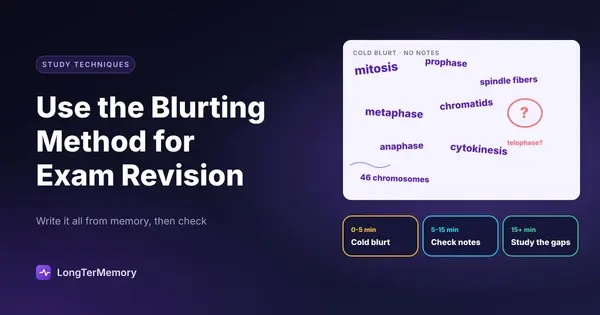
The blurting method is exactly what the name suggests. You close your notes. You take a blank sheet of paper. And you write down everything you can remember about a topic, in any order, without looking at anything. You keep writing until nothing else comes.
Then you open your notes, read what you actually wrote, compare it to what you should have covered, and circle or highlight everything you missed or got wrong. That circled material is your knowledge gap, and it’s your study agenda for the rest of that session.
It sounds deceptively simple, and that simplicity is part of why people underestimate it. The mechanism behind it is retrieval practice, one of the most consistently supported findings in cognitive psychology. Every time you retrieve information from memory, the memory trace for that information gets stronger. More importantly, every time you try to retrieve something and fail, you become more primed to retain it when you look it up.
This is why writing down everything you remember, even imperfectly, is more valuable than reading through your notes for the fifth time. The struggle of retrieval is where the learning happens.
How It Differs from Re-Reading
Re-reading creates what psychologists call the fluency illusion. When you read familiar material, it processes quickly and smoothly. Your brain interprets that fluency as understanding and knowledge, when actually it’s just recognition. You know what the words look like. You don’t necessarily know the concept well enough to reproduce it.
The blurting method bypasses the fluency illusion entirely. When you close your notes and try to write from memory, there’s no text to recognize. Either you can produce the information or you can’t. There’s no middle ground, no comfortable fake-knowing. Every blank on your page is honest data.
That honesty is the point. The discomfort you feel when your pen hovers and nothing comes is the most valuable feedback you can get during revision. It tells you exactly what you don’t know, which is the one thing re-reading actively hides from you.
The Full Blurting Method Process
Here’s the complete technique, step by step:
Step 1: Choose a topic or chapter. Pick a specific, contained topic rather than trying to blurt a whole subject. “Chapter 4: Cardiovascular System” works. “Everything about biology” doesn’t.
Step 2: Review your notes once, briefly. This is optional. Some practitioners start with a cold blurt at the beginning of the session. Others do a quick review first, then close the notes. If you’re using blurting at the start of a new revision session (to test what survived since last time), start cold. If you’re using it mid-session to consolidate what you just read, do the quick review first.
Step 3: Close everything. Notes, textbook, screen. Nothing open. Nothing visible.
Step 4: Write everything you remember. Dump it onto paper. Don’t worry about order, presentation, or completeness. Use bullet points, diagrams, lists, whatever helps you get it out. Write fast. The goal isn’t a neat summary, it’s a complete extraction of what’s currently in your head.
Step 5: Open your notes and compare. Read through what you wrote. Then read through your actual notes. Everything that was in your notes but not on your blurt page is a gap. Everything you wrote incorrectly is also a gap.
Step 6: Mark the gaps. Circle, highlight, or write them on a separate “gaps” list. These are the only things you need to actively study from here. Everything you got right is already solid, don’t spend more time on it.
Step 7: Study the gaps, then blurt again. Read through just your circled gaps. Close the notes. Blurt again, focusing on the content you just studied. This cycle of “blurt, identify gaps, study gaps, blurt again” is the engine of the technique.
Using Blurting at the Start of a Revision Session to Find Knowledge Gaps
Most students open their notes before they do anything else. They’re immediately primed by the content in front of them, which means they never get to discover what they actually remember independently.
Starting every revision session with a cold blurt inverts this completely. You begin by testing what survived from last time, before you look at anything.
This practice has several advantages:
Advantage 1: You Get Honest Diagnostics Every Session
You’ll quickly discover that the material you thought was solid at the end of yesterday’s session is patchier than you expected today. This isn’t a failure of your memory. It’s normal forgetting curve behavior. What the cold blurt gives you is accurate information about what actually needs review today, rather than what you felt good about yesterday.
Without a cold blurt, students tend to re-read all their notes even when most of it doesn’t need revision. With a cold blurt, you identify the specific 20 to 30% that needs attention and focus entirely on that.
Advantage 2: You Stop Wasting Time on What You Already Know
This is one of the bigger inefficiencies in student revision: spending equal time on things you know well and things you’re fuzzy on. The blurting method naturally prioritizes by revealing what you know (don’t spend more time on this) and what you don’t (spend all your time on this).
Over a revision period, this compounds. You stop cycling through material you’ve already mastered and concentrate revision time on genuine gaps.
Advantage 3: You Condition Your Memory for Exam-Style Retrieval
In an exam, you’re given a question and a blank page. You produce information. The blurting method is a direct simulation of that cognitive demand. The more times you practice retrieving information from nothing, under conditions that feel slightly uncomfortable, the more natural and automatic that retrieval becomes.
Students who do consistent blurting in revision typically report that they feel less anxious in exams, not because they studied more, but because the exam format feels familiar. They’ve been doing cold retrieval under pressure for weeks.
A Practical Blurting Schedule
If you’re revising across multiple subjects, a useful structure looks like this:
| Time | Activity |
|---|---|
| 0, 5 min | Cold blurt: write everything you remember about yesterday’s topic |
| 5, 15 min | Review notes, identify gaps from cold blurt |
| 15, 45 min | Study gaps using active recall (flashcards, Feynman method, re-reading gaps only) |
| 45, 60 min | Second blurt on the same topic |
| 60, 65 min | Open notes, verify second blurt completeness |
| 65, 90 min | Move to new topic, begin with fresh blurt |
This structure means you’re doing genuine retrieval practice throughout the session, not just at the end.
Integrating Blurting with Spaced Review for a Complete Exam Preparation System
The blurting method works well as a standalone technique, but it works even better when you integrate it with spaced repetition, the practice of reviewing material at increasing intervals over time.
The Problem Blurting Alone Doesn’t Solve
Blurting is excellent at showing you what you don’t know right now. But it doesn’t automatically schedule future reviews to make sure you don’t forget it. After a blurting session, you might solidify a gap perfectly, only to have it fade again in two weeks because you never revisited it.
Spaced repetition solves this. The optimal spacing for a memory depends on how well you know it: things you know well need less frequent review, things you’re shaky on need more. A spaced repetition system automates this scheduling.
The Combined System
Here’s how to combine blurting with spaced repetition effectively:
Step 1: Blurt to identify real gaps. Use blurting at the start of each study session to identify what you don’t know. This prevents you from wasting review time on material that’s already solid.
Step 2: Convert gaps into spaced repetition cards. Any gap you identify through blurting, a specific fact, definition, relationship, process, becomes a card in your spaced repetition system. You’re not building your card deck by reading through the textbook and guessing what might come up. You’re building it by identifying what you actually don’t know.
This means your card deck is a direct map of your real knowledge gaps, not a comprehensive summary of everything in the syllabus.
Step 3: Use blurting for topics, spaced repetition for details. Blurting works best at the level of topics and concepts: “What do I know about photosynthesis?” Spaced repetition works best at the level of specific details: “What is the correct equation for aerobic respiration?” Use both in parallel.
Step 4: Blurt before each spaced repetition session. Before you open your flashcard app, do a one-minute blurt on the general topic area. This primes your memory for the specific retrieval you’re about to do, and it gives you a real-time check on how your knowledge is developing.
Using LongTerMemory for Spaced Repetition Integration
LongTerMemory lets you upload your study materials and automatically generates Q&A pairs for spaced repetition. This works well alongside the blurting method: use blurting during active revision to identify your gaps in real time, and use LongTerMemory to ensure those gaps get revisited on a schedule that prevents forgetting.
The combination means you’re covering both the immediate encoding (blurting identifies and forces retrieval of gaps today) and the long-term retention (spaced repetition ensures those same gaps are reviewed at the optimal point before they fade again).
Common Mistakes When Using the Blurting Method
Mistake 1: Peeking at Your Notes Before Blurting
The most common failure is opening notes “just for a second” before starting a blurt. Once you’ve seen the content, you can no longer get honest data about what you remembered independently. The technique only works if the blurt is genuinely from memory.
If you catch yourself reaching for the notes before you’ve started, close them. The discomfort of starting with a blank page is the point. Sit in it.
Mistake 2: Not Going Back to Check
Blurting without comparing to your notes is like taking a practice test without reviewing the answers. You’ve done the hard part, the retrieval, but you’ve skipped the part that actually tells you what you need to fix.
Always spend equal time on the review phase. This is where you convert your blurt into a specific study plan for the rest of the session.
Mistake 3: Treating a Full Page as Success
A full blurt page feels good. It shouldn’t make you complacent. The gaps are what matter. Even if you covered 80% of the topic correctly, the 20% you missed is more valuable study material than the 80% you got right. Celebrate coverage briefly, then focus entirely on the gaps.
Mistake 4: Only Blurting Once Per Session
The real power of blurting comes from the study-gaps, blurt-again cycle. One blurt at the start of a session is better than nothing. A blurt, gap analysis, targeted study, and second blurt is dramatically more effective. The second blurt shows you whether the targeted study actually worked, or whether you need to go deeper.
Why Blurting Works So Well for High-Stakes Exams
For exams where the pressure is significant, like professional licensing tests, medical boards, bar exams, or major standardized tests, the blurting method addresses a specific psychological problem: the gap between knowing material in a relaxed environment and retrieving it under pressure.
When you’re anxious, working memory capacity decreases. Information that felt accessible in your study room can become hard to reach in an exam hall. Candidates who have practiced cold retrieval repeatedly, in the slightly uncomfortable conditions of a blurting session, have conditioned their memory retrieval to work under that kind of pressure.
It’s the same principle behind why practice tests under timed conditions are more valuable than untimed ones. You’re training the specific cognitive performance you’ll need on exam day, not just the knowledge base. Blurting every day for four weeks before a high-stakes exam is rehearsing that performance in the most relevant way possible.
The Bottom Line
The blurting method is retrieval practice in its simplest form: close the notes, write everything you remember, compare what’s missing. It takes five minutes to learn and a few sessions to become genuinely useful as a habit.
Its value comes precisely from what makes it uncomfortable. The blank page, the pen hovering, the realization that something you thought you knew isn’t coming out, that’s not a sign of poor preparation. That’s the method working exactly as it should. It’s showing you the truth about your knowledge rather than letting you hide behind the reassuring familiarity of re-reading.
Use it at the start of every revision session. Combine it with spaced repetition so your gaps get systematically revisited. Do a second blurt after studying your gaps to confirm the learning actually landed. And do it consistently enough that cold retrieval starts to feel natural, because that’s exactly what exam day will ask of you.