How to Use Your Certification to Get a Raise or Promotion
Turn your professional certification into a raise or promotion with practical strategies for timing, framing, and negotiation.
Table of Contents
- Timing the Certification Conversation With Your Employer for Maximum Impact
- Strike While the Achievement Is Fresh
- Timing Around Business Cycles
- After a Visible Win
- How to Quantify the Value of Your Certification to Your Organization
- Map the Certification to Business Outcomes
- Use Market Data
- Benchmark Against Internal Peers
- Negotiation Strategies for Salary Increases Tied to Professional Credentials
- Request a Dedicated Meeting
- Lead With the Value, Not the Ask
- Name a Specific Number
- Prepare for the Most Common Objections
- Consider the Full Compensation Picture
- The Strategic Case for Serial Certification
- After You Get the Raise: Setting Up the Next One
You spent months preparing. You sacrificed weekends, early mornings, and more than a few social events. You passed the exam. And now the certificate sits in your inbox or on your wall and you are wondering: what exactly do I do with this?
Getting a professional certification is one thing. Converting it into a raise or promotion is a different skill entirely, and it is one most people are never taught. The assumption tends to be that employers will notice and reward you automatically. Sometimes they do. More often, they need you to make the case explicitly, and the way you make that case makes an enormous difference.
This guide walks through the timing, the framing, and the negotiation mechanics that give you the best shot at turning your certification into a concrete career win.
Timing the Certification Conversation With Your Employer for Maximum Impact
Timing is the most underrated variable in salary and promotion negotiations. Even a compelling case for a raise falls flat if the context is wrong.
Strike While the Achievement Is Fresh
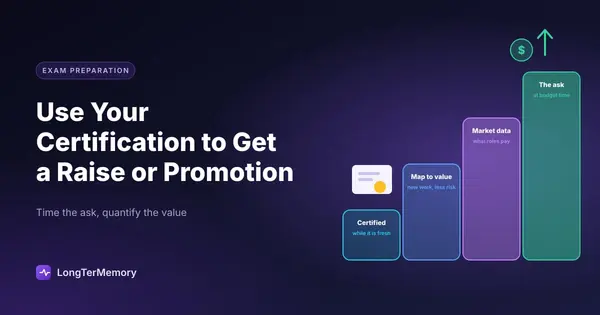
The optimal window for a certification-related compensation conversation is immediately after you pass, not three months later. Here is why: the psychological salience of your achievement fades over time for you and for your employer. What felt like a significant accomplishment in October feels routine by January. You want to have the conversation while the achievement is still a live, recent fact.
If you wait until your annual review and mention the certification you earned eight months ago as part of a longer list of accomplishments, it registers very differently than walking into your manager’s office within two weeks of passing and requesting a specific conversation about how this credential affects your compensation.
Timing Around Business Cycles
Beyond the recency window, you need to be aware of your company’s budget cycles. Most organizations have annual budget planning periods, often in Q3 or Q4, where compensation decisions for the following year are made. If you earn your certification in November and your company’s budget is locked in October, you may be asking for something that genuinely cannot happen until the next cycle, and that is not a rejection, it is logistics.
Understanding when your company makes these decisions lets you time your certification preparation accordingly. If you know the annual review cycle runs November through January, aiming to earn your certification by late September or early October puts you in the conversation before the budget is finalized.
After a Visible Win
Even better than asking right after certification is asking right after certification plus a recent visible win. A successful project delivery, a solved client problem, a process improvement you led. The combination of “I just passed a significant exam” and “and here is the business impact I delivered last month” creates a much stronger case than either alone.
You cannot always control when wins happen, but you can keep your ears open for timing opportunities. The period right after a major project wraps, when your contribution is fresh and your manager is in a positive frame of mind, is a naturally good moment to shift the conversation toward your development and compensation.
How to Quantify the Value of Your Certification to Your Organization
The most common mistake professionals make in these conversations is leading with the effort they put in rather than the value the organization receives. Your manager almost certainly respects that you worked hard. But compensation decisions are made based on value, not effort.
You need to answer the question your employer is implicitly asking: what does this certification mean for the work we do?
Map the Certification to Business Outcomes
Different certifications carry different business value depending on your industry and role. Here is how to think through it:
Does the certification qualify you for work you could not do before? For example, a PMP certification may make you eligible to lead larger projects or manage clients who require certified project managers on their account. An AWS certification may qualify you for a role tier that was previously unavailable to you. If the credential opens up a category of work, the value is tangible and you can say so directly.
Does the certification reduce organizational risk? Certifications in compliance, security (like CISSP, CISM, or CISA), healthcare, or law often signal that a person meets a standard that protects the organization from liability or regulatory exposure. If your certification means the company can point to a certified practitioner in that area, that has direct risk-reduction value.
Does the certification align with a direction the company is already moving? If leadership has signaled that the organization is expanding its cloud infrastructure, and you just earned a cloud certification, you are not just adding credentials. You are signaling that you are invested in the same future the company is investing in.
Use Market Data
Salary transparency sites like Levels.fyi (for tech), LinkedIn Salary, Glassdoor, and certification-specific salary surveys give you external reference points. Many certification bodies, including PMI, AWS, and CompTIA, publish annual salary surveys for their credential holders.
If the market data shows that certified professionals in your role and region command 12% more than non-certified counterparts, that is a concrete number you can bring to the table. You are not making a personal argument. You are pointing to what the market says your skill set is worth. That is a much easier conversation to have.
Build a simple one-page document for the conversation that includes:
- The certification you earned and what it required
- The market rate differential for certified vs. non-certified professionals in your field
- How this credential maps to current or upcoming projects or responsibilities
- Any specific business outcomes you have already contributed that your preparation or expertise enabled
You do not need to hand this document over. Having it forces you to think through your case clearly, and thinking through it clearly makes you more persuasive in the conversation itself.
Benchmark Against Internal Peers
If you know that colleagues at a similar level with similar certifications earn more than you currently do, that internal benchmark can be more powerful than market data because it removes the “that’s not how we pay here” objection. Be careful about how you use this information. Leading with “I know Sarah makes more than me” rarely lands well. But knowing that the gap exists can strengthen your walk-away clarity.
Negotiation Strategies for Salary Increases Tied to Professional Credentials
Knowing your case does not automatically translate into a successful negotiation. The mechanics of how you have the conversation matter a great deal.
Request a Dedicated Meeting
Do not ambush your manager with a salary conversation at the end of a one-on-one about something else. Request a specific conversation with a brief framing: “I just passed my AWS certification and I’d like to set up time to talk about how that affects my compensation and career trajectory here.” This signals that you are professional and prepared, and it gives your manager time to think before you walk in.
A manager who has advance notice is a manager who can think about whether to approve a raise, rather than having to say “let me get back to you” which often turns into nothing happening.
Lead With the Value, Not the Ask
When you sit down, start by articulating what you bring now that you did not before. Walk through the value points you have already prepared: the business outcomes enabled, the market data, the risks mitigated or opportunities unlocked. Let the case build before you state a number.
This is counterintuitive for many people who feel like leading with “I want X” is more honest or direct. It can feel more direct, but it often triggers an immediate defensive response rather than an open conversation. Leading with value primes your manager to see why the ask is reasonable before they have to process the ask itself.
Name a Specific Number
When you do make the ask, be specific. “I’d like to discuss increasing my salary” is a weak opening. “Based on the market data and what this certification enables for the team, I’m asking for a base salary adjustment to $X” is much stronger.
Specific asks are taken more seriously than vague ones. They signal that you have done your research and you know what you are worth, which is itself a signal of professional competence. The discomfort of naming a specific number is worth pushing through.
Prepare for the Most Common Objections
“The budget is frozen right now.” Ask about a timeline for the next review cycle and get a specific date in the calendar. “Can we put a follow-up meeting on the calendar for March when the new budget takes effect?”
“We need to evaluate how the certification translates to your work here.” This is a reasonable response. Ask for a specific review in 90 days based on defined criteria: “That makes sense. Can we agree on what I need to demonstrate in the next quarter and schedule a follow-up?”
“We don’t pay differently based on certifications.” This is worth pushing back on gently: “I understand the policy, but the certification also reflects a significant upgrade in what I’m capable of doing and what value I can deliver. Can we talk about how that growth maps to career progression here?”
If the answer is a hard no and no timeline or criteria are offered, that is important information about how much the organization values professional development. It is worth factoring into your longer-term plans.
Consider the Full Compensation Picture
Salary is not the only lever. If a direct salary increase is genuinely not possible, negotiate for other things that have real value:
- A defined timeline for the salary review (with it in writing)
- A title change that better reflects your current credential level
- Additional paid time off for continued professional development
- Reimbursement for the next certification exam or prep materials
- A clear written criteria for what a promotion to the next level requires
Getting a certification reimbursement policy established is particularly valuable because it creates a company-level commitment to your ongoing development.
The Strategic Case for Serial Certification
One certification is a credential. A strategic sequence of certifications is a career narrative, and the latter is significantly more valuable.
If your first certification is AWS Solutions Architect, the natural next steps are AWS Developer or AWS DevOps, with the ultimate goal of a senior architect or cloud lead title that commands a premium. If your first certification is PMP, the path might run through PMI-ACP (Agile) or a PRINCE2 certification, broadening the project management frameworks you can operate in.
Mapping your certifications to a progression, and communicating that progression explicitly to your employer, positions you not as someone who passed a test but as someone with a multi-year trajectory of increasing capability. That is a very different conversation to have, and it tends to generate different kinds of opportunities.
LongTerMemory is worth knowing about here. If you are preparing for your next certification while working full-time, the platform’s spaced repetition system makes it much more realistic to study in small, consistent sessions without burning out. Upload your study materials, let the system generate practice questions, and review during your commute or lunch break. The efficiency gains are real.
After You Get the Raise: Setting Up the Next One
If the negotiation succeeds, the work does not stop. The raise or promotion you just earned is a data point about what has worked. Use it to set up the next one.
Document what the criteria were, what you demonstrated, and what the outcome was. If your manager mentions that you are on track for a further review in 18 months contingent on leading a specific type of project, put that in writing (a follow-up email after the conversation is fine) and track against it.
The professionals who build consistent upward trajectories are the ones who treat each career conversation as part of an ongoing process rather than a one-off event. Your certification was the investment. Getting paid for it appropriately is the return. Managing the next cycle of investment and return is what a career looks like over time.