How to Build a Certification Roadmap for Career Advancement
Plan your professional certifications strategically. Learn how to sequence, prioritize, and study for certifications that accelerate your career.
Table of Contents
- Step One: Anchor Everything to a Specific Career Goal
- Step Two: Map the Certification Landscape in Your Field
- An Example Roadmap: Cloud Infrastructure
- Step Three: Sequence Certifications to Build on Each Other
- Step Four: Balance Cost, ROI, and Study Time Investment
- Step Five: Build a Realistic Study Timeline
- Making Study Sessions Actually Efficient
- Managing Renewal Deadlines and Continuing Education
- When to Pause the Roadmap
- The Bottom Line: A Roadmap Beats Random
Here’s a frustrating situation that more people land in than you’d think. You decide to get certified in your field, you pick something that sounds relevant, you spend months studying for it, you pass, and then… not much changes. The certification goes on your resume, you’re proud of it, but the actual career impact is underwhelming. You’re not sure what you did wrong.
Usually, the problem isn’t the studying. It’s the planning, specifically, the lack of it.
Professional certifications are most powerful when they’re part of a deliberate sequence, not random additions to a resume. The certifications that actually move your career forward are the ones that connect to each other logically, align with a specific career trajectory, and demonstrate a coherent progression of expertise to employers.
Building a certification roadmap means figuring out which credentials to pursue, in what order, and how to sequence your study time and financial investment for the maximum career return. This guide walks you through exactly how to do that.
Step One: Anchor Everything to a Specific Career Goal
The biggest mistake people make when planning certifications is thinking about them from the credential side instead of the career side. They look at what’s popular, or what seems impressive, or what their company is willing to pay for, and work backward from there.
The right approach is the opposite. Start with a clear answer to this question: what specific role or level of role do I want to be in three to five years?
This might be “team lead in cloud infrastructure,” or “senior data analyst at a mid-size tech company,” or “independent project management consultant,” or “CISO at a financial services firm.” The specificity matters because different career destinations require very different certification paths.
Once you have a destination, you can research what certifications employers consistently require or prefer for that role. This means actually reading job postings, not just a few but dozens, for the roles you’re targeting at companies you’d genuinely want to work at. Pay attention to what certifications appear repeatedly in the requirements or preferred qualifications. Those are the ones worth your time. The rest are noise.
Also pay attention to what certifications the people currently in those roles hold. LinkedIn is useful here. Search for people with the title you’re targeting, look at their credentials sections, and identify patterns. What certifications appear most consistently among people who have the job you want? That’s your signal.
Step Two: Map the Certification Landscape in Your Field
Most professional certification ecosystems have a logical architecture, though it’s not always obvious from the outside. Once you understand the structure, sequencing becomes much cleaner.
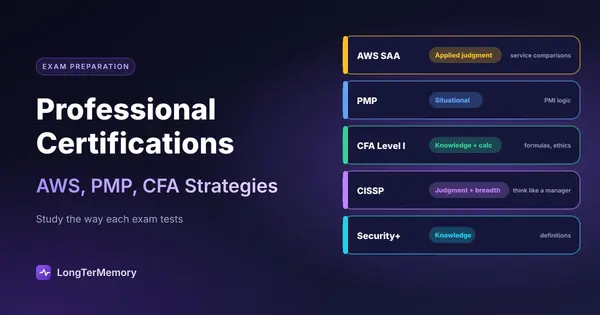
Foundational credentials are designed for people entering a field. They establish baseline knowledge and are often prerequisites (formal or informal) for more advanced certifications. In IT, this is something like CompTIA A+, or AWS Cloud Practitioner, or ITIL Foundation. In project management, it might be the CAPM before the PMP. In cybersecurity, it might be CompTIA Security+ before moving into specializations.
Professional-level credentials require experience and deeper knowledge. These are the certifications that meaningfully differentiate you from candidates without them. AWS Solutions Architect, PMP, CISSP, CFA Level II, CPA, CISM, the credentials in this tier typically have experience requirements and are designed to certify genuine professional competence, not just studied knowledge.
Specialist or expert credentials represent the deepest tier of certification in a domain. AWS Specialty certifications, the CISSP concentrations, the CFA Level III, these signal mastery in a narrow area and are most relevant for very senior roles or highly specialized positions.
Understanding where each certification sits in this hierarchy tells you two things: what order makes sense, and what you need before you can realistically pursue each credential.
An Example Roadmap: Cloud Infrastructure
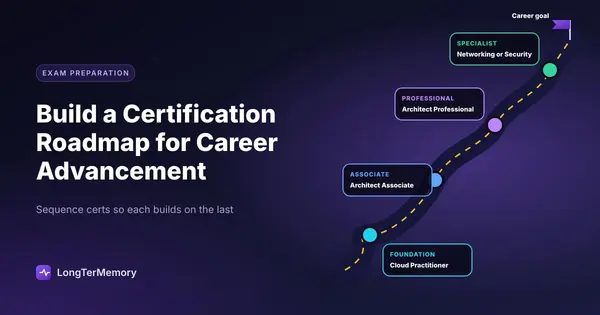
Let’s make this concrete with an example. If your goal is senior cloud architect at a technology company:
| Stage | Certification | Purpose |
|---|---|---|
| Foundation | AWS Cloud Practitioner | Establishes cloud fundamentals |
| Associate | AWS Solutions Architect Associate | Core architecture knowledge |
| Professional | AWS Solutions Architect Professional | Senior-level validation |
| Specialist | AWS Advanced Networking or Security | Differentiating specialization |
This path has internal logic. Each credential builds on the previous one in terms of knowledge. Studying for each becomes more efficient because you’re building on established understanding rather than starting from scratch.
Step Three: Sequence Certifications to Build on Each Other
The most efficient certification paths are the ones where each credential reinforces the learning for the next one. This is the key insight that separates strategic certification planning from credential collecting.
When certifications share overlapping knowledge domains, studying for the second one is significantly faster than studying for the first, because you already have the conceptual foundation. An IT professional who has passed the AWS Solutions Architect Associate will find studying for the Professional version substantially faster than starting from scratch, because the underlying AWS architecture knowledge is already in place.
This principle of progressive knowledge scaffolding applies across fields:
- In finance, CFA Level I knowledge directly supports Level II, which directly supports Level III.
- In project management, CAPM knowledge overlaps significantly with PMP content.
- In cybersecurity, CompTIA Security+ builds directly toward CISSP domain knowledge.
- In IT service management, ITIL Foundation provides the framework context for all higher ITIL levels.
When you map your roadmap, look for these overlapping knowledge domains and sequence your certifications to maximize the reuse of what you’ve already learned. Don’t choose credentials based solely on prestige or market hype. Choose them partly based on how efficiently they build on each other.
Step Four: Balance Cost, ROI, and Study Time Investment
Certifications are investments, and like all investments, they need to be evaluated in terms of return relative to cost.
Costs of a certification include:
- Exam fees (ranging from under $100 for some entry-level credentials to over $1,000 for some professional-level exams)
- Study materials (books, online courses, practice exams), typically $100 to $500+
- Time investment, often 100-400+ hours for professional-level credentials
- Opportunity cost, the time spent studying is time not spent on other career development activities
Returns on a certification can include:
- Salary increases (many certifications carry documented compensation premiums)
- Eligibility for roles you couldn’t apply for without the credential
- Increased competitive strength in promotions or job searches
- Expanded professional network through certification communities
- Consulting or freelance opportunities that require the credential
The ROI calculation isn’t always obvious upfront, which is why the job market research from Step One matters so much. If you’re seeing the certification repeatedly in job postings for roles that pay significantly more than your current role, the ROI case is relatively easy to make. If it only shows up occasionally, or only in companies you wouldn’t want to work at, that’s a different calculation.
Employer reimbursement is also worth investigating. Many organizations offer education benefits that cover certification costs, sometimes including study materials and exam fees. Pursuing certifications your employer will pay for isn’t just smart financially, it often also signals to your employer that you’re investing in skills aligned with company needs, which has its own career benefits.
Step Five: Build a Realistic Study Timeline
Once you have your roadmap, you need to translate it into a realistic timeline. This is where optimism usually needs a significant correction.
Professional-level certifications are demanding. The PMP requires 36 or 60 months of project management experience before you can even sit the exam. The CISSP requires five years of security experience in at least two domains. The CFA program typically takes four to five years to complete all three levels, with pass rates below 50% at each level. These aren’t credentials you accumulate quickly.
For planning purposes, a useful framework for each certification is:
- Determine your experience eligibility (some certifications have experience prerequisites that must be met regardless of how prepared you are).
- Estimate realistic study hours (use pass rate data, forum posts from recent candidates, and official preparation estimates as reference points).
- Map those hours to your available study time (be honest about how many hours per week you can genuinely sustain without burning out).
- Add a buffer (things always take longer than you plan; build in at least 20% extra time).
- Set an exam date (having a concrete date creates accountability and prevents indefinite preparation).
If your roadmap covers three or four certifications over a multi-year career arc, don’t try to plan all of it in detailed precision right now. Plan the next credential in detail. Have a rough outline for the ones after that. Update the plan as your situation evolves.
Making Study Sessions Actually Efficient
A certification roadmap is only useful if the studying behind it is actually effective. And this is where a lot of people lose time and momentum.
Passive review, reading through study guides and watching lecture videos repeatedly, is the most common study method and one of the least efficient. Research on learning consistently shows that active recall, testing yourself on material before you check whether you’re right, produces dramatically better retention than passive review.
For certification preparation specifically, this means:
- Using practice exams and practice questions as a primary study tool, not a final check.
- Working through question banks repeatedly until you can consistently explain not just the right answer but why the wrong answers are wrong.
- Creating your own flashcards for key concepts, definitions, frameworks, and processes.
- Explaining concepts out loud as if teaching them to someone unfamiliar with the field.
LongTerMemory is particularly useful for certification preparation because it automates the conversion of your study materials (PDFs of official guides, domain summaries, practice question explanations) into spaced-repetition flashcards. This means you can spend your limited study time on active retrieval rather than manual organization of what to review and when. The platform handles the scheduling logic, surfacing material at optimal intervals based on your performance.
Managing Renewal Deadlines and Continuing Education
Many professional certifications expire or require continuing education credits to maintain. This is often an afterthought when pursuing a credential, but it should be part of your roadmap planning.
Common renewal structures:
| Certification | Renewal Period | Continuing Education Requirement |
|---|---|---|
| PMP | 3 years | 60 PDUs |
| CISSP | 3 years | 120 CPE credits |
| CFA | Annual | Statement of professional conduct |
| AWS certifications | 3 years | Recertification exam |
| ITIL certifications | No expiry | None (some higher levels differ) |
Understanding renewal requirements before you pursue a certification helps you plan the ongoing investment required to keep it valid. Some certifications require continuous active engagement with the field to accumulate the necessary continuing education credits. Others require periodic exams. The ongoing commitment should factor into your prioritization, especially if you’re deciding between two certifications with similar career impact.
When to Pause the Roadmap
Not every period in your career is right for aggressive certification pursuit. Periods of high workplace demands, major life transitions, or burnout are times when pausing the roadmap to let existing knowledge consolidate is often the strategically correct move.
The goal of a certification roadmap isn’t to perpetually push toward the next credential. It’s to make deliberate, well-timed investments in your professional capabilities that compound over time. Pursuing a certification when you can’t give it adequate preparation time often means failing the exam and having to retake it, which costs more in both time and money than waiting for a better window.
Also worth noting: work experience itself is a form of skill building that often matters as much as certifications to employers. A certification combined with genuine hands-on experience in the domain is far more compelling than a certification accumulated without corresponding practice. Your roadmap should include intentional efforts to gain the experience that makes your certifications meaningful, not just the credentials themselves.
The Bottom Line: A Roadmap Beats Random
Professional certifications can make a meaningful difference in your career trajectory. But their impact depends heavily on strategic sequencing, realistic planning, and efficient preparation.
Start with a clear career destination. Research what credentials appear consistently in job postings for that role. Map the certification hierarchy in your field. Sequence credentials to build on each other efficiently. Evaluate cost and ROI realistically. Build a sustainable study timeline. Use active learning methods that make your preparation efficient. And account for renewal requirements before you commit.
That’s a roadmap worth following. Not a credential collection, but a deliberate path toward a specific professional destination, built one well-chosen certification at a time.
The difference between people whose certifications change their careers and people whose certifications just fill a corner of their resume isn’t luck. It’s planning.