How to Study for the CISM or CISA Certification
Preparing for CISM or CISA? This guide covers domain priorities, study strategies, and practice question tactics to pass your information security exam.
Table of Contents
- CISM vs. CISA: Understanding the Difference Before You Study
- The Experience Requirement: Don't Overlook This
- Building Your Study Plan
- Estimate Realistic Study Time
- Start with the ISACA Review Manual
- Use the QA&E Database
- The Mindset Shift: ISACA Thinks Like a Manager (or Auditor)
- Domain Prioritization: Where to Focus
- For CISM
- For CISA
- Practice Question Strategy
- Phase 1: Diagnostic (First 2 Weeks)
- Phase 2: Domain-by-Domain Deep Work (Middle Bulk of Study)
- Phase 3: Mixed Practice and Simulation (Final 3–4 Weeks)
- The Week Before the Exam
- Maintaining the Certification
- Using Technology to Accelerate Your Prep
- The Bottom Line
If you’re considering the CISM (Certified Information Security Manager) or CISA (Certified Information Systems Auditor) certification, you’re already aiming at two of the most respected credentials in the information security and IT audit world. Both are issued by ISACA and both carry serious weight with employers. But they’re quite different animals in terms of what they test, who they’re designed for, and how you should prepare.
This guide walks you through the key differences, how to build a smart study plan for each, and the practice question strategies that consistently separate candidates who pass from those who don’t.
CISM vs. CISA: Understanding the Difference Before You Study
Before you open a single review manual, it’s worth making sure you’re preparing for the right exam. These two certifications are frequently confused , and studying for the wrong one (or blending your prep approach) is an expensive mistake.
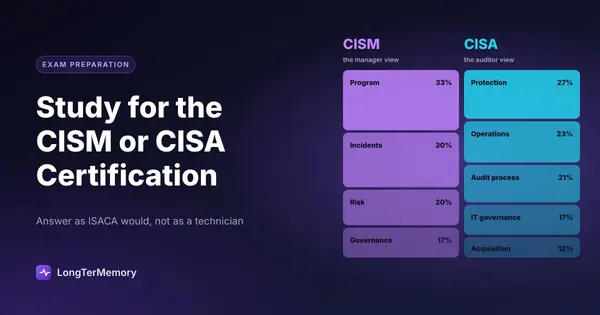
CISM is a management-level credential. It’s designed for people who are responsible for managing, designing, and overseeing an enterprise’s information security program. The four CISM domains are:
| Domain | Weight |
|---|---|
| Information Security Governance | 17% |
| Information Risk Management | 20% |
| Information Security Program | 33% |
| Incident Management | 30% |
CISA, on the other hand, is an audit credential. It’s designed for people who audit, control, and assure IT systems. The five CISA domains reflect this:
| Domain | Weight |
|---|---|
| Information Systems Auditing Process | 21% |
| Governance and Management of IT | 17% |
| Information Systems Acquisition, Development, and Implementation | 12% |
| Information Systems Operations and Business Resilience | 23% |
| Protection of Information Assets | 27% |
The practical difference: CISM asks what a manager would decide. CISA asks what an auditor would find, flag, or recommend. If your day job involves running a security program, CISM fits your experience. If it involves reviewing controls and writing audit reports, CISA is the natural fit.
Choosing the wrong exam doesn’t just mean studying the wrong material , it means the exam questions will feel alien to your work experience, which makes them significantly harder to answer correctly.
The Experience Requirement: Don’t Overlook This
Both certifications require verified work experience before the certification is granted , but you can sit for the exam before completing it.
- CISM requires five years of information security work experience, with at least three years in security management across at least two CISM domains.
- CISA requires five years of professional experience in information systems auditing, control, or security.
ISACA does allow some substitutions (education, other certifications) that can waive up to two years of experience. Check the current ISACA requirements because these details change, and the last thing you want is to pass the exam and then find out you don’t yet qualify for certification.
The key point: passing the exam and being certified are two separate milestones. If you’re light on experience, sit for the exam now, pass it, and then complete the experience requirement over the following five years. Your passing score stays valid.
Building Your Study Plan
Estimate Realistic Study Time
Most candidates who pass their first attempt report studying somewhere between 100 and 150 hours total. That’s a wide range because experience matters enormously. Someone who has spent a decade managing security programs will find CISM questions much more intuitive than someone coming from a purely technical background.
A reasonable baseline for someone with relevant work experience:
- 3 to 4 months of structured study at roughly 8–10 hours per week
- Accelerated (6–8 weeks): 15–20 hours per week , achievable, but demands real discipline
For CISA, candidates from non-audit backgrounds often need closer to 150 hours because the audit mindset , particularly the IS auditing process domain , requires building a mental model that doesn’t come from hands-on security work alone.
Start with the ISACA Review Manual
The official ISACA review manual for your target exam is essential reading, not optional. It’s dense, it’s not exactly a page-turner, but every question on the actual exam is written to align with the frameworks and definitions in that manual. When practice questions use a term in a surprising way, the manual almost always explains why.
Don’t try to memorize the manual. Instead, read it for frameworks and context, then use practice questions to identify where your mental model diverges from ISACA’s.
Use the QA&E Database
ISACA sells access to their Question, Answer & Explanation (QA&E) database, which contains hundreds of exam-style questions with detailed explanations. This is arguably the single most useful study tool available. The explanations don’t just tell you what the right answer is , they explain why each wrong answer is wrong, which is how you build the pattern recognition you need for the actual exam.
Work through these questions in sets of 20–30, then review every question , including the ones you got right , before moving on.
The Mindset Shift: ISACA Thinks Like a Manager (or Auditor)
This is the piece most candidates miss, especially those with strong technical backgrounds.
ISACA exam questions are not asking what the technically correct solution is. They’re asking what a responsible manager (CISM) or a thorough auditor (CISA) would prioritize, recommend, or do first.
That distinction matters enormously. Here’s a pattern you’ll see repeatedly:
The organization has detected a potential data breach. What should the information security manager do FIRST?
Technical candidates instinctively reach for “isolate the affected systems” or “forensic investigation.” ISACA’s preferred answer is almost always something like “notify senior management” or “activate the incident response plan.” The manager’s first responsibility is governance and escalation, not technical remediation.
Similarly for CISA, questions about system implementations almost always prioritize controls and auditability over performance or technical elegance.
Practice this mindset deliberately. When you read a question and your gut says “fix the problem,” stop and ask yourself: “What would a manager or auditor who’s responsible for governance do first?” Nine times out of ten, that reframe points you toward the right answer.
Domain Prioritization: Where to Focus
Not all domains are equal, and your study time should reflect the exam weighting.
For CISM
Incident Management (30%) and Information Security Program (33%) together make up nearly two-thirds of the exam. Do not underweight these. Deep familiarity with:
- Incident response lifecycle (preparation → detection → containment → recovery → lessons learned)
- How security programs align to business objectives
- Metrics and reporting upward to senior leadership
Information Risk Management (20%) comes next. Focus on risk assessment methodology, risk treatment options (accept, mitigate, transfer, avoid), and how to present risk to non-technical stakeholders.
For CISA
Protection of Information Assets (27%) and IS Operations and Business Resilience (23%) carry the most weight. Prioritize:
- Access controls and identity management
- Business continuity and disaster recovery (from an audit perspective , not implementation, but assurance)
- Physical and environmental controls
IS Auditing Process (21%) is the domain that trips up non-auditors. Spend dedicated time on audit evidence standards, sampling methods, and audit report writing.
Practice Question Strategy
Random practice question exposure is not an effective study method. Use a structured approach:
Phase 1: Diagnostic (First 2 Weeks)
Take 50–100 questions per domain without any prior study. Your goal is not to score well , it’s to identify which domains feel foreign and which align with your experience. This tells you where to concentrate your manual reading.
Phase 2: Domain-by-Domain Deep Work (Middle Bulk of Study)
Read each domain section in the review manual, then immediately do 30–50 practice questions on that domain. When you get something wrong, don’t just note the right answer , understand the reasoning. If the explanation doesn’t make sense, go back to the manual.
Phase 3: Mixed Practice and Simulation (Final 3–4 Weeks)
Stop domain-specific practice. Switch to full mixed-question sessions of 100–150 questions under timed conditions (the real exam gives you roughly 1.5 minutes per question for CISM’s 150 questions, and similar pacing for CISA’s 150).
Track your rolling accuracy by domain. Any domain consistently below 65% deserves additional review.
The Week Before the Exam
Stop learning new material the week before the exam. Your brain needs consolidation time, not new input.
Spend that final week doing light review sessions of 30–40 questions per day, reviewing your weak-area notes, and getting physically ready. Sleep matters more than grinding at this stage , memory consolidation happens during sleep, and showing up exhausted to a 4-hour exam is a mistake that no amount of extra study compensates for.
On exam day, read every question twice before selecting an answer. ISACA questions often include qualifiers (“FIRST,” “MOST important,” “BEST”) that completely change which answer is correct. Candidates who rush frequently miss these qualifiers and pick the second-best answer when the best was right there.
Maintaining the Certification
Both CISM and CISA require Continuing Professional Education (CPE) hours to maintain active status:
- CISM: 20 CPE hours per year, 120 over the 3-year renewal cycle
- CISA: 20 CPE hours per year, 120 over the 3-year renewal cycle
ISACA audits CPE submissions, so keep records. Attending ISACA chapter events, taking courses, publishing articles, or training others all count toward CPE. If you’re actively working in the field, you’re probably accumulating CPE hours without realizing it , start tracking them from your certification date.
Using Technology to Accelerate Your Prep
Modern AI-powered study tools can meaningfully reduce the time it takes to internalize CISM and CISA material. If you can upload your notes, domain summaries, or highlighted sections from the review manual and generate instant flashcard decks and practice questions, you can dramatically compress the review cycle.
LongTerMemory lets you do exactly this , upload your study materials as PDFs and automatically generates spaced repetition flashcards and Q&A pairs from them. For domain-heavy certifications like CISM and CISA where there’s a large volume of frameworks and terminology to internalize, having a tool that automatically schedules your review sessions around your actual forgetting curve is a genuine advantage over manual flashcard creation.
The Bottom Line
CISM and CISA are rigorous exams that reward the candidate who understands how ISACA thinks, not just the candidate who knows the most. The study plan that consistently works:
- Choose the right exam for your career trajectory
- Read the official manual for frameworks, not memorization
- Use practice questions as the primary learning tool
- Internalize the manager/auditor mindset before exam day
- Simulate exam conditions in your final weeks
- Rest and consolidate the week before
The candidates who fail usually either underestimate the volume of material, neglect the mindset shift, or grind passive review instead of active practice questions. The candidates who pass do the opposite. It’s genuinely that predictable.
If your job is in information security or IT audit, you already have more relevant experience than you’re giving yourself credit for. The gap is almost always in knowing how ISACA frames that experience, not in lacking the experience itself.