How to Prepare for the CPCU Exam: Complete Study Guide
A practical guide to studying for the CPCU designation, covering the exam series structure, high-yield content areas, and multi-exam study strategies.
Table of Contents
- CPCU Designation Structure and How the Exam Series Works
- The Two Pathways
- The Eight Exams
- The Ethics Component
- High-Yield Content Areas Across CPCU Course Exams
- CPCU 500: Foundations of Risk and Insurance
- CPCU 520: Insurance Operations
- CPCU 530: Business Law for Insurance Professionals
- CPCU 540: Finance and Accounting for Insurance Professionals
- Commercial Lines Concentration (551, 552)
- Study Approach for the Multi-Exam CPCU Designation
- Pace Yourself: One Exam at a Time
- Use the Institutes' Study Tools Strategically
- Build a Flashcard Deck From Chapter Summaries
- Connect Study Material to Your Day Job
- Practice Questions Are Non-Negotiable
- Making the Most of LongTerMemory for CPCU Prep
- The Conferment Ceremony
- Final Thoughts
If you work in property and casualty insurance and you’re serious about advancing your career, the Chartered Property Casualty Underwriter (CPCU) designation is one of the most respected credentials you can earn. It’s not an easy one, though, and the multi-exam structure catches a lot of candidates off guard. Unlike a single-exam certification, the CPCU is a program you commit to for months or years, working through a series of courses before you earn the right to use those four letters after your name.
This guide is for candidates who want to understand exactly what they’re getting into, how to structure their study approach across the full designation, and how to pass each exam without burning out or losing months to ineffective preparation.
CPCU Designation Structure and How the Exam Series Works
The Two Pathways
The CPCU designation is awarded by The Institutes, and it’s organized around two tracks:
- CPCU with a Commercial Lines focus (recommended for underwriters, risk managers, and commercial lines professionals)
- CPCU with a Personal Lines focus (better suited for personal lines adjusters, agents, and customer-facing roles)
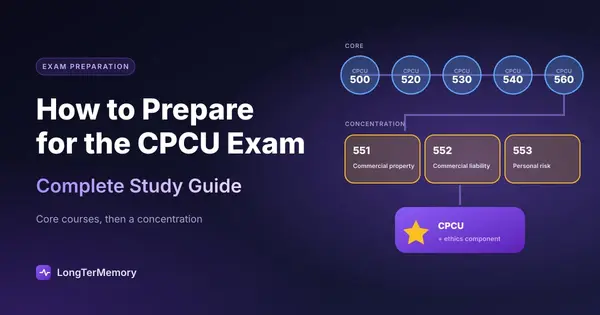
Regardless of which track you choose, there are eight required exams total. Five of those are core exams that everyone takes, and three are concentration exams based on your chosen pathway. On top of completing the exams, you need to meet an ethics requirement and have at least two years of relevant work experience before you can attend the conferment ceremony.
The Eight Exams
Here’s an overview of the core and concentration exams:
| Code | Course | Focus Area |
|---|---|---|
| CPCU 500 | Foundations of Risk and Insurance | Core |
| CPCU 520 | Insurance Operations | Core |
| CPCU 530 | Business Law for Insurance Professionals | Core |
| CPCU 540 | Finance and Accounting for Insurance Professionals | Core |
| CPCU 560 | Financial Services Institutions | Core |
| CPCU 551 | Commercial Property Risk Management and Insurance | Commercial Concentration |
| CPCU 552 | Commercial Liability Risk Management and Insurance | Commercial Concentration |
| CPCU 553 | Survey of Personal Risk Management, Insurance, and Financial Planning | Personal Concentration |
Each exam consists of 75 multiple-choice questions and is taken at a Prometric testing center. The passing score varies by exam but typically requires around 70% correct. You can register for exams individually through The Institutes, and there’s no required order, though most candidates follow a logical sequence starting with CPCU 500.
The Ethics Component
Before you can receive the CPCU designation, you must pass an online ethics course and agreement. This is separate from the main exam series. It’s not particularly difficult, but don’t overlook it or assume you’ll knock it out after the other exams. Schedule it and complete it as you approach the end of your exam series.
High-Yield Content Areas Across CPCU Course Exams
Each CPCU exam has its own content focus, and knowing where to concentrate your preparation time is the difference between targeted efficiency and covering too much material too broadly.
CPCU 500: Foundations of Risk and Insurance
This is most candidates’ starting point and the conceptual backbone of the entire designation. The highest-yield content areas are:
- Risk management concepts: pure vs. speculative risk, frequency vs. severity, risk treatment options (avoid, reduce, retain, transfer)
- Insurance mechanism: how insurers pool and transfer risk, the law of large numbers, adverse selection
- Underwriting principles: selection, classification, pricing
- Policy analysis: declarations, insuring agreement, conditions, exclusions
Many candidates treat CPCU 500 as an easy warm-up, and then get surprised by how conceptually dense the material is. The foundational principles in CPCU 500 show up in every subsequent exam. Time invested here pays off throughout the program.
CPCU 520: Insurance Operations
This course covers how insurance companies actually function, from marketing and distribution to claims and reinsurance. High-yield areas:
- Distribution systems: direct writing, independent agents, managing general agents
- The underwriting process: submission, evaluation, pricing decisions, regulatory constraints
- Claims operations: the claims investigation process, settlement authority, bad faith liability
- Reinsurance: treaty vs. facultative, proportional vs. non-proportional, why companies use it
Expect scenario-based questions that test whether you understand not just definitions but how departments and processes interact. Abstract memorization isn’t enough here.
CPCU 530: Business Law for Insurance Professionals
This is the exam that surprises candidates who aren’t comfortable with legal concepts. The content covers:
- Contract law: offer, acceptance, consideration, capacity, legal purpose
- Agency law: agent vs. broker authority, vicarious liability, scope of employment
- Tort law: negligence elements, strict liability, intentional torts
- Insurance regulatory law: licensing requirements, rate and form regulation, solvency regulation
The business law exam is genuinely difficult for people without a legal background. Allocate more preparation time than you think you need. Flashcards work extremely well here because so much of it involves legal definitions and rules with distinct exceptions.
CPCU 540: Finance and Accounting for Insurance Professionals
Financial literacy is non-negotiable for CPCU candidates, and this exam tests it. Key content areas:
- Financial statements: reading a balance sheet and income statement, loss reserve analysis
- Time value of money: present value, future value, annuities
- Insurance-specific financial concepts: combined ratio, loss ratio, expense ratio, investment income
- Capital requirements: risk-based capital, insurer solvency analysis
Candidates from underwriting or claims backgrounds who have limited financial training often find this the most challenging core exam. Work through practice problems consistently, not just conceptual reading.
Commercial Lines Concentration (551, 552)
These are the most practically relevant exams for most CPCU candidates:
CPCU 551 (Commercial Property): Commercial property coverage forms, business income, inland marine, builder’s risk, flood and earthquake exclusions, valuation methods (replacement cost vs. ACV)
CPCU 552 (Commercial Liability): Commercial general liability, auto liability, professional liability, umbrella and excess coverage, workers compensation
If you work in commercial lines, this is where your existing job knowledge gives you a significant advantage. Leverage it by connecting study material to scenarios you’ve seen at work.
Study Approach for the Multi-Exam CPCU Designation
Pace Yourself: One Exam at a Time
The most common reason candidates stall in the CPCU program is overcommitment. They register for two or three exams per year, fall behind, lose momentum, and let registrations lapse. The designation gets abandoned before completion.
A more sustainable approach: one exam at a time, on a committed 8 to 12 week timeline per exam. That’s a manageable pace that typically allows completion of the full designation in two to three years while working full-time.
Eight to twelve weeks per exam looks like this:
| Week | Activity |
|---|---|
| 1, 2 | Read through the assigned textbook once (don’t re-read, move forward) |
| 3, 4 | Create flashcards from key definitions, concepts, and rules |
| 5, 6 | Active recall drills: test yourself on flashcards daily, blank-page recall after each chapter |
| 7, 8 | Practice questions: at least 150 questions per sitting, review all wrong answers deeply |
| 9, 10 | Full practice exams under timed conditions, topic-level gap analysis |
| 11, 12 | Final targeted review, focus on weak areas only |
Use the Institutes’ Study Tools Strategically
The Institutes provide online study tools including practice questions, sample exams, and study guides. These are not optional extras, they’re core to passing. Their practice questions closely mirror the style and difficulty of actual exam questions.
Critical note: The Institutes update textbook content periodically. Always confirm you’re studying from the current edition before you begin. Using an outdated edition is one of the most wasteful mistakes CPCU candidates make.
Build a Flashcard Deck From Chapter Summaries
Each chapter in the CPCU textbooks ends with a summary. Those summaries are dense, but they’re also a near-perfect blueprint for your flashcard deck. For every term defined, create a Q&A card. For every concept explained, create a card that prompts you to explain it in your own words.
By the time you’ve built your deck from the chapter summaries, you’ve already done one pass through the most important content. The deck then serves you through the rest of your study period.
Connect Study Material to Your Day Job
One of the biggest advantages CPCU candidates have over other professional certification candidates is that their study material directly relates to their work. You’re not studying abstract concepts in a field you’ve never touched, you’re studying the theoretical framework behind work you do every day.
Use this. When you’re reviewing policy concepts at work, consciously connect what you’re looking at to what you’re studying. When you encounter a coverage question at work, look it up in your textbook that evening. This kind of contextual reinforcement sticks far better than isolated textbook study.
Practice Questions Are Non-Negotiable
The CPCU exams are knowledge-intensive, but they test application more than raw recall. Multiple-choice questions are frequently scenario-based, presenting a situation and asking what coverage applies, what the insurer’s obligation is, or what legal standard governs a dispute.
Candidates who study only by reading and re-reading the text without doing substantial practice question work consistently underperform. Do a minimum of 200 practice questions per exam, and review every wrong answer until you understand exactly why you missed it.
The pattern of your errors tells you where to focus. If you’re consistently missing questions about reinsurance, that’s your signal to go back to that section with active recall rather than passive re-reading.
Making the Most of LongTerMemory for CPCU Prep
Spaced repetition is particularly valuable for a multi-year designation program like the CPCU, because you need to retain material from early exams while learning material for later ones. Without a systematic review schedule, what you learned for CPCU 500 will have faded significantly by the time you’re sitting CPCU 552.
A spaced repetition system, like the one built into LongTerMemory, automatically schedules your review sessions based on how well you know each card, showing you difficult cards more often and cards you know well less frequently. Upload your CPCU study notes and let the platform generate practice questions automatically, so the review work maintains itself without requiring you to manually manage a review schedule.
This is especially valuable for the legal and financial exams, where there’s a large volume of discrete terminology that benefits from regular low-dose review rather than intensive cramming.
The Conferment Ceremony
If you complete all eight exams, meet the ethics requirement, and satisfy the work experience requirement, you’re eligible to attend the CPCU Society Annual Meeting, where you’ll be officially conferred the designation.
Most candidates who reach this point describe the conferment ceremony as genuinely meaningful, not just a formality. Earning the CPCU designation over two or three years of consistent work while managing a full-time career is a significant accomplishment. It’s worth doing it the right way.
Final Thoughts
The CPCU designation is one of those credentials that actually opens doors in the insurance industry. Hiring managers in underwriting, claims, risk management, and product development recognize it as evidence of serious professional commitment. But it only opens doors if you earn it, which requires managing a multi-year study program without burning out or cutting corners.
The candidates who succeed take it one exam at a time, use active recall and practice questions rather than passive reading, and connect their study material to their professional experience. That approach isn’t glamorous, but it’s reliable, and it gets you across the finish line.