How to Study French for DELF or DALF Certification
A complete DELF and DALF study guide: how the levels work, strategies for writing and speaking papers, and the best self-study resources for French exams.
If you need official proof of your French, whether for a university application, a visa, French citizenship, or a job, the DELF and DALF are the certifications that matter. They are issued by the French Ministry of Education, they never expire, and they are recognized worldwide. They are also, and this surprises many candidates, very much their own kind of exam, with formats and expectations that trip up even fluent speakers who walk in unprepared.
I have seen people who chat comfortably in French for hours fail the B2 writing paper, and modest speakers pass C1 because they understood exactly what the examiners wanted. That gap between “knowing French” and “passing a French exam” is what this guide is about.
Understanding the DELF and DALF Level Structure
First, the landscape. DELF and DALF are not two different exams so much as one family split across the six levels of the CEFR (Common European Framework of Reference for Languages):
| Certification | CEFR Level | Rough meaning | Common use |
|---|---|---|---|
| DELF A1 | Beginner | Basic phrases, introductions | Personal milestone |
| DELF A2 | Elementary | Simple everyday exchanges | Some residency applications |
| DELF B1 | Intermediate | Handle daily life independently | French citizenship requirement |
| DELF B2 | Upper intermediate | Argue, debate, write essays | University admission in France |
| DALF C1 | Advanced | Nuanced, structured, fluent | Competitive programs, professional roles |
| DALF C2 | Mastery | Near-native precision | Academic and translation careers |
Two practical consequences follow from this structure.
You choose your level when you register. There is no single exam that grades you into a level. You sign up for B2 specifically, and you either pass B2 or you do not. This makes level selection a strategic decision. Most advisors, myself included, suggest registering for the level you can already perform on a mediocre day, not the one you hit on your best day with a favorable topic.
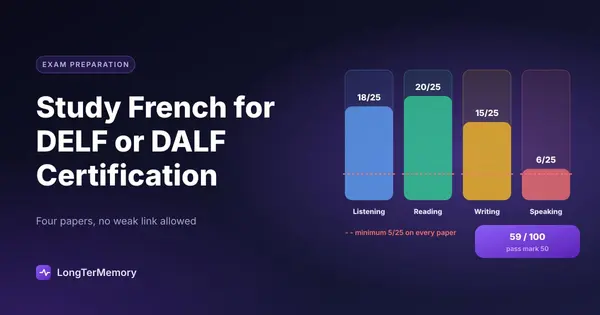
Each exam has four papers, and you must not bomb any of them. Every level tests listening, reading, writing, and speaking. Each paper is worth 25 points. You need 50 out of 100 overall to pass, but also a minimum of 5 out of 25 on every single paper. That minimum rule is the classic trap: a strong reader with weak speaking cannot simply absorb the loss. Your weakest skill sets your risk, which should shape how you allocate study time.
DELF B2 and DALF C1: Where Most of the Action Is
The majority of candidates target B2 or C1, because those are the levels institutions actually ask for. B2 is the standard bar for admission to French universities. C1 exempts you from further language testing almost everywhere and signals genuine professional competence.
The jump from B2 to C1 is bigger than the previous jumps. B2 asks you to defend an opinion. C1 asks you to synthesize multiple sources into structured formal writing, the famous synthèse, which is a skill even native speakers have to learn deliberately. Budget for that difference: moving from a solid B2 to a passing C1 typically takes several months of targeted work, not a few weeks.
Strategies for the Written Production Paper
The writing paper is where preparation pays off most predictably, because the formats are standardized and the scoring rubrics are public.
At B2, you will write an argumentative text of roughly 250 words: a formal letter, a contribution to an online debate, or a letter to a newspaper. The examiners score you on task fulfillment, argument structure, coherence, grammar, and vocabulary range. Note what that list implies: a well-organized essay with intermediate grammar outscores a chaotic essay with impressive grammar.
Concrete tactics that raise B2 writing scores:
- Learn the formal letter conventions cold. Openings, closings, register. “Je vous prie d’agréer, Madame, Monsieur, l’expression de mes salutations distinguées” should type itself.
- Build a stock of connectors and use them visibly: d’une part / d’autre part, en revanche, par conséquent, néanmoins. Examiners are explicitly scoring cohesion, so signposting is not cheating, it is the task.
- Plan for 5 minutes before writing. Two or three arguments, one example each, a brief conclusion. Candidates who start writing immediately produce the disorganized essays that rubrics punish.
- Respect the word count. Significantly under-length responses cap your score no matter how elegant they are.
At C1 (DALF), the writing paper changes character. You produce a synthèse of about 220 words condensing two or three source documents, plus a longer essai argumenté. The synthèse has strict rules: no personal opinion, no copying full sentences from the sources, and a tight length tolerance. Practicing this format is non-negotiable. Nobody improvises a good synthèse, and it is the single most common reason strong candidates fail C1.
Strategies for the Oral Production Paper
The speaking test pairs you with one or two examiners. At B2, you receive a short text prompting a debate topic, prepare for 30 minutes, present your position for about 10 minutes, and then defend it in a discussion where the examiner deliberately pushes back.
That pushback surprises people. The examiner is required to challenge you, it is how they elicit the spontaneous argumentation the rubric demands. Treat disagreement as the exam working normally, not as a sign you are failing.
What actually helps:
- Practice the monologue structure until it is automatic: introduce the topic, announce your plan, develop two or three arguments with examples, conclude. The structure is scored directly.
- Record yourself weekly. Speaking into a recorder for 10 structured minutes, then listening back, is uncomfortable and enormously effective. You will catch your own filler patterns and grammar slips faster than any teacher can point them out.
- Prepare flexible phrases for thinking time: “C’est une question complexe qui mérite réflexion”, “Permettez-moi de nuancer ce point”. Silence reads as breakdown; managed pauses read as fluency.
- Do at least two full mock orals with a partner or tutor before the real day. The 30-minute preparation window has its own rhythm, and you want your second-ever attempt at it to happen in practice, not in the exam room.
For listening and reading, the highest-value habit is simple: work exclusively with exam-format material in the final month. General comprehension practice builds the skill, but format familiarity, knowing you hear each recording twice at B2, knowing how trap answers are worded, converts skill into points.
Resources for Self-Study Preparation
You can absolutely prepare for DELF or DALF without an expensive prep school. Here is the self-studier’s toolkit, most of it free:
Official and exam-specific:
- France Éducation International (FEI), the body behind the exams, publishes sample papers (sujets) for every level with answer keys and scoring grids. Start here, always.
- The Réussir le DELF / DALF book series (Didier) is the semi-official prep line, with full practice exams and examiner-style commentary.
Listening, daily and free:
- RFI Savoirs offers news broadcasts in deliberately clear French (Journal en français facile) with transcripts and exercises, perfectly pitched for B1-B2.
- TV5Monde’s apprentissage section has thousands of graded video exercises sorted by CEFR level.
- Any French podcast at natural speed (InnerFrench is a favorite for B1-B2 learners) builds the ear for C1.
Vocabulary and grammar retention:
- This is where spaced repetition belongs in your plan. Exam-level French demands thousands of words and the connector phrases that structure formal writing, exactly the kind of volume that collapses without systematic review. Instead of hand-writing flashcards for months, you can upload your notes, vocabulary lists, and even articles into LongTerMemory and let it generate question-answer pairs and schedule the reviews automatically. The time you save on card-making goes straight into writing practice and mock orals, the two activities nothing can automate.
Speaking practice:
- Language exchange apps (Tandem, HelloTalk) for free conversation partners; give them your debate topics and ask them to argue back.
- One or two paid sessions with an online tutor specifically for mock orals is money well spent if you spend anything at all.
A Sample 12-Week Plan for DELF B2
To make this concrete, here is a workable structure for a candidate with intermediate French and about an hour a day:
| Weeks | Focus |
|---|---|
| 1-2 | Take one full past paper as a diagnostic. Identify your weakest skill. Set up daily spaced repetition. |
| 3-6 | Skill-building phase: daily listening (RFI), two essays per week against the rubric, weekly recorded monologue. |
| 7-9 | Exam-format phase: timed papers only, one full skill paper per day on rotation. |
| 10-11 | Two complete mock exams under real timing. Drill remaining weak spots. |
| 12 | Light review, connector phrases, letter formats, rest. No new material. |
The single most important line in that table is the first one. Diagnose before you study. The minimum-score rule means your weakest paper is your real enemy, and most self-studiers instinctively practice their strongest skill because it feels better.
The Mindset That Passes
The DELF and DALF reward candidates who treat them as what they are: standardized exams with published rules, predictable formats, and transparent rubrics. Your French does not need to be perfect. It needs to be organized, appropriate to the register, and delivered in the expected format, at a level you have rehearsed until it feels routine.
Prepare the formats deliberately, automate your vocabulary review, practice speaking out loud every week, and register for the level you can pass on an average day. Do that, and the exam becomes a demonstration, bonne chance, you will not need much luck at all.