
How to Build a Long-Term Language Learning Habit
Discover how to build a language learning habit that actually lasts. Science-backed strategies to make consistent practice non-negotiable.
Table of Contents
- Why Motivation Fails for Language Learning
- Daily Minimum Practice: The Non-Negotiable Floor
- Making Practice Non-Negotiable Through Habit Stacking
- What to Actually Practice Every Day
- Spaced Repetition Vocabulary Review
- Short, Focused Speaking or Writing Practice
- Comprehensible Input
- Tracking Progress to Sustain Engagement
- The Plateau Problem (And How to Navigate It)
- Handling Missed Days Without Derailing
- The Long Game: What You're Building
You’ve probably started learning a language before. Maybe more than once. You downloaded the app, did a few sessions a day, felt the momentum building, and then, somewhere around week three or four, life happened. A busy week. A few skipped sessions. Then the guilt of skipping made starting again feel harder than it was in the first place. And eventually, you just… stopped.
If that sounds familiar, you’re not alone. Language learning has one of the highest dropout rates of any self-improvement pursuit. Not because languages are impossible, but because almost everyone approaches them in a way that’s designed to fail. They rely on motivation, which is temporary, instead of habit, which can be permanent.
This guide is about building the kind of long-term language learning habit that doesn’t depend on feeling inspired. The kind that works on tired Tuesdays and busy Fridays and all the ordinary days in between. Here’s what actually works, and why.
Why Motivation Fails for Language Learning
Let’s start with an honest conversation about motivation, because misunderstanding it is the root cause of most failed language learning attempts.
Motivation is a feeling. Feelings fluctuate. Some days you wake up genuinely excited to practice your target language. Most days you don’t, especially once the initial novelty has worn off. If you’ve structured your learning so that it only happens when you feel like it, you’ve accidentally built a system that falls apart the moment you stop feeling like it.
Research on habit formation is pretty clear on this. A study by Phillippa Lally at University College London found that the average time to form a habit is around 66 days, with significant variation depending on the behavior and the person. Sixty-six days is a long time to rely on motivation. You need something more durable.
The more useful framing is this: motivation gets you started; systems keep you going. Your goal in the early stages of building a language habit isn’t to feel motivated, it’s to reduce the friction between you and the habit until it requires less willpower than it does to skip.
Daily Minimum Practice: The Non-Negotiable Floor
One of the most effective reframes for long-term language learners is the concept of a daily minimum. Not a goal. Not an ideal session length. A minimum.
Your daily minimum is the smallest amount of language practice that you genuinely commit to doing every single day, no matter what. For most people, this is somewhere between 10 and 20 minutes. The exact number matters less than the absoluteness of the commitment.
Here’s why this works. On good days, you often exceed your minimum. You get into a flow, you’re enjoying it, you go for 45 minutes instead of 15. Those are great days. But on bad days, the days when you’re exhausted or overwhelmed or just not feeling it, your minimum is the line you hold. Ten minutes of genuinely focused language practice on a terrible Thursday does more for your long-term progress than zero minutes, and it keeps the streak alive, which matters psychologically more than most people acknowledge.
The key to making a daily minimum work is keeping it actually minimal. If your minimum is 30 minutes, you’ll skip it on hard days because 30 minutes feels like too much when you’re drained. If your minimum is 10 minutes, almost no day is bad enough to prevent 10 minutes.
This is sometimes called the two-minute rule in habit literature, though for language learning you probably want a slightly longer floor. The principle is the same: make the commitment small enough that there’s no reasonable excuse for skipping it.
Making Practice Non-Negotiable Through Habit Stacking
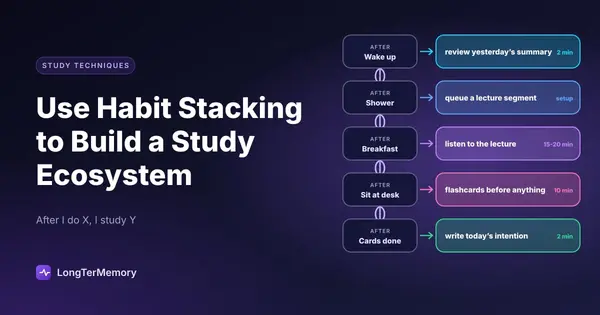
Habit stacking is one of the most reliable techniques for making a new behavior automatic, and it’s particularly well-suited to language learning.
The idea, popularized by James Clear in Atomic Habits, is to attach a new behavior to an existing one. Rather than carving out an entirely new block of time from scratch, you leverage a routine that already exists as an anchor point for your language practice.
A few examples:
- After you make your morning coffee, you do 15 minutes of vocabulary flashcards before you touch your phone.
- During your commute (if you’re not driving), you listen to a podcast or audio lesson in your target language.
- After dinner and before you watch anything in the evening, you spend 10 minutes reviewing new words.
- Before bed, you do your spaced repetition flashcard review.
The “after X, I do Y” structure is important. It turns your language practice from a decision you make every day (which burns willpower) into a sequence that follows automatically from something you already do without thinking.
The best anchor for language practice is usually something consistent, daily, and moderately low-energy, something like meals, morning routines, commutes, or pre-sleep wind-down. These already-existing patterns have strong associative networks in your brain. Attaching new behaviors to them gives your practice a free ride on an established neural highway.
What to Actually Practice Every Day
Once you have a habit structure in place, you need to fill it with the right kind of practice. This is where many people make a second major mistake: they choose activities that feel like learning but produce slow results.
Passive exposure (listening to music in your target language while you do something else, or watching shows without really paying attention) contributes at the margins, but it shouldn’t form the core of your practice. Your brain needs active engagement to build language skills efficiently.
The most effective core practices for building a long-term language habit are:
Spaced Repetition Vocabulary Review
Vocabulary is the engine of language comprehension. You need words. And the most efficient way to build vocabulary is through spaced repetition, reviewing words at systematically increasing intervals so you’re always studying the ones you’re on the verge of forgetting rather than ones you already know cold.
LongTerMemory makes this process significantly easier by automating flashcard creation and scheduling. You can import your target language materials, and the platform handles the review schedule, so you spend your limited practice time actually learning rather than managing what to study. For vocabulary-heavy language work, this kind of automation is a genuine game-changer.
Short, Focused Speaking or Writing Practice
Many language learners avoid production, speaking or writing, because it’s uncomfortable. This is understandable and also counterproductive. Producing language is what builds fluency. Comprehension and production use different cognitive pathways, and the one you practice is the one you develop.
You don’t need a language exchange partner every day (though those are great). Even talking to yourself in your target language during daily activities, narrating what you’re doing, describing your plans for the day, or trying to think in the language, all of these count and all of them build the neural pathways that make fluency possible.
Comprehensible Input
Comprehensible input is content in your target language that’s slightly above your current level but still mostly understandable. The concept comes from linguist Stephen Krashen’s input hypothesis, and the research behind it is substantial.
At beginner levels, this might be children’s books, graded readers, or simplified podcasts. At intermediate levels, it’s articles, YouTube videos on topics you find genuinely interesting, or shows with subtitles in the target language (not your native language). At advanced levels, it’s native-level content of your choice.
The key word is genuinely. Interest is not optional for long-term habit maintenance. If the content bores you, you’ll stop engaging with it. Find topics that you would actually want to read or watch in your native language, and consume them in your target language instead. The motivation to follow the content pulls your language practice along with it.
Tracking Progress to Sustain Engagement
One of the challenges of long-term language learning is that progress can feel invisible for extended periods. Unlike, say, weightlifting, where you can measure the weight going up, language improvement often feels gradual and hard to detect in the moment. This invisibility of progress is a major contributor to dropout, because people interpret “I can’t see improvement” as “I’m not improving,” when actually both things are happening simultaneously.
Tracking your practice addresses this in two ways. First, it makes your consistency visible even when your skill improvement isn’t, which is often enough to sustain motivation. The streak itself becomes motivating. Second, it forces you to notice small victories, a word you understood that you didn’t last week, a sentence you read without pausing, a conversation you managed to navigate.
Simple tracking works fine. A habit tracker app, a calendar with X marks for completed days, or a simple log in a notebook all accomplish the same goal: creating a visual record of consistency that your brain can latch onto on days when the progress doesn’t feel real.
You can also track more directly by doing periodic comprehension tests, timed readings, or conversation recordings that you compare over time. The specifics matter less than the act of measuring, because measurement makes progress legible, and legible progress sustains effort.
The Plateau Problem (And How to Navigate It)
Almost every language learner hits plateaus, periods where the rapid progress of the early months slows down and improvement becomes harder to perceive. These plateaus are normal and predictable. They’re not signs that you’ve hit your ceiling. They’re signs that you’ve moved from building foundational knowledge to integrating it, which is slower and harder to measure.
The most dangerous response to a plateau is to interpret it as failure and quit. The second most dangerous response is to do more of exactly what you’ve been doing and expect different results.
Effective plateau navigation usually involves changing the type of input you’re consuming (if you’ve been reading, try listening; if you’ve been listening, try producing), increasing the difficulty slightly, or shifting your focus to a specific skill area that feels weak.
It also helps to change the content you’re using. Fresh topics, new genres, or a different medium can re-activate the sense of novelty and challenge that you felt in the early stages. Your brain learns through novelty. When content becomes very familiar, the learning slows down. Seeking out content that stretches you, even uncomfortably, is one of the main levers you have at a plateau.
Handling Missed Days Without Derailing
At some point, you will miss a day. Maybe several. This is not a reason to treat your habit as broken. The most dangerous moment for a long-term habit isn’t the first miss, it’s the second one. Research suggests that missing one day has minimal impact on a habit, but missing two in a row is when habits start to unravel, because “I’ll do it tomorrow” becomes a narrative that repeats.
The practical rule: never miss twice. When you miss a day, simply commit to returning the next day, and do it. Don’t try to compensate by doubling your next session. Don’t engage in self-criticism about the missed day. Just return. The habit is the streak of consistency over weeks and months, not the perfection of zero misses.
Also worth noting: some periods of reduced practice are fine and even necessary. Life gets busy. Travel, work crises, family situations, these are all real. Deliberately reducing to your minimum (rather than stopping entirely) during intense periods is a completely valid strategy. Survival mode is maintenance mode. You’re preserving the habit even when you can’t develop the skill as aggressively.
The Long Game: What You’re Building
Here’s the thing about language learning that’s easy to lose sight of when you’re in the grind of daily practice: you’re building something permanent.
Procedural language knowledge, the kind that lets you understand and speak without conscious translation, lives in parts of your long-term memory that are remarkably durable. People who learn languages as children often retain broad comprehension decades later even without using the language in between. The knowledge doesn’t disappear, it just becomes less accessible without activation.
This means every hour you invest in consistent daily practice is adding to something that compounds over years. The discomfort of showing up on the days when you don’t feel like it isn’t wasted, it’s load-bearing. It’s the session that keeps the system alive so that all the better sessions can do their work.
Language learning is genuinely one of the most rewarding long-term investments you can make in your cognitive capabilities and your life experience. But it only delivers that payoff to people who stay consistent long enough for it to become real. That consistency isn’t built on motivation. It’s built on systems, minimums, habits, and the decision to keep going on ordinary days.
Start small. Stack it onto something you already do. Track it. Adjust when you plateau. And never miss twice.
That’s the whole system. The fluency comes from following it.