How to Create Effective Summary Notes for Any Subject
Learn how to create summary notes that boost retention and cut review time. Discover progressive summarization and spaced review techniques that actually work.
Table of Contents
- What to Include and What to Exclude From a Useful Summary
- The Progressive Summarization Technique for Deep Note Compression
- Layer One: The Initial Capture
- Layer Two: The First Pass
- Layer Three: The Summary Paragraph
- Layer Four: The Single Sentence
- Layer Five: The Retrieval Trigger
- Using Summary Notes for Spaced Review Instead of Re-Reading
- Making Summary Notes Work for Different Subjects
- The Psychology of Good Summaries
- Common Summary Mistakes to Avoid
- Building a Summary System That Lasts
- Summary Notes as a Long-Term Asset
The best summary notes are not shorter versions of your textbook. They are filtered decision tools that help your brain retrieve what matters under pressure. Most students get this wrong. They copy headings, paste bullet points, and end up with a condensed document that is still too long to review and too shallow to test themselves on.
Creating effective summary notes is a skill. Like any skill, it improves with a clear system. This guide will show you exactly what to include, what to ignore, and how to turn your summaries into an engine for long-term retention.
What to Include and What to Exclude From a Useful Summary
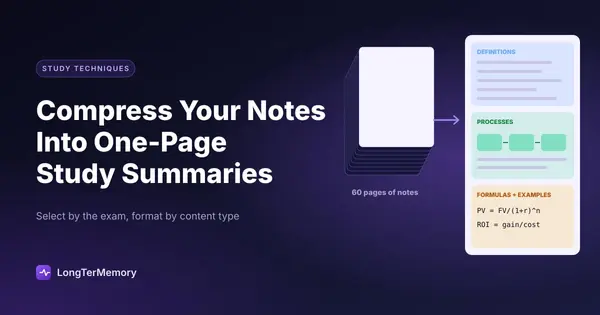
The core principle is simple. A summary should contain testable concepts, relationships between ideas, and your own framing language. It should not contain copied definitions, full sentences from the source, or information you already know cold.
Students often worry that leaving something out means forgetting it. The opposite is true. When you force yourself to exclude material, you make a judgment about importance. That judgment itself is a form of learning. Research on selective attention shows that the act of choosing what matters improves memory for the chosen content by signaling priority to your brain.
Here is a practical filter for what earns a place in your summary.
| Include This | Exclude This |
|---|---|
| Core concepts stated in your own words | Copied definitions from the textbook |
| Relationships and cause-effect chains | Isolated facts without context |
| Formulas with an example of when to apply them | Raw formulas without application notes |
| Questions you predict will appear on the exam | Trivia or edge cases rarely tested |
| Connections to topics you studied earlier | Material you can already recall perfectly |
If you finish a summary and it is longer than one to two pages per major topic, you are probably summarizing too little. The goal is compression with meaning, not compression for its own sake. A summary that is too long will not get reviewed. A summary that is too short will not remind you of enough to trigger recall.
The Progressive Summarization Technique for Deep Note Compression
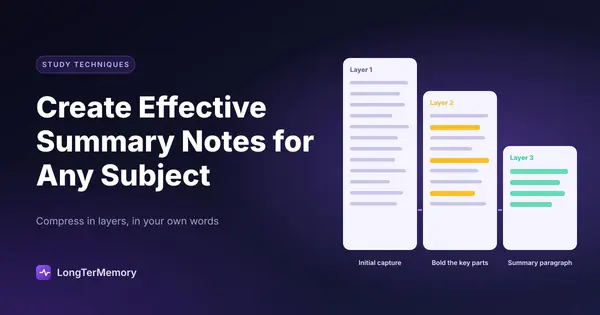
Progressive summarization is a layered approach to building summaries over time. Instead of writing one perfect summary in a single session, you create multiple passes. Each pass distills the material further. This technique was popularized by productivity writer Tiago Forte and has been widely adopted by students and professionals who manage large volumes of information.
The power of progressive summarization comes from repeated engagement. Every time you revisit your notes and decide what to keep, you strengthen the neural pathways associated with that content. You are not just editing. You are studying.
Layer One: The Initial Capture
After your first reading or lecture, capture the full set of notes without worrying about length. Use whatever method works for you: outline, Cornell notes, or a digital document. This layer is your safety net. It contains everything.
Layer Two: The First Pass
Within 24 hours, return to your full notes and highlight or bold the most important 20 to 30 percent. This is not careful line editing. It is quick triage. Ask yourself: if I could only remember three things from this lecture, what would they be? Mark those.
Layer Three: The Summary Paragraph
A few days later, write a one-paragraph summary of the material using only the points you highlighted. Force yourself to connect ideas with causal language. Do not list. Explain. For example, instead of writing “mitochondria, ATP, cellular respiration,” write “mitochondria produce ATP through cellular respiration, which means blocking oxygen transport shuts down energy production in the cell.”
Layer Four: The Single Sentence
After another week, reduce the paragraph to a single sentence that captures the essence of the topic. This sounds impossible for complex subjects, but that is the point. The struggle forces you to identify the true core. A medical student might reduce a cardiology lecture to: “Heart failure is fundamentally a problem of pump dysfunction leading to backward congestion and forward hypoperfusion.”
Layer Five: The Retrieval Trigger
The final layer is a set of questions rather than statements. These questions should require you to reconstruct the full argument from memory. For the cardiology example above, the question would be: “What are the two directional consequences of pump dysfunction in heart failure?” When you review, you read the question and attempt to answer it fully before checking your notes.
This layered system works because it aligns with how memory consolidates. Each pass happens after a delay, which introduces desirable difficulty. The delays force your brain to work harder to reconstruct the material, which produces stronger encoding than immediate repetition.
Using Summary Notes for Spaced Review Instead of Re-Reading
The biggest mistake students make with summary notes is using them for passive review. They read their summaries the night before the exam, recognize the content, and assume they know it. This is the fluency illusion in action. Recognition is not recall.
The correct way to use summary notes is as a retrieval practice tool. Here is how to do it.
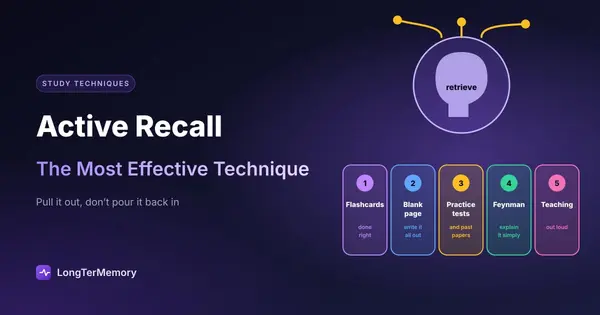
Turn every major heading in your summary into a question. If your summary has a section on “Keynesian fiscal policy,” the question becomes “How does Keynesian fiscal policy propose to manage economic downturns?” Write these questions on a separate sheet or flashcard. During review, look only at the questions. Attempt to answer them out loud or in writing. Only after you have made a genuine attempt do you check the summary.
This method transforms your summary from a reading document into a testing document. A 2013 meta-analysis by Dunlosky and colleagues ranked practice testing as one of the two highest-utility study techniques across all research reviewed. The other was spaced repetition. Using your summaries for retrieval practice combines both.
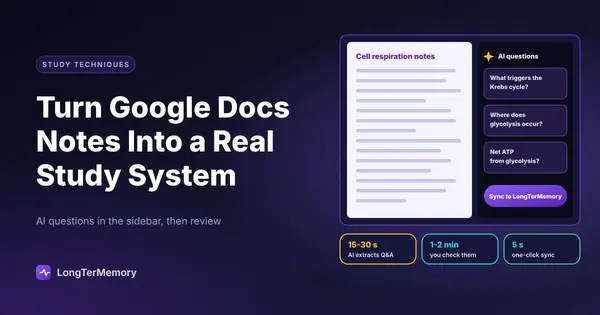
If you use a spaced repetition app, you can integrate your summary layers directly. Load your layer-five questions into your deck. Include a reference to the layer-three summary paragraph as the answer. When you get a question wrong, review the full summary paragraph. When you get it right consistently, the question alone is enough maintenance.
For students who want to automate this process, LongTerMemory can generate question-and-answer pairs directly from your uploaded notes and summaries. Instead of manually converting paragraphs into flashcards, the system produces retrieval-ready cards that preserve the relationships you worked hard to identify. You focus on judgment and synthesis. The tool handles the formatting and scheduling.
Making Summary Notes Work for Different Subjects
Summary notes are not one-size-fits-all. The format should adapt to the type of material you are learning.
For concept-heavy subjects like psychology or philosophy, focus on arguments and evidence. Your summaries should trace the logic of each position and the counterarguments against it. Include the names of key studies and what they demonstrated, but not the methodological details unless those are tested.
For fact-heavy subjects like anatomy or history, use structured formats. Tables, timelines, and comparison charts beat paragraphs. The human brain processes visual structure faster than dense text. A timeline of the French Revolution encodes sequence more effectively than a paragraph describing the same events.
For problem-solving subjects like math or physics, summarize solution patterns rather than individual problems. Write down the problem type, the conditions that signal it, and the general solution strategy. Include one worked example per pattern, but no more. Your summary should function as a diagnostic flowchart, not a problem set.
The Psychology of Good Summaries
There is a reason why students resist summarizing. It feels like you are losing information. You spent hours reading, and now you are throwing most of it away. That feeling is normal, but it is misleading.
Cognitive load theory tells us that working memory has severe limits. When you try to review everything, you overload that capacity and retain almost nothing. When you review a well-designed summary, you stay within the limits and actually process the material deeply. A 2011 study published in Science found that students who used retrieval practice with condensed material outperformed those who reviewed full notes by 40 to 50 percent on delayed tests.
Good summaries also reduce decision fatigue. When you sit down to study and you have three hundred pages of notes, you waste mental energy deciding where to start. A summary removes that friction. You open it and begin. The structure does the navigation for you.
Common Summary Mistakes to Avoid
Even students who understand the value of summaries often undermine themselves with a few predictable errors.
Mistake one: copying instead of translating. If your summary reads like a shorter textbook, you have not summarized. You have abridged. Abridgment does not improve memory. Translation into your own words does. The effort of finding your own language is what encodes the concept.
Mistake two: including too much detail on easy topics. Students often pad their summaries with material they already know well because it feels good to write something confidently. This is a waste of space and review time. Your summary should be weighted toward your weak areas. If you know the Krebs cycle cold, it does not need more than a sentence. If you confuse the different types of RNA, that deserves a full comparison table.
Mistake three: never revisiting the summary. A summary written once and never updated becomes outdated as your understanding improves. The best students treat their summaries as living documents. They add connections as they learn related topics. They downgrade concepts they have mastered and upgrade concepts they keep missing.
Mistake four: reviewing summaries passively. We have said it before, but it bears repeating. Reading is not studying. If your review session consists of looking at your summary, you are not preparing for an exam. You are preparing to recognize material when you see it again. Exams require recall. Train for the test you will actually take.
Building a Summary System That Lasts
If you study multiple subjects, you need a consistent system for creating and storing summaries. Inconsistency creates friction, and friction kills habits.
Choose a single format and stick with it. Whether you prefer paper notebooks, Notion, Google Docs, or a dedicated study app, the tool matters less than the repetition. What matters is that you can find any summary within ten seconds and that the format is the same every time.
Set a recurring calendar block for summary review. Sunday evenings work well for many students. During that block, do not create new summaries. Review old ones using retrieval practice. Update them if your understanding has changed. This maintenance cycle prevents the decay that otherwise erodes your work within weeks.
If you are preparing for a high-stakes exam, consider building a master summary in the final two weeks. This is a single document that contains only the highest-yield material from all your topic summaries. It should be short enough to review in an hour. It functions as your last-pass material before the exam, not your primary learning tool.
Summary Notes as a Long-Term Asset
The best part of building strong summary notes is that they keep paying off. Unlike textbook chapters, which you will never reread, a good summary stays useful. When you take the next course in a sequence, your summaries from the prerequisite are faster review than any textbook. When you prepare for professional certification years later, your old summaries jumpstart your memory.
This is especially true if you combine your summary system with spaced repetition. The summary provides the conceptual framework. The spaced schedule provides the timing. Together, they produce retention that lasts years, not days.
If you want to speed up the process of turning your summaries into active recall material, LongTerMemory can help. Upload your notes or summaries, and the system generates exam-style questions that test understanding rather than surface recall. The cards are scheduled automatically, so your review happens at the optimal intervals without you managing a calendar. You can try it for free and see how much faster your summaries convert into durable knowledge.
Effective summary notes are not about writing less. They are about choosing better. Start with the filters, build your layers, and review with retrieval. Your future self, sitting in the exam room, will thank you.