How to Build Test-Taking Confidence Over Multiple Exam Cycles
Every exam you take teaches you something. Learn how to turn repeated test experience into genuine confidence using data, mindset shifts, and strategy.
Table of Contents
- Why Experience Beats Preparation Alone
- Reframing What "Failing" an Exam Means
- The Data You Should Collect After Every Exam
- Score Reports
- Timing Analysis
- Emotional Log
- Building Confidence Through Deliberate Simulation
- What Makes a Simulation Effective
- The Desensitization Effect
- Managing Test Anxiety in the Moment
- Tactical Breathing
- Process, Not Outcome
- Strategic Question Navigation
- Building Confidence Over Multiple Cycles: A Framework
- The Long View: Confidence as a Skill
There’s a version of exam confidence that most people are familiar with , the kind that comes from knowing the material cold. Study hard enough, and confidence follows naturally. That version is real, but it’s incomplete. Because even highly prepared candidates often walk into high-stakes exams with a trembling pen hand, a racing heart, and a tendency to second-guess answers they know perfectly well.
The other kind of confidence , the kind that holds up under pressure , doesn’t come from knowing more. It comes from exam experience itself. And the good news is that you can build it deliberately, across multiple exam cycles, in ways that have nothing to do with studying harder.
Why Experience Beats Preparation Alone
Consider what actually happens the first time someone sits for a high-stakes exam: a professional certification, a bar exam, a graduate entrance test. Even a deeply prepared candidate confronts things they didn’t anticipate:
- The physical sensation of sitting for 3+ hours under fluorescent lights
- The disorienting moment when a question is phrased in a way that doesn’t match how they studied it
- The decision of when to skip a question versus push through
- The temptation to change answers when time is running low
- The psychological weight of knowing this exam matters
None of these challenges are about content knowledge. They’re about the exam environment itself , and the only way to prepare for them is through exposure.
This is why serial exam-takers , people who take the same certification multiple times, or who sit for multiple high-stakes exams over a career , often show a pattern that surprises observers: they get better at passing exams at a rate that exceeds their improvement in underlying knowledge. The skill of exam-taking is a real, separable skill, and it develops through repetition.
Reframing What “Failing” an Exam Means
Before talking about how to build confidence through repeated exam cycles, it’s worth addressing the frame most people bring to exam failure: that it’s primarily a negative data point , evidence of inadequacy, wasted time, or lack of preparation.
This framing is both emotionally understandable and strategically harmful.
Every exam you sit generates a detailed dataset about:
- Which content domains you understand and which you don’t
- How your performance under pressure differs from your performance in practice
- Where your time management breaks down
- How you respond to question types that confuse you (too much time? skipping? guessing patterns?)
- The physical and mental conditions in which you perform best
An exam result , whether a pass or fail , is only valuable to the extent that you extract and act on this data. Candidates who approach each exam cycle as a data-collection event rather than a verdict on their intelligence get dramatically more out of the experience, regardless of outcome.
The mental shift sounds simple but requires practice: “I didn’t pass this time” is not the same statement as “I failed.” The first describes a result. The second misidentifies the result as something it isn’t.
The Data You Should Collect After Every Exam
If you sat for an exam and didn’t pass , or passed narrowly , there’s information available to you that most candidates ignore or don’t know how to use.
Score Reports
Most major certification and standardized exams provide score reports broken down by domain or content area. These are not just numbers to wince at , they’re a priority list for your next study cycle.
If your score report shows you underperformed significantly in Domain C, your next preparation cycle should weight Domain C heavily. This seems obvious, but candidates routinely start their second preparation cycle doing the same thing they did the first time, spread evenly across all domains, which is almost never the right approach.
Timing Analysis
Did you run out of time? Did you finish with 45 minutes to spare? Both patterns contain important information.
Finishing with large amounts of time remaining often indicates you’re rushing through questions or not reading them carefully enough. Running out of time indicates either slow processing, excessive deliberation on hard questions, or inefficient test navigation. Both are fixable with targeted practice , but only if you notice them.
In practice testing (not in actual exams, where notes are prohibited), track which questions took you significantly longer than average. Those are usually the question types where your understanding is shakiest , not just the content, but the cognitive pattern the question requires.
Emotional Log
This sounds soft but isn’t. After an exam, write down within 24 hours:
- At what point(s) during the exam did you feel anxious, confident, or uncertain?
- Were there specific question types that triggered avoidance behavior?
- Did your performance feel consistent throughout, or did you notice a drop in the second half?
- Did you change any answers? Were those changes usually right or wrong?
This information tells you whether you have a performance problem (anxiety, fatigue, time management) versus a preparation problem (knowledge gaps). These require completely different interventions, and confusing them is very common.
Building Confidence Through Deliberate Simulation
The most reliable way to build genuine test-taking confidence is through simulation that is as realistic as possible. Not practice, not studying , simulation.
The distinction matters: practicing questions tells you what you know. Simulating an exam tells you how you perform under exam conditions. Those two things diverge more than most people realize.
What Makes a Simulation Effective
Timing discipline. Set a timer for the exact duration of the real exam. Do not pause it. Do not extend it when you’re almost done. The discomfort of the timer is part of what you’re conditioning yourself to.
No reference materials. If notes or books aren’t allowed in the real exam, they shouldn’t be in your simulation. Candidates who simulate with their notes nearby and reassure themselves that “I could look it up if I needed to” are undermining the whole point.
Environmental matching. If your exam is in a testing center, go to a library or quiet room rather than doing your simulation at home on your couch. The more your simulation environment matches the real thing, the better the transfer. Some candidates even book a coworking space or exam prep center for their final simulations.
Full question counts. Simulating 40% of the exam’s questions is not the same as simulating the full thing. The difficulty of long exams is partly just the cognitive load of sustained performance. You can’t train that by doing half.
The Desensitization Effect
Psychologists call it systematic desensitization: repeated exposure to an anxiety-triggering situation, under controlled conditions, reduces the anxiety response over time. Exam anxiety is real and follows the same neurological pattern as other anxiety responses , which means it responds to the same interventions.
Every realistic simulation you complete makes the next one feel slightly less threatening. By the time you sit for the real exam after four or five full simulations, you’ve been in that situation before. Your nervous system has, in a real sense, already learned that you can get through it.
This is part of why candidates who sit for the same exam multiple times often report that their anxiety decreases substantially on the second and third attempt , not because they’re less worried about the result, but because the experience of sitting for the exam no longer feels unknown.
Managing Test Anxiety in the Moment
Even with solid preparation and multiple simulations, some degree of anxiety on exam day is normal and not necessarily harmful. Research consistently finds that mild anxiety improves performance on cognitively demanding tasks by increasing focus and arousal. The goal is not to eliminate anxiety , it’s to prevent it from tipping into the range where it impairs performance.
Tactical Breathing
Controlled, slow breathing directly activates the parasympathetic nervous system, counteracting the fight-or-flight response that acute anxiety triggers. A simple protocol:
- Inhale for 4 counts through your nose
- Hold for 4 counts
- Exhale slowly for 6–8 counts through your mouth
- Repeat 3–5 times
This takes less than two minutes and produces measurable reductions in heart rate and anxiety. Use it before the exam begins, and again if you notice your focus fragmenting mid-exam.
Process, Not Outcome
One of the most reliable ways to derail performance mid-exam is to start thinking about the outcome while you’re still sitting it. “If I get this wrong, I might fail. If I fail, I have to retake this whole thing. What does that mean for my career timeline…”
This chain of thought consumes working memory that you need for the actual questions. The intervention is simple but requires practice: notice when you’ve drifted to outcome thinking, and deliberately redirect attention back to the process , the specific question in front of you.
Focus only on the question you’re on. Not the last five you might have gotten wrong. Not the next section coming up. The question in front of you right now.
Strategic Question Navigation
Many candidates improve their performance substantially just by changing the order in which they engage with questions:
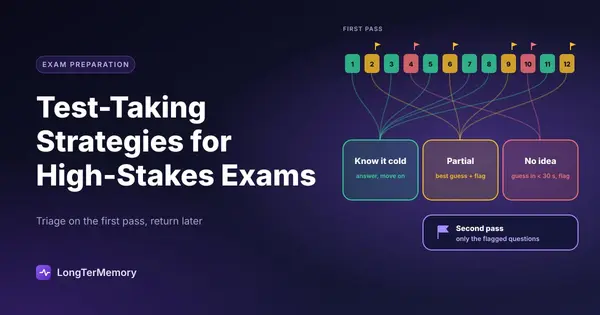
- Pass through quickly first: read each question and either answer it confidently or flag it and skip. Don’t get stuck.
- Return to flagged questions: now that you’ve been through the full set, your brain has been primed with the exam’s content, and some previously stuck questions will unlock.
- Guess remaining questions: never leave a question blank unless there’s a wrong-answer penalty (some exams have this, many don’t , know your exam’s rules).
This navigation approach reduces time wasted on hard questions early, prevents the psychological spiral of getting stuck, and takes advantage of the primacy effect , the tendency for the brain to be sharper early in a session.
Building Confidence Over Multiple Cycles: A Framework
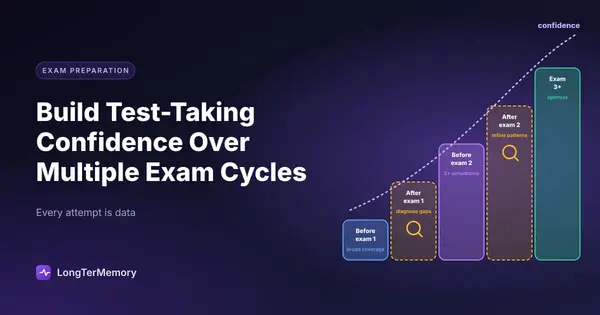
If you’re in a situation where you’re taking the same exam for a second or third time, here’s how to structure each cycle to maximize improvement:
| Cycle | Primary Focus | Key Activity |
|---|---|---|
| Before Exam 1 | Broad coverage, content familiarity | Full syllabus review, practice questions |
| After Exam 1 | Diagnosis, gap identification | Score report analysis, emotional log, timing review |
| Before Exam 2 | Targeted weak areas, simulation | Domain-weighted study, ≥3 full simulations |
| After Exam 2 | Refinement, pattern recognition | Identify remaining gaps, adjust question approach |
| Before Exam 3+ | Edge cases, performance optimization | Advanced practice, exam mindset conditioning |
Notice that each cycle includes both content work and performance work. Candidates who focus exclusively on content on their second attempt often underperform their knowledge , they’re better prepared but still haven’t addressed the performance gap.
The Long View: Confidence as a Skill
The most important mindset shift for anyone navigating multiple exam cycles is recognizing that test-taking confidence is a skill , something you get better at through practice, reflection, and iteration. It is not a trait you either have or don’t.
Candidates who develop genuine exam confidence over multiple cycles share a few characteristics: they treat every result as information, they simulate relentlessly under realistic conditions, they address performance factors separately from content gaps, and they maintain a stable internal narrative about their trajectory rather than letting any single result define their ability.
The candidate who passes on the first attempt may have had the right content knowledge at the right time. The candidate who works through two or three cycles thoughtfully often comes out the other side not just with a credential, but with a set of exam skills and a resilience under pressure that serves them for decades of professional life.
That’s not a consolation prize , it’s a genuine advantage, hard-earned and durable.
If you’re studying for an upcoming exam and want a smarter way to track what you know and target your weak spots, LongTerMemory can automatically generate Q&A flashcards from your study materials and schedule reviews based on your actual performance , so you focus your limited prep time exactly where it matters most.