How to Use Exam Pressure as Positive Motivation
Turn exam pressure into productive energy by understanding the Yerkes-Dodson curve and using pressure as fuel instead of fear.
Table of Contents
- The Yerkes-Dodson Curve: Why Some Pressure Helps
- Reframing Pressure as Evidence That You Care
- Turning Pressure Into a Study Plan
- The Role of Deadlines in Focus
- Avoiding the Avoidance Trap
- Building Pressure-Proof Habits
- What to Do When Pressure Becomes Panic
- Using Pressure to Improve Exam-Day Performance
- The Bottom Line
Exam pressure is one of the most universal experiences in learning. Your heart beats faster, your mind races through everything you still need to review, and a deadline that once felt distant now sits on your chest like a weight. Most people treat this pressure as the enemy. They try to eliminate it through deep breathing, positive affirmations, or pretending the exam does not matter.
But pressure is not always harmful. In the right amount, it is one of the most powerful motivators your brain has. The trick is not to remove it. The trick is to calibrate it so it sharpens your focus instead of paralyzing you.
This post explains how to use exam pressure as positive motivation, drawing on a century of research into stress and performance, and giving you practical ways to turn deadline energy into productive action.
The Yerkes-Dodson Curve: Why Some Pressure Helps
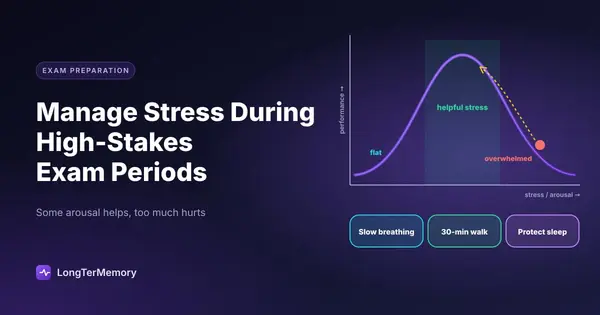
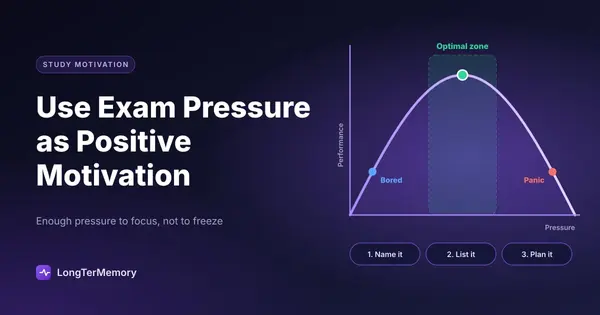
The relationship between pressure and performance is not a straight line. It is a curve, first described by psychologists Robert Yerkes and John Dodson in 1908. Their research showed that performance improves as arousal increases, but only up to a point. After that peak, more pressure starts to hurt performance.
Imagine a simple graph. On the left, with very low pressure, you are bored and unfocused. Your performance is poor because you do not care enough. As pressure rises, your attention tightens and your effort increases. You enter the optimal zone where you work efficiently and think clearly. If pressure keeps climbing past that point, anxiety takes over. Working memory shrinks, decision-making gets worse, and you start making mistakes you would never make under calmer conditions.
The goal is not zero pressure. The goal is to stay in the middle of that curve, where pressure energizes you without overwhelming you. That middle zone is where productive motivation lives.
Reframing Pressure as Evidence That You Care
One of the most useful mindset shifts around exam pressure is to interpret it differently. Instead of thinking, “I am stressed, which means I am not ready,” try thinking, “I feel pressure because this matters to me.” The physical sensations are nearly identical whether you label them fear or excitement. The label changes how you respond.
Research from Harvard Business School found that when people reframed anxiety as excitement before a high-stakes task, their performance improved. They did not become less aroused. They simply interpreted the arousal as a positive signal rather than a threat. This is called anxiety reappraisal, and it works because it does not ask you to deny reality. It asks you to assign a better meaning to the same reality.
When you notice your heart rate increasing before a study session, tell yourself, “This is my body preparing me to focus.” When you feel the urge to procrastinate because the exam feels big, say, “This pressure is here because I want to do well, and that is a good thing.” The words feel small, but they shift your nervous system from threat mode to challenge mode.
Turning Pressure Into a Study Plan
Pressure without a plan becomes panic. Pressure with a plan becomes momentum. The moment you feel that deadline energy rising, channel it into specific actions.
Start by writing down exactly what the exam covers. Not a vague subject, but the actual topics, chapters, skills, and question types. Then estimate how much time each requires. Be honest. Most people underestimate by about 30 percent, which is why they end up cramming.
Next, build a schedule that distributes the work across the days or weeks you have left. If you have three weeks and fifteen topics, you know roughly how much you need to cover per week. This transforms a scary, shapeless deadline into a series of concrete daily targets.
Here is a simple framework for converting pressure into a plan.
| Step | What to do | Why it works |
|---|---|---|
| Name the pressure | Write down exactly what worries you | Vague fear is harder to manage than specific problems |
| List the material | Break the exam into topics and skills | You cannot plan what you have not defined |
| Estimate time | Assign realistic hours to each topic | Prevents the planning fallacy |
| Schedule daily work | Put specific tasks on specific days | Pressure becomes action instead of anxiety |
| Build in buffer time | Reserve 20 percent of your schedule for setbacks | Keeps you in the optimal pressure zone |
When your plan is clear, pressure stops feeling like a wall and starts feeling like fuel pushing you forward.
The Role of Deadlines in Focus
Deadlines are uncomfortable, but they are also one of the best focus tools available. Without a deadline, your brain spreads attention across many things and prioritizes what is easy or immediately rewarding. With a deadline, your brain narrows its focus to what actually matters.
You can use this deliberately. Set mini-deadlines before the real exam. Tell yourself you will finish a chapter by Friday, complete a practice test by Sunday, and master a weak topic by Wednesday. Each mini-deadline creates a small burst of pressure that keeps you moving.
The key is to make the deadlines real enough to matter but not so tight that they push you into panic. If a mini-deadline is impossible, you will ignore it. If it is too easy, it will not motivate you. Aim for deadlines that require focused effort but are achievable with a good session.
Avoiding the Avoidance Trap
Pressure often produces avoidance. You feel overwhelmed, so you clean your desk, scroll through your phone, or reorganize your notes instead of studying. This feels productive in the moment, but it makes the pressure worse because the deadline gets closer while the work stays undone.
The cure is to start with something so small that resistance cannot stop you. Instead of telling yourself to study for three hours, tell yourself to study for five minutes. Open one document. Review three flashcards. Do one practice question. Once you start, the pressure usually converts into forward motion within a few minutes.
This works because of the Zeigarnik effect, the psychological tendency to remember and want to complete unfinished tasks. A five-minute start creates an open loop in your mind. Your brain wants to close it, so continuing feels easier than stopping.
Building Pressure-Proof Habits
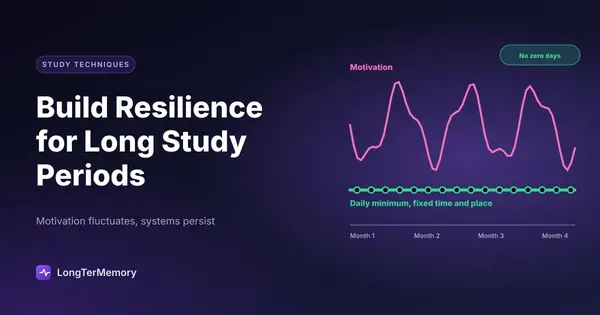
Motivation from pressure is effective in the short term, but it is not sustainable. If every study session depends on a looming deadline, you will eventually burn out. The better approach is to build habits that keep you in the productive middle of the Yerkes-Dodson curve even when no deadline is near.
A daily review habit is the single best pressure reducer. If you spend twenty minutes each day reviewing material with active recall or spaced repetition, you accumulate knowledge gradually. When the exam approaches, you are reviewing and consolidating instead of learning from scratch. The pressure is still there, but it is manageable because the foundation already exists.
Tools that automate review schedules help enormously. LongTerMemory, for example, can generate flashcards from your notes and schedule them using spaced repetition, so your daily review habit requires almost no setup. The less friction between you and the habit, the more likely you are to maintain it.
What to Do When Pressure Becomes Panic
Sometimes pressure crosses the line into panic despite your best efforts. Your thoughts race, your chest tightens, and you cannot concentrate. When this happens, the goal is not to study harder. The goal is to bring your nervous system back into the optimal zone.
The fastest way to do this is through the body, not the mind. Slow breathing, especially exhaling for longer than you inhale, activates the parasympathetic nervous system and reduces the stress response. A short walk, cold water on your face, or a few minutes of stretching can also interrupt the spiral.
Once your body calms down, reframe the situation. Ask yourself, “What is the smallest useful thing I can do right now?” The answer might be reviewing ten flashcards, organizing one topic, or rereading a single page. Small actions restore a sense of control, and control is what moves you back from panic into productive pressure.
Using Pressure to Improve Exam-Day Performance
On the day of the exam, some pressure is inevitable and even helpful. A small amount of arousal keeps you alert and focused. The mistake is trying to eliminate all nerves. Instead, welcome them as a sign that your body is mobilizing for a challenge.
Before the exam starts, take a few slow breaths and remind yourself that you have prepared. Then focus on one question at a time. If you hit a difficult question, mark it and move on. Dwelling creates pressure spikes that push you out of the optimal zone. Momentum keeps you in it.
After the exam, reflect on how the pressure felt. Did it help you focus, or did it overwhelm you? Use that information to adjust your preparation for next time. Every high-stakes exam is also data you can use to get better at performing under pressure.
The Bottom Line
Exam pressure is not something to fear. It is a signal that the outcome matters and your body is ready to work for it. The goal is to keep that pressure in the productive middle zone where it sharpens focus and drives action without causing panic.
You do this by reframing pressure as excitement, channeling it into specific plans and mini-deadlines, starting with tiny actions to beat avoidance, and building daily review habits that reduce last-minute cramming. When pressure becomes a tool instead of an obstacle, you stop surviving exams and start performing well on them.
If you want a study system that keeps you prepared before the pressure peaks, LongTerMemory can help you turn your notes into daily review cards automatically. The best way to handle exam pressure is to make sure the knowledge is already there when the deadline arrives.