How to Manage Stress During High-Stakes Exam Periods
Evidence-based strategies to manage exam stress, reduce anxiety, and perform at your best during high-stakes certification and academic exams.
Table of Contents
- The Physiological Stress Response and Its Effect on Exam Performance
- What Happens When Stress Kicks In
- The Difference Between Helpful and Harmful Stress
- How Chronic Pre-Exam Stress Compounds the Problem
- Evidence-Based Stress Reduction Techniques for Exam Season
- Controlled Breathing
- Regular Physical Activity During the Study Period
- Sleep as a Non-Negotiable
- The Power of Pre-Exam Routines
- Writing About Exam Anxiety Before the Exam
- How to Reframe High-Stakes Exams to Reduce Anticipatory Anxiety
- The Reclassification of Arousal
- Separating Identity From Outcome
- The Preparation Confidence Shift
- Managing Stress During the Exam Itself
- A Final Word on Self-Compassion
There is a specific kind of dread that sets in a few weeks before a high-stakes exam. It is different from the everyday anxiety of an upcoming test in school. With a certification exam, a board exam, or a professional licensing test, the stakes feel much larger. Your career trajectory, your sense of identity, the money you have spent on prep materials, the months of preparation. It all seems to be riding on a single morning.
That dread is normal. But it is also manageable, and more importantly, it is something you can actively work with rather than against. The good news is that the same cognitive science that teaches us how to study more effectively also tells us a lot about how stress affects performance and what you can do about it. This guide covers both the physiological reality of exam stress and the practical strategies that actually help.
The Physiological Stress Response and Its Effect on Exam Performance
Before we talk about how to manage stress, it helps to understand what is actually happening in your body and brain when you experience it.
What Happens When Stress Kicks In
When you encounter a perceived threat, whether that is a charging bear or an upcoming exam, your body activates the sympathetic nervous system. Cortisol and adrenaline flood your system. Heart rate increases. Breathing becomes shallower. Blood flow is redirected toward your muscles and away from your prefrontal cortex, the part of your brain responsible for working memory, reasoning, and complex problem-solving.
This is the stress response, and it was designed for physical emergencies. For running from predators, it is excellent. For sitting in an exam room and trying to recall the exact pathophysiology of heart failure or the precise steps of a dynamic programming algorithm, it is considerably less helpful.
The prefrontal cortex impairment is the key mechanism to understand. Under high stress, working memory capacity drops. You know something, you have studied it, but it feels just out of reach. That is not you failing. That is cortisol interfering with retrieval, and it is a normal physiological response to perceived threat.
The Difference Between Helpful and Harmful Stress
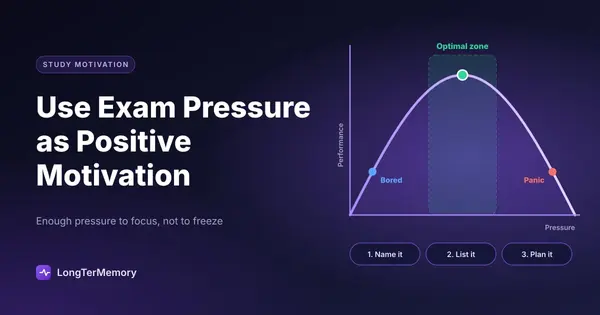
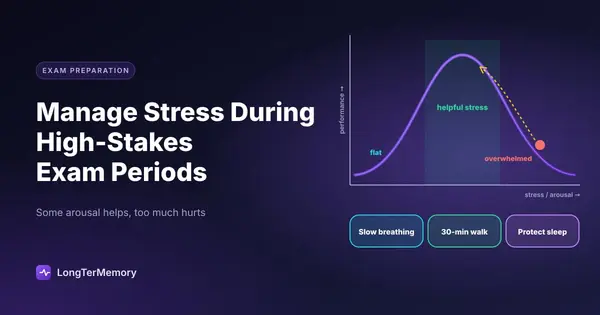
Not all exam stress is bad. A moderate level of arousal improves performance on many cognitive tasks. This is the Yerkes-Dodson curve, a well-established relationship between arousal and performance that shows an inverted U shape. Too little arousal, and you are sluggish. Too much, and performance collapses. The zone of peak performance sits in the middle.
The goal of stress management before an exam is not to eliminate all anxiety. It is to keep yourself in that productive middle zone, engaged and alert but not so overwhelmed that your working memory is offline.
How Chronic Pre-Exam Stress Compounds the Problem
The week before a high-stakes exam is often when stress peaks, which is also exactly when sleep quality tends to deteriorate and nutrition habits tend to collapse. This creates a compounding problem: chronic elevated cortisol disrupts the sleep that memory consolidation requires, which means you are not retaining the last-minute studying you are doing, which creates more anxiety about being underprepared, which further disrupts sleep. Recognizing this cycle is the first step to breaking it.
Evidence-Based Stress Reduction Techniques for Exam Season
The following strategies are not pop psychology. Each one has meaningful empirical support for reducing stress and improving performance under pressure.
Controlled Breathing
Box breathing (inhale for four counts, hold for four, exhale for four, hold for four) activates the parasympathetic nervous system within minutes. It directly counteracts the shallow, rapid breathing of the stress response and lowers heart rate. Navy SEALs use this technique before high-stakes operations. It works in a parking lot before an exam, too.
You do not need to do this for twenty minutes. Even three to five cycles of box breathing before entering the exam room is enough to shift your physiological state meaningfully.
The physiological mechanism is direct: slow, controlled exhalation lengthens the vagal tone, which tells your body that the immediate threat has passed. Your prefrontal cortex comes back online. Retrieval gets easier.
Regular Physical Activity During the Study Period
The research on exercise and cognitive performance is remarkably consistent. Even moderate aerobic exercise (a 30-minute walk at a brisk pace) increases levels of BDNF (brain-derived neurotrophic factor), which supports neuroplasticity and memory consolidation. It also reduces baseline cortisol levels over time.
Many candidates feel that exercise is a luxury they cannot afford during intense exam prep. The reality is that candidates who exercise during their study period tend to retain information more effectively and report lower anxiety on exam day. Even three sessions per week of moderate exercise improves outcomes. You do not need to train for a marathon.
Think of physical activity not as time away from studying but as an investment in the quality of the studying you do. Thirty minutes of walking improves the next three hours of focused review in a way that those same thirty minutes spent staring at your notes does not.
Sleep as a Non-Negotiable
This cannot be said forcefully enough: sleep deprivation is directly harmful to exam performance. Not just uncomfortable or suboptimal. Directly harmful. A person operating on five or six hours of sleep shows measurable declines in working memory, attention, and the ability to access previously encoded information.
The night before your exam is particularly critical. Memory consolidation happens during slow-wave and REM sleep, and the final night of sleep before retrieval is when much of that consolidation occurs. Staying up until 2 AM going over notes and then sitting an exam on four hours of sleep is not a tradeoff that pays off. The knowledge you fail to consolidate through sleep is not accessible to you in the exam room, no matter how recently you reviewed it.
Set a hard stop time for studying the night before your exam. Something in the eight to nine PM range if your exam is early morning. Wind down with something relaxing. Protect your sleep like it is part of your preparation, because it genuinely is.
The Power of Pre-Exam Routines
Elite athletes talk about pre-performance routines because they work. Doing the same sequence of small actions before a high-pressure performance reduces cognitive load and creates a sense of control. Your brain associates the routine with a state of focused readiness.
Build a simple pre-exam morning routine: same breakfast, same timing, a brief review of high-confidence material (not areas you feel shaky on), a few minutes of controlled breathing. The specifics matter less than the consistency. Routine signals safety to your nervous system.
Writing About Exam Anxiety Before the Exam
This one surprises people. A study published in Science by Gerardo Ramirez and Sian Beilock found that expressive writing about exam anxiety immediately before the exam significantly improved performance on math tests. The hypothesis is that writing offloads the worries from working memory, freeing up cognitive resources for the actual exam.
Ten minutes of journaling the morning before your exam, specifically writing about what you are worried about and why, may sound counterintuitive. You might expect it to amplify anxiety. The research suggests the opposite: it reduces the intrusive worry thoughts that compete for working memory during the exam itself.
How to Reframe High-Stakes Exams to Reduce Anticipatory Anxiety
Beyond practical stress management techniques, there is a cognitive dimension to managing exam anxiety that is often overlooked. How you think about the exam shapes how you experience it.
The Reclassification of Arousal
Harvard psychologist Alison Wood Brooks conducted research showing that telling yourself “I am excited” rather than “I am anxious” before a high-stakes performance improved outcomes compared to trying to calm down. The physiological states of anxiety and excitement are nearly identical (elevated heart rate, heightened arousal), but the cognitive interpretation is different.
Calm is difficult to achieve under genuine high-stakes pressure. Excitement is more accessible because it requires only a cognitive shift, not a physiological one. Telling yourself “I am excited and ready” before entering the exam room is not positive self-deception. It is a cognitive reframe that activates a different interpretive frame around the same physiological state.
Separating Identity From Outcome
A significant source of exam stress is the conflation of exam performance with personal worth. When your identity feels dependent on passing, the stakes feel existential. This produces a level of threat response that far exceeds what the actual situation warrants.
Try to hold this clearly: your exam result is information about how well your preparation matched the exam’s demands on a specific day. It is not a judgment about your intelligence, your worth as a professional, or your future potential. People who pass on the second attempt often credit the first attempt as the thing that clarified exactly what they needed to work on. A single data point does not define a career.
This is not about minimizing the importance of the exam. It is about separating it from identity-level stakes, because identity-level stakes produce cortisol spikes that impair the very performance you are hoping to achieve.
The Preparation Confidence Shift
One of the most reliable ways to reduce pre-exam anxiety is accurate self-assessment. Many candidates have genuinely prepared well and still feel anxious, partly because anxiety is sticky and partly because they have never stepped back to look at the evidence of their preparation.
Try this: the week before your exam, make a list of everything you have done to prepare. The hours of question banks. The content review. The practice tests. The flashcard sessions. Looking at that concrete record of effort shifts you from abstract worry (“I don’t know if I’m ready”) to evidence-based confidence (“I have done X, Y, and Z and my practice scores show improvement”). That shift is not irrational. It is accurate.
Managing Stress During the Exam Itself
Pre-exam strategies get you to the door. But stress can spike inside the exam room, too, especially when you hit a question you genuinely do not know.
Mark it and move on. Getting stuck on a hard question raises cortisol and impairs performance on subsequent questions. Skip it, flag it, and come back at the end. A question you cannot answer in 90 seconds is often answerable in 30 seconds when you return to it with a fresh brain and lower arousal.
Use process of elimination actively. When you feel blank, start with what you know is definitely wrong. Eliminating two options out of four turns a guess into a coin flip, which is meaningfully better odds. Active cognitive engagement with what you do know reduces the sense of helplessness that amplifies stress.
Take brief physiological resets between sections if your exam format allows breaks. Stand up. Do a few box breaths. Drink water. Even two minutes of deliberate recovery between sections can reset your cortisol baseline enough to matter.
A lot of exam stress comes from not knowing whether you are on track. LongTerMemory gives you a clear daily review queue: upload your study materials, and it generates question and answer flashcards and schedules them with spaced repetition, so you always know what to study today and nothing falls through the cracks.
A Final Word on Self-Compassion
High-stakes exam prep is genuinely hard. The months of preparation, the financial investment, the uncertainty, it is a lot to carry. Being hard on yourself when you struggle, calling yourself stupid when you miss practice questions, treating every gap in your knowledge as evidence of fundamental inadequacy, does not produce better outcomes. It produces more cortisol.
Self-compassion, treating yourself the way you would treat a friend going through the same challenge, is not soft. It is neurologically optimal. Lower shame, lower cortisol, better prefrontal cortex function, better performance.
You have done the work. Give your brain the conditions it needs to show what it knows.