Tips for Exam Success That Go Beyond Studying More
More study time isn't always the answer. Discover the sleep, nutrition, mindset, and logistics strategies that actually move your exam score.
Table of Contents
- Why "Just Study More" Eventually Stops Working
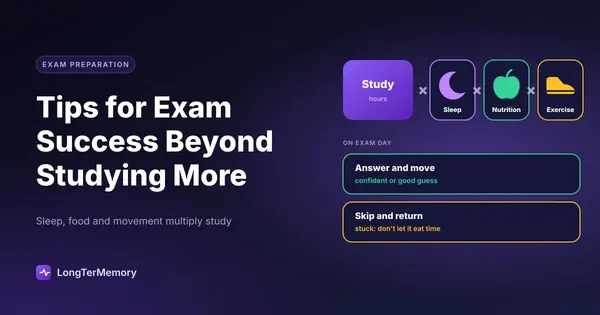
- Sleep, Nutrition, and Exercise as Exam Performance Multipliers
- Sleep Is Not Optional
- What You Eat Actually Matters
- Exercise in the Days Before an Exam
- Mindset Strategies That Actually Improve Test Performance
- Reframing Test Anxiety
- **Pre-Exam Rituals and Routines**
- The Identity Shift: From "Trying Not to Fail" to "Showing What I Know"
- The Logistics of Exam Day That Most Students Ignore
- Know the Location, Know the Rules
- Arrive with Margin
- **Pacing and Question Management**
- After the Exam: The Habits That Compound
- Putting It Together
At some point, most serious students hit a ceiling. They’re putting in the hours. They’re reviewing the material. They’re doing practice tests. And yet the scores aren’t moving the way they should be, or they’re anxious on test day in a way that doesn’t reflect how prepared they actually are.
The standard advice in these situations is always the same: study more. But studying more, past a certain point, is usually the wrong prescription. What’s getting in the way often isn’t content knowledge. It’s everything else, the sleep, the food, the mindset, the logistics, and all the things that determine whether your brain is actually able to perform when the exam starts.
This is the stuff nobody talks about enough, and it’s the stuff that genuinely separates students who know the material from students who demonstrate that they know it.
Why “Just Study More” Eventually Stops Working
There’s a real relationship between study time and exam performance, but it’s not linear. Up to a point, more study time equals better results. Past that point, the returns diminish sharply, and the marginal value of one more hour of cramming is almost nothing compared to the marginal value of a solid night’s sleep.
The research on this is pretty clear. Memory consolidation happens primarily during sleep. If you’re staying up late to squeeze in one more review session and trading that time against sleep, you’re actually working against yourself. The information you tried to study during those late hours will be less likely to stick, and your recall and reasoning ability in the exam will be compromised.
There’s also the question of stress and cognitive performance. High levels of anxiety genuinely impair working memory, the mental workspace you need to answer complex questions. Students who are well-prepared but poorly regulated emotionally can perform significantly below their actual knowledge level under exam conditions.
So once your content preparation reaches a certain threshold, the highest-leverage moves are almost always outside the study room.
Sleep, Nutrition, and Exercise as Exam Performance Multipliers
Sleep Is Not Optional
If you’re serious about exam performance, sleep has to be non-negotiable in the 72 hours before an exam. This doesn’t mean you can’t study during that period. It means that if something has to give, it’s not sleep.
Here’s why: during the night after you study, your brain replays and consolidates the information you encoded during the day. This isn’t a metaphor. Research using brain imaging has shown that the hippocampus literally reactivates memories during sleep, transferring them to long-term storage. Cut that process short and you lose retention that no amount of the following morning’s cramming can recover.
Practical sleep strategy for exam preparation:
- Aim for 7-9 hours per night for the week before the exam
- Avoid drastic changes to your sleep schedule in the final few days
- On the night before the exam, prioritize lying down even if you can’t sleep, rest is still beneficial
- Avoid caffeine after 2pm in the days leading up to the exam
The night-before panic study session is almost always counterproductive. You’re not going to learn anything significant in those late hours that your brain will actually be able to use the next morning. What you will do is arrive at the exam tired and anxious.
What You Eat Actually Matters
The brain accounts for roughly 20% of the body’s energy expenditure. What you eat directly affects how much cognitive fuel you have available during an exam.
On exam day, the goal is stable blood glucose and sustained energy. That means:
- Eat a real meal 2-3 hours before the exam, not a candy bar in the parking lot
- Prioritize complex carbohydrates (oatmeal, whole grain bread, sweet potato) over simple sugars
- Include protein (eggs, yogurt, nuts) for sustained satiety
- Avoid heavy, fatty meals that divert blood flow to digestion and away from the brain
- Bring a small snack if the exam is long, something with protein and slow-burning carbohydrates
What to avoid: the large coffee on an empty stomach, the greasy fast-food breakfast because you ran out of time, the sugary energy drink that spikes and crashes. These feel like a boost in the moment and consistently underperform in practice.
Hydration is also frequently underestimated. Even mild dehydration, around 2% of body weight, measurably impairs cognitive performance. Drink water consistently in the days before the exam, not just on the morning of. Arriving well-hydrated matters more than gulping a bottle of water right before you start.
Exercise in the Days Before an Exam
This is the one that surprises most people. Exercise immediately before studying or before an exam has been shown to improve cognitive performance, not impair it.
Even a 20-minute brisk walk elevates BDNF (brain-derived neurotrophic factor), a protein that supports learning and memory, for hours afterward. Students who exercise regularly during exam periods consistently show better recall than sedentary counterparts, even when total study hours are the same.
You don’t need to go to the gym for two hours. A walk, a quick run, a yoga session, any sustained movement that gets your heart rate up for 20-30 minutes will produce measurable cognitive benefits. Build this into your pre-exam routine.
Mindset Strategies That Actually Improve Test Performance
Reframing Test Anxiety
Some degree of pre-exam anxiety is normal and even helpful. The arousal associated with stress, the elevated heart rate, the heightened alertness, can enhance performance when you interpret it as readiness rather than threat.
Research by Alison Wood Brooks at Harvard found that students who were instructed to say “I am excited” before a performance task significantly outperformed students who tried to calm down. The physiological state is the same. The label you put on it matters.
Before your next exam, instead of telling yourself to calm down, try acknowledging the adrenaline as your body preparing to perform. “I’m ready. I’m focused. This is what the preparation was for.” It sounds simple. It works.
Pre-Exam Rituals and Routines
Elite athletes have pre-competition routines not because those routines have magical properties, but because they create consistency and signal to the brain that performance mode is beginning. Students can use the same principle.
Design a pre-exam ritual that you practice consistently during your study sessions and then replicate before the actual exam. This could be as simple as:
- A short walk to get the blood flowing
- Five minutes of reviewing your most important summary notes (not cramming, just refreshing)
- A brief breathing exercise to settle your heart rate
- A silent moment to remind yourself why this matters to you
The key is consistency. If you do the same sequence before practice tests, your brain will associate that sequence with focused performance, and you’ll access that state more readily when you need it.
The Identity Shift: From “Trying Not to Fail” to “Showing What I Know”
This is subtle but powerful. A lot of students walk into exams in avoidance mode. Their mental framing is “I hope I don’t mess this up.” That framing increases anxiety and narrows focus.
The alternative framing, what psychologists call a mastery orientation, is “This is my chance to show what I’ve learned.” It shifts the goal from avoiding failure to demonstrating competence. Students with this orientation tend to persist longer on difficult questions, use better test-taking strategies, and recover more quickly from questions they don’t know.
You can’t fake this shift with an affirmation you don’t believe. But you can build toward it by connecting your preparation to your confidence. The more thoroughly prepared you are, the more natural the mastery orientation feels. Which is one reason solid preparation matters: it’s not just about content, it’s about walking in with legitimate confidence.
The Logistics of Exam Day That Most Students Ignore
Know the Location, Know the Rules
This one seems obvious until you’re standing in the wrong building fifteen minutes before your exam starts. Visit or verify the exam location in advance if it’s new to you. Know the parking situation. Know whether there’s a building check-in you need to navigate.
For remote or proctored online exams: test your equipment the night before, not the morning of. Internet connection, webcam, microphone, the proctoring software, run through all of it.
Know the rules cold:
- What identification do you need to bring?
- What materials are allowed (calculators, reference sheets, scratch paper)?
- What are the policies on bathroom breaks?
- What happens if you’re late?
Not knowing these things wastes cognitive energy on the day of the exam, and that energy is better spent on the actual questions.
Arrive with Margin
The exam starts at 9am. You should be seated and settled by 8:40am. Not running in at 8:59am with your heart pounding and your bag half-unzipped.
Arriving early gives you time to:
- Get physically settled in the space
- Observe the room layout
- Do a few minutes of whatever pre-exam ritual you’ve developed
- Let your nervous system return to baseline before the clock starts
Students who arrive rushed perform worse. This is documented. Arriving with margin isn’t a luxury; it’s a performance strategy.
Pacing and Question Management
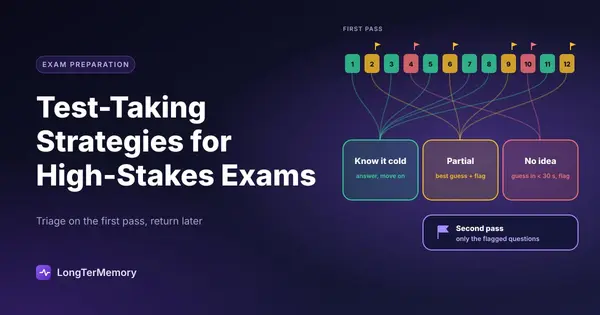
Before you start answering, spend 2-3 minutes scanning the exam structure. How many questions? What sections? Are there any especially long or difficult sections you should budget extra time for?
Then set your internal pace accordingly. For a 100-question exam in 90 minutes, that’s 54 seconds per question on average. You’ll spend less on easy ones and more on hard ones, so knowing that average helps you flag when you’re drifting.
| Strategy | When to Use |
|---|---|
| Answer and move | When you’re confident or can make a good guess |
| Skip and return | When you’re genuinely stuck, don’t let one question eat your time |
| Use process of elimination | When you can rule out at least two options |
| Review at the end | If you have time, revisit flagged questions |
Don’t change answers without a good reason. First instincts on multiple-choice questions are correct more often than second-guessing suggests, unless you’ve genuinely recalled new information that changes your answer.
After the Exam: The Habits That Compound
What you do after one exam affects how you perform on the next.
Debrief your performance. Not to beat yourself up, but to learn from it. Which topics felt solid? Which questions caught you off guard? Were there patterns in what you missed? This analysis, done calmly after the stress has passed, is some of the highest-quality study data you’ll ever get.
Return to a recovery routine. Serious exam periods are physically and mentally taxing. After a major exam, prioritize sleep, exercise, and things that aren’t studying. Burnout in the middle of a multi-exam stretch is a real risk, and recovery is how you prevent it.
Build your next prep cycle smarter. If you used LongTerMemory to turn your study materials into automated flashcard reviews, look at which cards you struggled with most. That data tells you exactly where to focus your energy next time, without the guesswork of trying to remember what felt hard.
Putting It Together
You’ve probably figured out by now that the most prepared students aren’t just the ones who studied the hardest. They’re the ones who prepared smartly, which means treating everything that affects exam performance as part of their preparation, not just the content review.
Sleep is preparation. Nutrition is preparation. Arriving early and knowing the rules is preparation. Managing anxiety and framing the exam correctly is preparation.
The content work gets you to the starting line. Everything else determines what you do once you’re there.
Want to make your content preparation more efficient so you have more energy left for everything else? LongTerMemory converts your study materials into a fully scheduled review system that handles the flashcard management automatically, so you spend your study time on actual learning, not logistics.