How to Develop Test-Taking Strategies for High-Stakes Exams
High-stakes exams require more than knowledge. Discover question triage, flagging strategies, and exam-day mindset tools that lift your performance.
Table of Contents
- What "High-Stakes" Actually Demands From You
- Question Triage Strategies for Managing Time Across Exam Sections
- Calculate your time budget before you start
- The first-pass principle
- Triage questions into three categories
- Flagging and Returning: How to Handle Uncertain Questions
- The rule on changing answers
- Working through flagged questions on the second pass
- Educated guessing when you truly don't know
- Mindset and Physical Strategies for Performing Well on Exam Day
- Managing exam-day anxiety
- Sleep: the most undervalued exam strategy
- Nutrition and hydration on exam day
- Building a pre-exam routine
- Making Strategy Part of Your Preparation
- The Exam-Day Mindset
There’s a particular kind of frustration that comes from leaving a high-stakes exam and realizing you knew more than you showed. You studied. You understood the material. And then something about the format, the pressure, the time, made the knowledge harder to access than it should have been.
This happens more than people realize, and it’s not just about nerves. It’s about test-taking as a skill set that’s entirely separate from content knowledge. Knowing the material is necessary. It’s not sufficient.
The good news is that test-taking strategy is genuinely learnable. It doesn’t require a special kind of intelligence. It requires deliberate practice, the same way any other skill does. And on high-stakes exams, the return on investing in strategy development is often larger than the return on cramming more content.
Here’s what that strategy development actually looks like.
What “High-Stakes” Actually Demands From You
High-stakes exams share a few common characteristics that distinguish them from regular course tests:
- The results have major life consequences: licensing, certification, admissions, career advancement
- Preparation periods are long: weeks or months, not a few days
- The test itself is extended: often 2-4+ hours, sometimes across multiple sessions
- Questions are designed to discriminate: they’re specifically constructed to separate candidates who have deep understanding from those with surface familiarity
That last point is crucial. High-stakes exams don’t just test whether you know things. They test whether you know things under pressure, with time constraints, and with answers that are designed to be plausibly misleading.
A strategy that might work fine for an end-of-chapter quiz will fail you here. You need approaches calibrated for these specific conditions.
Question Triage Strategies for Managing Time Across Exam Sections
Time management on a high-stakes exam isn’t just about working quickly. It’s about working in the right order, allocating your time to questions where the investment pays off most.
Calculate your time budget before you start
Before you answer a single question, do a quick calculation. Take the total available time and divide by the number of questions. This gives you your average time per question. For a 180-minute exam with 120 questions, that’s 90 seconds per question.
Now: don’t try to spend exactly that time on every question. Use it as a benchmark. Questions that should take you 20 seconds (you know this immediately) should free up time for questions that genuinely require 3 minutes of careful thought.
Knowing your time budget prevents one of the most common exam-performance mistakes: spending 8 minutes on a difficult question early in the exam and then rushing through 15 questions at the end. Your final 15 questions deserve the same quality of thinking as your first 15.
The first-pass principle
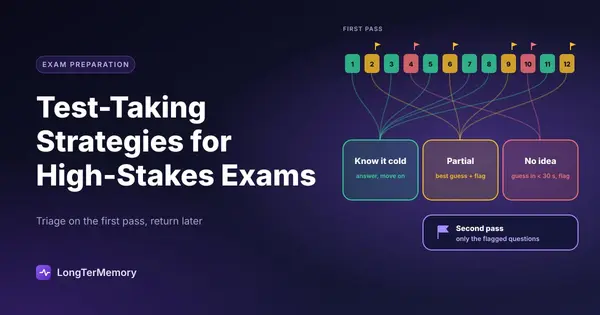
Experienced exam-takers use a first-pass approach: go through the entire section once, answering only the questions you can answer confidently and quickly. Flag everything else.
This does two things. First, it ensures that every question you can answer gets answered before time becomes a factor. Second, it gives you a complete picture of the exam before you start engaging with the harder questions, which sometimes gives you context clues for things you weren’t sure about.
On paper exams: mark flagged questions lightly in the margin. On computer-based exams: virtually all modern testing platforms have a built-in flag or mark function. Use it. Don’t rely on memory for which questions you want to return to.
Triage questions into three categories
As you work through the exam, mentally sort questions into three buckets:
- Know it cold: Answer immediately, no flag
- Partial certainty: Can eliminate some options but not sure of the final answer. Answer your best guess and flag for return
- No idea: Flag and move on. Don’t spend more than 30 seconds here
The biggest mistake candidates make is spending disproportionate time on Category 3 questions early in the exam. Time spent agonizing over something you genuinely don’t know has a very low expected value. Time redirected to reviewing Category 2 questions, where you can often improve your answer with more thought or when you remember something from a later question, is much higher value.
| Category | Action | Time allocation |
|---|---|---|
| Know it cold | Answer and move on | Minimal, stick to your pace |
| Partial certainty | Answer best guess, flag | Your average per-question time |
| No idea | Quick educated guess, flag | Under 30 seconds |
Flagging and Returning: How to Handle Uncertain Questions
The flag-and-return strategy is only valuable if you actually use the second pass well. Most candidates who flag questions come back to them and second-guess themselves into choosing a worse answer.
The rule on changing answers
The research on answer changing is more nuanced than the popular advice (“go with your first instinct”). Studies show that answer changes are correct more often than they’re wrong, but only when the change is driven by a genuine new insight, a specific reason, or remembering something relevant from another question.
Change your answer when:
- You’ve remembered specific content that directly contradicts your first choice
- A later question in the exam gave you relevant context
- You re-read the question and realize you misread it the first time
Don’t change your answer when:
- You just feel uncertain and want to try something different
- You’re running out of time and changing seems like action
- It “feels” better without a specific reason
The signal that your brain has genuinely updated is that you can articulate why the new answer is better. If you can’t explain it, don’t change it.
Working through flagged questions on the second pass
When you return to a flagged question, start by re-reading it carefully. Sometimes the question that felt impossible on first read becomes clearer when you’re not under the time pressure of a clean run-through.
For multiple choice, use active elimination before re-reading the options. Ask yourself: “What do I know about this topic?” before looking at the answers. This activates retrieval independently of the answer choices, which prevents the choices themselves from distorting your recall. Then compare what you retrieved against the options.
For questions where you’re down to two plausible answers, look for the one that is more specific, more complete, or more directly answers the exact question asked. High-stakes exam questions are precisely worded. Answer choices that are technically true but slightly off-scope are designed to catch candidates who are reading carelessly.
Educated guessing when you truly don’t know
On exams without penalty for guessing (most modern high-stakes exams), no question should ever be left blank. You’re not penalized for wrong answers, so an educated guess is always worth submitting.
Educated guessing isn’t random. Use what you do know:
- Eliminate answers that are clearly in a different domain than what’s being asked
- If two answers seem to say the same thing in different words, both are probably wrong (only one answer can be correct)
- Watch for absolute language (“always,” “never,” “only”) which is often incorrect in complex domains
- In professional exams, answers that emphasize ethical practice, safety, or patient/client wellbeing are frequently correct
Mindset and Physical Strategies for Performing Well on Exam Day
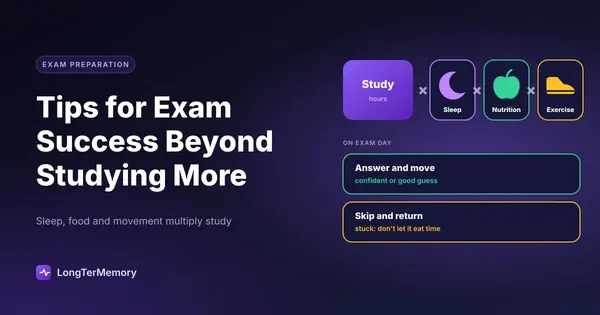
Content knowledge and strategic test-taking skills can both be undermined by what’s happening in your body and mind on exam day. The highest-stakes exams in the world are still taken by humans, and human performance is affected by sleep, nutrition, anxiety, and mental state.
Managing exam-day anxiety
Some level of anxiety before a high-stakes exam is normal and even helpful. Moderate arousal improves performance on cognitive tasks by increasing alertness and focus. The problem is when anxiety becomes high enough to impair working memory and disrupt the retrieval processes you need.
The most effective evidence-based approach to pre-exam anxiety is something researchers call expressive writing: spending 10 minutes before the exam writing freely about your worries and fears. Studies by psychologist Sian Beilock at the University of Chicago showed that this kind of pre-exam journaling significantly reduced test anxiety and improved performance among high-anxiety students, particularly on math and reasoning tasks.
The mechanism makes sense: by putting your worries into words, you process them cognitively instead of having them run as background noise during the exam itself. You’re not suppressing the anxiety; you’re giving it a dedicated outlet.
Reappraisal is the other evidence-based tool: rather than trying to feel calm (which often backfires), try reframing the physical symptoms of anxiety as excitement. “I’m excited about this opportunity” activates a similar arousal state to “I’m anxious about this exam” but with a completely different cognitive framing. Studies show this reappraisal strategy improves performance on high-pressure tasks.
Sleep: the most undervalued exam strategy
The night before a high-stakes exam, the most important thing you can do is sleep. Not cram. Sleep.
This is not a platitude. Sleep is when memory consolidation happens. The procedural and declarative memories you’ve built over your study period are solidified during sleep, particularly during slow-wave and REM stages. Pulling an all-nighter before an exam means arriving with impaired working memory, reduced processing speed, and degraded retrieval for exactly the kind of complex reasoning that high-stakes exams require.
A consistent sleep schedule in the two weeks before an exam matters more than the single night before. If your sleep has been disrupted by study schedule pressure, try to normalize it at least a week before the exam date.
For the night before: avoid stimulants after early afternoon, keep the exam material review light (a brief review of key concepts, not intensive new learning), and create conditions for sleep rather than studying until the last possible moment.
The relationship between sleep and memory is direct and well-established. How to use sleep strategically to enhance study sessions goes deeper into the specific mechanisms.
Nutrition and hydration on exam day
The research on exam-day nutrition is less dramatic than the headlines sometimes suggest, but the basics matter:
Eat a proper meal 2-3 hours before the exam. Not immediately before (digestive burden reduces cognitive sharpness) and not so far in advance that you’re hungry during the exam (hunger is distracting and depletes focus). Complex carbohydrates and protein provide stable energy. Avoid high-sugar options that produce an energy peak followed by a crash.
Hydrate adequately. Even mild dehydration (1-2% body weight) measurably impairs cognitive performance. Drink water in the hours before the exam. Don’t overhydrate to the point of needing bathroom breaks every 20 minutes, but don’t walk in already dehydrated from skipping fluids because you were rushing.
Avoid trying anything new on exam day. No unfamiliar foods, no new supplements, no experimental morning routines. Novelty creates unpredictability. Stick to what your body knows.
Building a pre-exam routine
Deliberate routine is one of the most effective tools for managing performance variability. Athletes know this intuitively: a pre-competition routine reduces the cognitive overhead of preparation and creates reliable conditions for peak performance.
For exam candidates, a pre-exam routine might look like:
- Wake up at the same time as during the study period (don’t suddenly shift your sleep schedule)
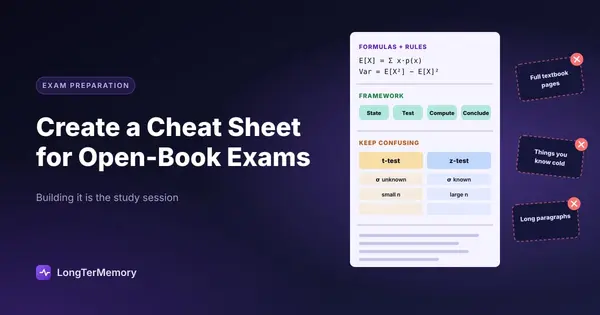
- Light review of key frameworks or formulas, not intensive study
- A 10-minute expressive writing session for anxiety reduction
- Your normal breakfast at the normal time
- Arriving at the test center with enough buffer that logistics are not a stress source
The specifics matter less than the consistency. A routine that reduces decision-making and novelty on exam morning frees cognitive resources for the exam itself.
Making Strategy Part of Your Preparation
The mistake many candidates make is treating test-taking strategy as an afterthought, something to think about in the final days before the exam. Strategy should be practiced throughout your preparation, not bolted on at the end.
This means doing practice exams under real conditions: timed, without breaks, without checking references, from start to finish. The first time you practice triage and flagging under genuine time pressure should not be in the actual exam.
LongTerMemory supports this kind of preparation by turning your study materials into practice question banks that can be reviewed under realistic conditions, with spaced repetition ensuring that content you’re less confident about gets more attention over time. The combination of solid content knowledge and practiced test-taking strategy is what high-stakes exam performance is actually built on.
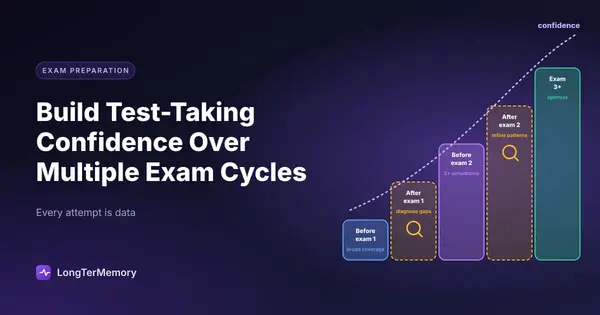
For a broader perspective on the mindset shifts that come with approaching multiple high-stakes exam attempts, how to build test-taking confidence over multiple exam cycles covers the experience-building dimension that complements strategy.
The Exam-Day Mindset
One last thing worth saying: on the day of the exam, your job is no longer to study. The study period is over. Your job is to perform.
That reframe matters because candidates who treat the exam as an extension of studying, continuing to second-guess their preparation, wondering if they studied the right things, wishing they’d done more, are dividing their attention between the past and the present. The present is where the exam is happening.
Focus on what you can control: reading questions carefully, managing your time deliberately, applying the strategies you’ve practiced. Let the content knowledge you’ve built work for you. Trust the preparation.
Everything you built over your study period is available to you in that room. Your job is to give it the best possible conditions to come through.