Best Study Habits for First-Generation College Students
A practical guide to college study habits for first-generation students: the hidden curriculum, building a study system from scratch, and campus resources.
Table of Contents
- The Hidden Curriculum: Rules Nobody Wrote Down
- Building a Study System When No One Handed You One
- The Core Three Techniques
- A Weekly Rhythm That Survives a Work Schedule
- Guard Your Calendar Like It Is Money
- Campus Resources First-Gen Students Underuse
- About Impostor Feelings
- Your First-Week Checklist
If you are the first person in your family to go to college, there is something nobody tells you directly, so let me say it plainly: college has an instruction manual, and some of your classmates got a copy at birth. Their parents told them what office hours are actually for, how to email a professor, why the syllabus matters, and that everyone feels lost in week three. You are figuring out all of that in real time, on top of the actual coursework, and often on top of a job.
That is not a deficit in you. It is a gap in information, and information gaps close. This guide is the missing manual for the studying part: the hidden rules nobody stated, the study system to build when no one at home can hand you theirs, and the campus resources you have already paid for and probably are not using.
The Hidden Curriculum: Rules Nobody Wrote Down
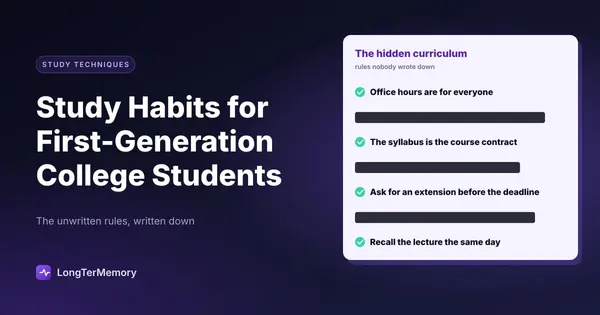
Sociologists call it the hidden curriculum: the unwritten norms, expectations, and moves that college rewards but never explicitly teaches. Continuing-generation students absorb it at the dinner table. First-gen students often discover each rule only after tripping over it. Here are the ones that affect your studying most:
The syllabus is a contract and a map. It is not a handout to skim on day one. It contains the grading weights (which tell you where points actually live), every deadline, the professor’s policies, and usually the exam format. Successful students read it like a strategy document: if the final is 40% and weekly homework is 10%, that ratio should shape how you spend your hours.
Office hours are for everyone, not for emergencies. This might be the single most costly misunderstanding. Many first-gen students believe office hours are where you go when you are failing, so going feels like an admission of defeat. In reality, office hours are unstructured access to the person who writes your exams. Strong students use them routinely: to check their understanding, to ask how to prepare, to become a face the professor knows. Go once in the first three weeks with one genuine question. That is the whole move.
“Read chapter five” does not mean read chapter five. It means: extract what matters from chapter five for this course. College reading loads are designed on the assumption that you read strategically, headings first, questions in mind, notes in your own words, not that you read every word like a novel. Nobody says this out loud.
Professors expect you to advocate for yourself. Extensions, clarifications, regrade requests, accommodations: these systems exist, but they are almost all activated by you asking, early and politely. Silence is read as everything being fine.
Struggling is the norm, not the signal you don’t belong. The classmates who seem effortlessly on top of things are drawing on coaching you cannot see, and plenty of them are struggling too, just quietly. Week-six panic is a universal experience, not a first-gen one.
None of these rules is hard. They are just invisible until someone states them. Now they are stated.
Building a Study System When No One Handed You One
Here is the honest upside of your position: because you are not inheriting anyone’s habits, you get to build your system from the actual science instead of from family folklore. And the science is refreshingly clear about what works. High school probably rewarded you for re-reading, highlighting, and cramming the night before. College punishes those, not because professors are cruel, but because the volume is five times higher and the questions test understanding rather than recognition.
The system below is built on the three most evidence-backed techniques in learning research, arranged into a weekly rhythm you can run even with a job and a commute.
The Core Three Techniques
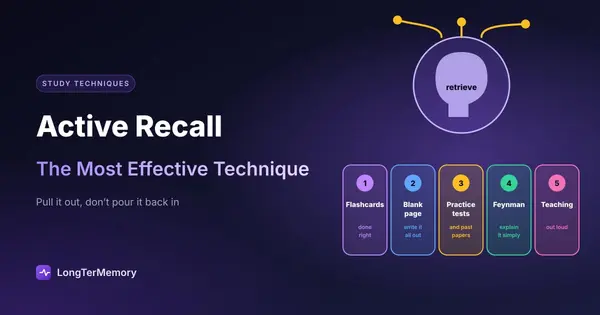
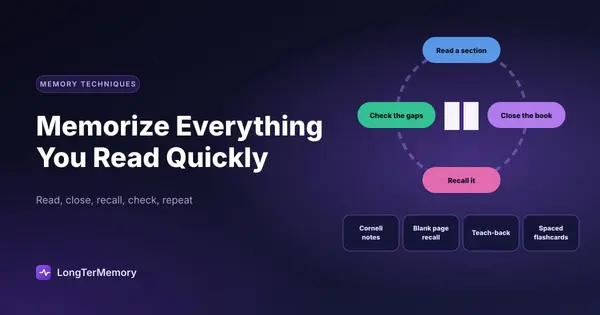
1. Active recall: test yourself instead of re-reading. After every lecture or reading, close everything and write down, from memory, the main ideas and how they connect. Then check what you missed. This feels harder and less pleasant than re-reading, which is exactly why it works: the effort of pulling information out of your memory is what strengthens it. Decades of research show self-testing roughly doubles retention compared to reviewing the same material passively.
2. Spaced repetition: many short reviews beat one long one. Instead of studying a topic once for three hours before the exam, touch it for twenty minutes across several days spread over weeks. Same total time, dramatically better memory. This is the single most powerful scheduling decision available to you, and it is also the one cramming culture ignores completely.
3. Interleaving and real problems. Where courses involve problem-solving (math, chemistry, economics, coding), do problems without the solution visible, mix problem types within a session, and treat every wrong answer as data about what to review. Watching someone else solve problems, in lecture or on YouTube, is recognition. Exams test production.
A Weekly Rhythm That Survives a Work Schedule
Many first-gen students work 15 to 30 hours a week, so the system has to run on fragments, not on mythical five-hour library blocks:
| When | What | Time |
|---|---|---|
| Same day as each lecture | Active recall dump of the lecture from memory | 10-15 min |
| Daily, anywhere | Spaced repetition review (phone is fine, bus counts) | 15-20 min |
| Twice a week per course | Problems or practice questions, closed-book | 30-45 min |
| Weekly | Quick planning pass: what is due, what is weak | 15 min |
Notice what is missing: marathon sessions. A daily-fragments system beats a weekend-warrior system on retention, and it degrades gracefully when life happens, missing one 15-minute review is recoverable in a way that missing your only four-hour block is not.
One tool note, because time is your scarcest resource: making flashcards by hand is the classic time sink of students who study seriously. You can skip that entire step by uploading your lecture notes, slides, and readings to LongTerMemory, which automatically turns them into question-answer pairs and schedules your reviews using spaced repetition. The reviewing is where the learning happens; the card-making is overhead, and overhead is what a working student cannot afford. The free trial costs nothing, which matters when every subscription decision is a real decision.
Guard Your Calendar Like It Is Money
Because for you it literally is. When work hours, family obligations, and classes all make claims on you, studying gets whatever is left unless you assign it first. Put your study fragments into your calendar as fixed appointments, the same status as a work shift. When family asks for your time, and first-gen students often carry heavier family obligations than their classmates, a written schedule turns “I can’t, I have to study sometime” into “I can help after 7, I have class work until then”. Concrete boundaries are easier to hold than vague ones, for you and for the people who love you.
Campus Resources First-Gen Students Underuse
Here is a framing shift worth internalizing: you already paid for all of this. Tuition and fees fund an entire support infrastructure, and using it is not getting help, it is collecting what you purchased. Continuing-gen students use these services shamelessly. The data consistently shows first-gen students use them less, usually because nobody explained what they are.
The tutoring center and supplemental instruction. Free, drop-in or scheduled help for specific courses, often staffed by students who aced the class recently. Supplemental instruction (SI) sessions, where they exist, are peer-led weekly reviews attached to historically hard courses, and attendance correlates strongly with grade improvement. Not remedial. Strategic.
The writing center. Free feedback on any paper at any stage, including “I have a prompt and no idea how to start”. One session can teach you the structure conventions that some of your classmates learned from college-educated parents proofreading their high school essays.
Office hours and TAs. Covered above, but it bears repeating as a resource: direct access to the exam-writer is the most underpriced asset on campus.
TRIO, first-gen programs, and multicultural student centers. Many campuses have federally funded TRIO Student Support Services or their own first-gen programs offering advising, tutoring, workshops, sometimes even grants and priority registration. These exist specifically for you. Find out in week one whether your campus has one, the eligibility is often exactly your situation.
Academic advisors, used early. Advisors can save you entire semesters of money and time, but only if you see them before registration decisions, not after. Book a real conversation, bring your degree plan, ask what students in your major wish they had known.
The library’s human beings. Research librarians will sit with you and teach you how to find sources for a paper, a skill nobody is born with and every professor assumes you have.
Counseling services. College stress is real, first-gen pressure, being the family’s proof of concept, carrying everyone’s hopes, is its own weight. Campus counseling is typically free and confidential. Using it is maintenance, not crisis management.
The general rule: if you feel like you are the only one who does not know something, a campus office exists whose entire job is that thing. Asking is not exposing a weakness. It is using the system the way it was designed to be used, by the people who designed it.
About Impostor Feelings
One more thing, because study advice is useless if you quietly believe you do not belong in the room. Impostor feelings, the sense that you were admitted by mistake and will eventually be found out, are extremely common among first-gen students, and they have a study-relevant cost: they make you hide confusion instead of asking, skip office hours, and avoid exactly the resources that would help.
So flip the evidence. You got in on the same criteria as everyone else. You are managing coursework plus navigation-without-a-map plus, likely, work and family, which is more, not less, than most of the room is handling. Confusion in a hard course is information about the course, not a verdict on you. And every question you ask in office hours, every tutoring session you book, is not proof you are behind. It is you doing college correctly.
Your First-Week Checklist
To make all of this actionable, here is the whole guide compressed into things you can do this week:
- Read every syllabus and write down grading weights and exam dates
- Put daily 15-minute review blocks in your calendar as fixed appointments
- Set up your spaced repetition system and feed it your first lecture notes
- Visit one professor’s office hours with one genuine question
- Walk into the tutoring center and the first-gen/TRIO office, just to learn what they offer
- After your next lecture, close your notebook and write what you remember
Six items. None of them requires talent, connections, or a family manual. That is rather the point: college rewards systems and information, and both of those, as of today, you have.