How to Build a Study Routine as a Graduate Student
Build a sustainable graduate school study routine that balances coursework, research, and teaching while developing long-term independent learning habits.
Table of Contents
- Understanding the Structural Difference Between Undergrad and Grad Study
- Building Independent Study Habits Without Structured Oversight
- Time Blocking for Grad School
- "Minimum Daily Contact" Rule
- Long-Form Retention Strategies for Graduate-Level Reading
- Annotate Actively, Not Decoratively
- The Literature Note System
- Spaced Repetition for Core Concepts and Terminology
- Balancing Coursework, Research, and Teaching Responsibilities
- Protect Your Best Hours for Your Hardest Work
- Batch Low-Value Tasks
- Say No as a Strategy
- Handling the Psychological Dimensions of Graduate Study
- The Routine That Compounds Over Time
Something changes the moment you enter graduate school. You already knew how to study, or you wouldn’t have gotten there. But suddenly the structure that carried you through undergrad, scheduled classes, assignments with clear deadlines, someone telling you exactly what to learn and by when, thins out considerably.
A master’s program or PhD puts far more of the responsibility onto you. Nobody is managing your daily study time. Nobody is checking whether you’ve kept up with your reading. The exams, when they come, test years of accumulated understanding rather than a semester’s memorized content.
This is an adjustment that catches a lot of graduate students off guard. The skills that made you excellent in undergrad, strategic cramming, following rubrics closely, knowing how to prepare for a specific test format, aren’t always what graduate school demands. The new skills you need are about independent structure, long-form retention, and sustained intellectual engagement over months and years.
Building a good study routine as a graduate student is one of the highest-leverage things you can do for your academic performance and your sanity. Here’s how to approach it.
Understanding the Structural Difference Between Undergrad and Grad Study
In undergrad, most of your cognitive work happened in service of graded assignments with clear timelines. You had relatively frequent, concrete feedback on whether you were learning.
Graduate school operates differently in several key ways:
Longer feedback loops. A dissertation chapter might not get advisor feedback for weeks. A qualifying exam might be months away. Your sense of progress depends more on internal metrics than external ones.
Self-directed reading. Rather than a textbook telling you what to know, you’re often navigating a literature and deciding for yourself what’s important, what’s foundational, and what can be skimmed.
Multiple simultaneous demands. Many graduate students are simultaneously doing coursework, conducting research, teaching or TAing, writing papers, and attending professional conferences. These all need time.
Open-ended intellectual work. Research doesn’t have a fixed endpoint the way a problem set does. This makes time management both harder and more important.
A study routine for graduate school needs to be designed around these realities, not around the undergraduate framework most of us internalized.
Building Independent Study Habits Without Structured Oversight
The single most important habit to develop early in graduate school is protecting time for studying and reading before you feel urgent pressure to do so.
In undergrad, urgency managed your time for you. The exam on Thursday created Thursday’s studying. In graduate school, if you wait for urgency, you end up cramming before qualifying exams, scrambling to catch up on reading you skipped months ago, and writing under panicked deadlines rather than sustained engagement.
Time Blocking for Grad School
Time blocking is the practice of assigning specific activities to specific time slots in your calendar, rather than working through a general to-do list. For graduate students, this is especially valuable because it forces you to confront the reality of how many hours you actually have.
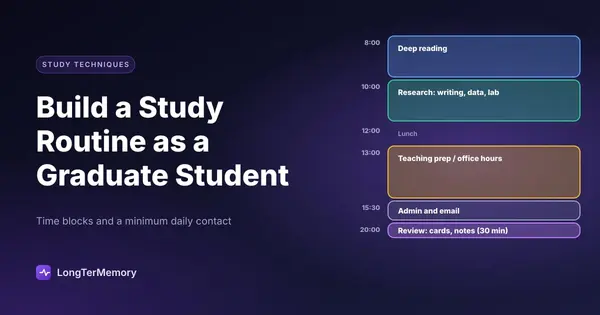
A realistic graduate student weekly time block might look like:
| Block | Activity |
|---|---|
| Daily, 8:00-10:00 AM | Deep reading / coursework engagement |
| Daily, 10:00-12:00 PM | Research tasks (writing, data, lab work) |
| 3 afternoons per week | Teaching prep and office hours |
| 1 afternoon per week | Admin, emails, scheduling |
| Daily, 30 minutes evening | Review/consolidation (flashcards, notes review) |
The specific allocation will vary enormously by program, year, and individual. The point is that reading and studying has assigned time before it competes with everything else, not after.
”Minimum Daily Contact” Rule
One habit that graduate students in research-heavy programs find useful is what some call a minimum daily contact rule: every day, you touch your main research project and your core coursework, even briefly.
A day where you spend six hours on teaching and have nothing left for research is common. The temptation is to skip the research entirely and “make it up tomorrow.” But even fifteen or twenty minutes of reading one paper, writing two paragraphs, or reviewing flashcards maintains a connection to the material that total breaks erode.
Minimum contact is not the same as adequate time. It’s the floor that keeps momentum alive during the busy weeks, not the ceiling you aim for when you have more space.
Long-Form Retention Strategies for Graduate-Level Reading
Graduate-level reading is qualitatively different from undergraduate reading. You’re not just consuming information, you’re building a scholarly understanding of a field: how arguments develop, what the contested questions are, how different positions relate to each other.
This demands a different approach to reading retention.
Annotate Actively, Not Decoratively
Highlighting for the sake of highlighting is a waste of time. Annotation that actually improves retention involves engagement with the text:
- Margin notes that respond to or question what the author is saying, not just summarize it
- Questions you want to follow up on after reading
- Connections to other things you’ve read (“this contradicts Smith 2019’s claim about X”)
- Summaries in your own words at the end of each section, before moving on
This slows down reading, which is the point. Reading that produces no durable understanding is faster but not more efficient.
The Literature Note System
Many graduate students find it useful to write a short literature note for every significant paper or book chapter they read. A literature note is not a summary, it’s your intellectual response:
- The core argument in one or two sentences
- What evidence or method the argument rests on
- What you agree with or find compelling
- What you find weak, contested, or unconvincing
- How it connects to your own research questions
These notes become invaluable when you’re writing. Instead of trying to recall what you thought about a paper you read eight months ago, you have a record of your actual intellectual engagement with it.
Tools like Obsidian, paired with Zotero for citation management, support this kind of connected note system well. Each literature note is its own file, linked to related notes and to your own developing arguments.
Spaced Repetition for Core Concepts and Terminology
Graduate programs require you to internalize a large amount of foundational knowledge: the major frameworks in your field, key theoretical debates, landmark studies and their findings, methodological approaches and their assumptions.
Spaced repetition is the most efficient tool for this kind of long-term retention. The forgetting curve means that information you encountered once in a seminar will be mostly gone within weeks. Systematic review at increasing intervals rebuilds and consolidates that knowledge so it stays available.
LongTerMemory can generate Q&A flashcards directly from your reading materials, including PDFs of papers and textbook chapters, and schedule them for optimal review. For graduate students with large reading loads, this removes the friction of manually creating flashcard decks. You upload the material, the AI generates relevant Q&A pairs, and the spaced repetition system takes over the timing of your reviews.
For a master’s student building foundational knowledge across a discipline, this approach can mean the difference between a review session that meaningfully consolidates your reading and one that feels like you’re re-reading everything from scratch.
Balancing Coursework, Research, and Teaching Responsibilities
The fundamental tension of graduate school for most students is time. You have coursework requiring sustained attention, research that demands uninterrupted deep work, teaching duties with preparation and grading, and professional activities like conferences, networking, and job applications.
There is no perfect formula. But there are structural principles that help.
Protect Your Best Hours for Your Hardest Work
Everyone has a cognitive peak window, a few hours when their thinking is clearest and their focus strongest. For most people, this is in the morning, though individual variation is real.
Whatever your best hours are, protect them fiercely for high-complexity work. Research writing, difficult reading, original thinking. Administrative tasks, emails, and mechanical grading can happen in lower-energy windows. The mistake many graduate students make is letting urgent-but-easy tasks (responding to emails) crowd into the same slots they should be using for important-but-not-urgent work (reading, writing, thinking).
Batch Low-Value Tasks
Teaching prep, grading, administrative work, and email all need to happen. Batching them, doing all your grading in one block, answering all your emails in one window, reduces the cognitive overhead of constantly context-switching.
When these tasks are interspersed throughout the day without batching, they fragment your attention in ways that make deep work much harder to sustain.
Say No as a Strategy
Graduate students who develop the habit of saying yes to everything, every extra committee, every additional responsibility, every last-minute favor, consistently underperform those who protect their time more deliberately.
Saying no to a marginal opportunity is not failure. It is resource allocation. Your time and cognitive capacity are the primary resources your graduate career runs on. Protecting them is a professional competency, not an antisocial character flaw.
Early in graduate school, this is hard to internalize. Every opportunity seems important. Every “no” feels like a missed chance. But the students who do the most significant work are almost always the ones who focus, not the ones who diversify maximally.
Handling the Psychological Dimensions of Graduate Study
No guide to graduate study routines is complete without addressing the emotional reality. Graduate school is genuinely difficult, not just intellectually but psychologically.
Imposter syndrome is nearly universal among graduate students. The feeling that everyone else knows more than you, that you don’t really belong, that someone is about to discover you’re not as smart as they think, is not evidence that those things are true. It’s a predictable response to being surrounded by smart, accomplished people who are all displaying their best work while you’re inside your own head watching yourself struggle.
The antidote is not forcing yourself to feel confident. It’s building evidence of competence through consistent action. Each paper you finish, each concept you master, each session you show up for even when you didn’t want to, is evidence that you can do this. That evidence accumulates.
Progress visibility is a challenge in graduate school because so much work goes into things that don’t produce visible output for a long time. A system that makes your progress concrete helps. Tracking daily study time, flagging papers as “read,” maintaining a running list of completed tasks, these create visible progress even during long stretches when the big milestones feel far away.
Periodic scheduled rest is not optional. The students who burn out in year two or three often did so because they treated rest as something to earn by completing work, rather than as something to schedule regardless of work status. Rest scheduled unconditionally is more sustainable than rest given to yourself as a reward, because the work is never fully done.
The Routine That Compounds Over Time
A graduate study routine doesn’t produce its full value in week one. It produces its value over semesters, over years, through consistent execution.
The student who reads deliberately every day, reviews their foundational knowledge regularly, writes a little even when they don’t feel like it, and protects their deep work time accumulates an advantage that becomes enormous over a few years. Not because any individual day was spectacular, but because the consistency compounds.
The starting point doesn’t need to be perfect. A routine you’ll actually execute imperfectly is infinitely better than an ideal routine you never quite start. Pick two or three of the habits above, apply them consistently for a month, and add more once they’re established.
You already proved you could succeed academically to get here. The graduate version of that success requires a different kind of discipline: not the sprint discipline of preparing for specific exams, but the marathon discipline of showing up consistently for work that pays off slowly, over a long time horizon.
That discipline is learnable. Build the routine that supports it. The rest follows.