How to Handle Difficult Exam Questions You Weren't Ready For
Stuck on an exam question you didn't prepare for? These in-exam strategies will help you stay calm, reason through it, and protect your score.
Table of Contents
- Why You'll Always Face Questions You Weren't Ready For
- In-Exam Strategies for Questions That Test Material You Didn't Cover
- Step 1: Re-read the Question Carefully
- Step 2: Decompose the Question Into Parts You Recognize
- Step 3: Eliminate What You Can
- Step 4: Apply First Principles
- Step 5: Commit and Move On
- Using Partial Knowledge and Reasoning to Earn Partial Credit
- The Power of Knowing What Something Isn't
- Reading Context Clues in the Question
- The Distractor Anatomy of Hard Questions
- Keeping Calm So One Hard Question Doesn't Derail the Whole Exam
- The One-Question Rule
- Controlled Breathing as a Reset Mechanism
- Reframe the Difficult Question as Evidence of Preparation
- Don't Count Correct and Incorrect During the Exam
- After the Exam: Processing Hard Questions Constructively
- The Preparation That Makes This Easier
You’re sitting in the exam, everything is going reasonably well, and then you hit a question that stops you cold. The topic looks vague, the answer choices seem almost equally plausible, and you have no memory of ever covering this material. Your heart rate climbs slightly. You stare at the screen.
This moment happens to virtually every exam candidate, no matter how well-prepared they are. What separates high scorers from average scorers isn’t whether they encounter these questions. It’s what they do when they do.
The skills required to handle difficult, unexpected exam questions are different from the skills required to learn content. Most people study the content. Very few people explicitly practice what to do when the content fails them. This guide is about that second set of skills.
Why You’ll Always Face Questions You Weren’t Ready For
Before we get into strategy, it’s worth being honest about why this happens, even to well-prepared candidates.
No exam is entirely predictable. Even heavily tested exams like the USMLE, bar exams, or professional certification exams have some material that falls outside what any study guide or review course fully covers. Exam writers deliberately include content that tests reasoning ability, not just memorization.
Memory fails under pressure. You may actually know the answer. Exam anxiety and performance pressure can temporarily block access to information that was perfectly accessible during your practice sessions. The right strategy can help you recover what you know rather than assuming you don’t know it.
Some topics are genuinely rare but testable. Every domain has peripheral content that appears only occasionally on exams but is within scope. A question on an obscure but testable topic isn’t unfair; it’s the exam doing its job.
Understanding this shifts your mindset. The question isn’t “why don’t I know this?” but “how do I perform my best on a question I’m uncertain about?”
In-Exam Strategies for Questions That Test Material You Didn’t Cover
The worst thing you can do when you hit a difficult question is freeze, panic, or spend five minutes trying to force a memory that isn’t there. Instead, move into a structured reasoning process.
Step 1: Re-read the Question Carefully
This sounds obvious, but it’s where most panicked exam-takers go wrong. When we feel uncertain, we rush. We skim the question, feel overwhelmed by the answer choices, and pick something without actually processing what’s being asked.
Force yourself to slow down and read the question twice.
Look for:
- What is the central concept being tested?
- What action does the question ask you to take? (Identify, calculate, recommend, evaluate, prioritize?)
- Are there qualifiers or limiting conditions? (Most, least, always, never, in this scenario…)
- What’s the context? (A specific population, setting, time constraint, or constraint?)
Sometimes re-reading a question reveals that it’s actually addressing something you do know, just packaged in unfamiliar terminology or from an angle you hadn’t considered during prep.
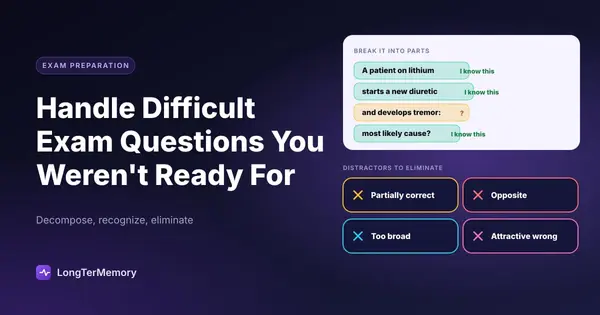
Step 2: Decompose the Question Into Parts You Recognize
Even if you don’t recognize the specific topic, break the question into smaller components that you might know something about.
For example: if a question asks about a niche assessment tool you’ve never heard of, ask yourself:
- What domain is this tool used in? (Clinical? Organizational? Environmental?)
- What type of tool is it likely to be? (Screening? Diagnostic? Intervention?)
- What would a reasonable, evidence-based tool in this domain typically look like?
This process of reasoning from what you know about a category toward what might be true of a specific item in that category is a transferable skill that works across exam types.
Step 3: Eliminate What You Can
In most multiple-choice exams, you don’t have to identify the correct answer directly. You just have to choose the best available answer after eliminating the others.
Systematic elimination strategy:
First pass: Remove any answer that is clearly incorrect. Common characteristics of wrong answers include:
- Extreme language without justification (never, always, completely, never, under no circumstances)
- Actions that violate established ethical or professional standards
- Options that address a different question than the one being asked
- Options that are factually contradicted by something in the question stem
After eliminating the clear wrong answers, you’re usually left with two options that both seem plausible. Now you’re making an educated decision between two reasonable choices, not a wild guess from four unknowns.
Step 4: Apply First Principles
If you still can’t identify the correct answer, step back from the specific topic and apply first principles from your field.
In healthcare exams: What is most likely to benefit the patient with the least risk? What does evidence-based practice typically recommend?
In business or management exams: What balances organizational efficiency with employee wellbeing? What aligns with legal and ethical standards?
In scientific exams: What is the most controlled, rigorous, and reproducible approach?
These principles don’t always lead you to the right answer, but they’re significantly better than random guessing. Answers that align with foundational professional values in a field are more likely to be correct than answers that violate them, even on obscure topic questions.
Step 5: Commit and Move On
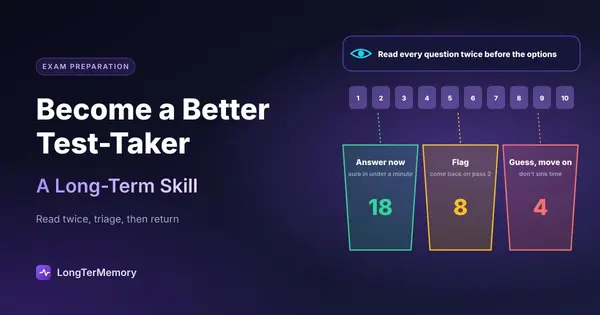
Once you’ve made your best decision, mark the answer and move forward. Do not sit on a difficult question for minutes while the clock runs down. Do not allow one uncertain question to infect your performance on the next five questions.
Flag the question if your exam interface allows it, so you can return if time permits. Then mentally close the door on it and redirect your full attention to the next question.
The hardest part of this step is psychological. Leaving a question you’re not confident about feels wrong. But continuing to stare at it almost never produces a new insight. You’ve made your best decision with the information available. Move on.
Using Partial Knowledge and Reasoning to Earn Partial Credit
On many professional exams, particularly those with partial credit or complex scoring, you don’t always need to be completely right. You need to demonstrate competent reasoning, even in areas of uncertainty.
More importantly: in multiple-choice contexts where there’s no penalty for guessing, partial knowledge is always worth acting on.
The Power of Knowing What Something Isn’t
Sometimes you can’t identify the correct answer, but you know that certain options are wrong. That partial knowledge is enormously valuable.
Consider: if you can confidently eliminate two of four answer options, you’ve improved your probability of guessing correctly from 25% to 50%. Across an exam with dozens of uncertain questions, those probabilities add up to meaningful score points.
Every piece of knowledge you have, even “I know that’s definitely not right,” should be deployed.
Reading Context Clues in the Question
Questions are written by humans, and well-written questions provide context clues that point toward the correct answer even when you don’t directly know it.
Look for:
- Conceptual alignment: If the question setup describes a community outreach situation and asks about next steps, answers that involve collaborative, community-centered approaches are more likely correct than top-down, directive ones.
- Scope alignment: If a question specifies a resource-limited setting, answers requiring extensive infrastructure are probably wrong.
- Temporal alignment: “Immediate next step” questions usually favor stabilization or assessment before intervention.
These aren’t foolproof, but they’re genuine reasoning shortcuts that reflect how good test questions are constructed.
The Distractor Anatomy of Hard Questions
Understanding how wrong answers are written helps you identify them faster. Common distractor patterns include:
| Distractor Type | Characteristic |
|---|---|
| Partially correct | True but doesn’t answer the question asked |
| Opposite | Directly contradicts the correct answer |
| Too broad | Correct concept but wrong scope |
| Too specific | Correct category but wrong application |
| Attractive wrong | Sounds very plausible, exploits a common misconception |
The “attractive wrong” distractor is the most dangerous and the most common on difficult questions. It’s specifically designed to appeal to candidates with superficial knowledge of a topic. If an answer feels almost too perfect, scrutinize it.
Keeping Calm So One Hard Question Doesn’t Derail the Whole Exam
The psychological challenge of difficult exam questions is often more significant than the technical challenge. Here’s how to keep your composure.
The One-Question Rule
Adopt this as a firm mental rule: one difficult question cannot determine the outcome of this exam. Even on a 100-question exam where each question is worth the same, a single question represents 1% of your score. Getting it wrong does not and cannot cost you the exam by itself.
When you feel the familiar anxiety spike of hitting a difficult question, remind yourself of this explicitly. “This is one question. My performance on every other question is unchanged. Handle this question as well as I can and move on.”
This sounds simple but requires practice to execute under pressure. If you haven’t explicitly trained this mindset during your preparation, exam day is a hard time to start.
Controlled Breathing as a Reset Mechanism
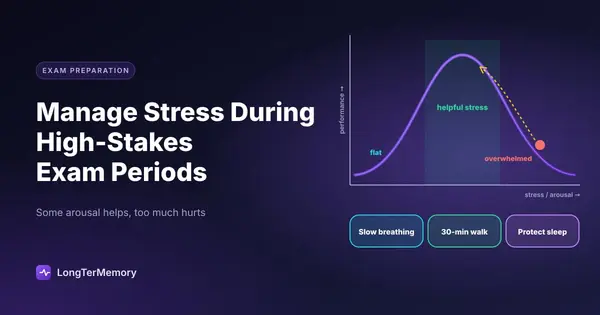
A brief, controlled breathing exercise takes less than 30 seconds and measurably reduces anxiety response. When you hit a question that triggers stress:
- Stop reading. Look away from the screen for a moment.
- Take one slow breath in through your nose (4 counts).
- Hold briefly (2 counts).
- Exhale slowly through your mouth (6 counts).
- Return to the question.
This isn’t meditation or self-help theater. Controlled breathing activates the parasympathetic nervous system, reduces cortisol response, and literally improves cognitive function under stress. It’s used by surgeons, pilots, and elite athletes for exactly this reason.
Reframe the Difficult Question as Evidence of Preparation
Here’s a mindset shift that genuinely helps: a question you can’t immediately answer is not a sign that you failed to prepare. It’s evidence that the exam is testing reasoning, not just recall.
If you could answer every question instantly from memory, either the exam is too easy or the knowledge alone would be sufficient to do your job. Hard questions that require reasoning are actually the exam doing what it’s supposed to do.
The well-prepared candidate who hits a hard question and reasons through it carefully is demonstrating something the easy-recall questions can’t: professional judgment. That’s what the exam is ultimately after.
Don’t Count Correct and Incorrect During the Exam
This is a habit that sabotages candidates in real-time. If you’re mentally keeping a running tally of “I think I got that one right, but I probably missed that one…” you’re allocating cognitive resources to a calculation that helps you nothing and harms your focus on the current question.
Stop counting. Commit to every question fully, then release it and move forward.
After the Exam: Processing Hard Questions Constructively
When the exam is over, resist the urge to immediately analyze every question you felt uncertain about. The post-exam period, especially before results are released, is one of the most psychologically difficult phases for candidates.
If you need to process, do it once, briefly, and then redirect. Ask yourself: “Did I apply my best reasoning? Did I use my preparation effectively?” If yes, the outcome is largely determined and rumination won’t change it.
If there’s a retake possibility, take notes on topic areas where you felt uncertain, not individual questions, to guide future preparation. Those pattern notes are genuinely useful. Replaying individual wrong answers is not.
The Preparation That Makes This Easier
The best way to handle difficult exam questions is to practice handling them before the actual exam.
Deliberate practice with hard questions:
- When doing practice exams, don’t just review correct answers. Spend extra time on questions you got wrong or guessed correctly on. Understand why the correct answer is correct and why the wrong answers are wrong.
- Practice timed question sets where you deliberately move through uncertain questions without stalling. Build the habit of commitment and forward motion.
- Work through “outside my comfort zone” questions: take a practice exam in a domain you know less well. The experience of being genuinely uncertain builds the skills for handling uncertainty under real exam conditions.
Spaced repetition for the knowledge base: Building a thorough, well-retained knowledge base through tools like LongTerMemory means fewer questions catch you completely off guard. The goal isn’t to know everything, but to know enough that “difficult” questions become “challenging but workable” rather than “completely unfamiliar.”
The margin between a passing score and a failing score on most professional exams is smaller than candidates imagine. Handling difficult questions with composure and systematic reasoning, rather than panic, is often exactly where those margin points come from.
You will encounter questions you weren’t ready for. What matters is what you do when you do.