How to Recognize the Signs of Study Burnout Early
Learn to spot study burnout before it takes over. Discover the early warning signs and proven strategies to recover fast and study smarter.
Table of Contents
- What Study Burnout Actually Is (And Isn't)
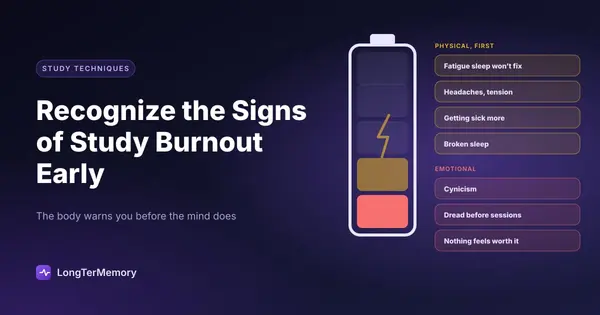
- The Physical Signs: Your Body Sends Signals First
- Chronic Fatigue That Sleep Doesn't Fix
- Frequent Headaches and Physical Tension
- Getting Sick More Often
- Disrupted Sleep, Even When You're Exhausted
- The Emotional Signs: When Studying Stops Feeling Meaningful
- Cynicism Toward Your Studies
- Irritability and Emotional Volatility
- Dread and Avoidance
- A Flat or Joyless State
- The Cognitive Signs: When Your Brain Stops Cooperating
- Concentration That Evaporates
- Information That Refuses to Stick
- Difficulty Making Decisions
- A Persistent Sense That Nothing You Do Is Enough
- Why Burnout Feels Like Laziness
- The Interventions That Actually Reverse Early-Stage Burnout
- Genuine Rest, Not Just Passive Time Off
- Temporarily Reduce Volume, Not Eliminate Studying
- Address the Sleep Deficit Actively
- Reconnect with Your Motivation
- Get Social Support
- When to Seek More Help
- The Bottom Line
You’ve been studying for weeks. Maybe months. The coffee isn’t working the way it used to. You sit down to review your notes and nothing sticks, not because the material is hard, but because your brain just… refuses to cooperate. You feel simultaneously exhausted and restless. Sound familiar?
What you might be experiencing is study burnout, and it’s far more common than most students admit. The tricky part is that it creeps up gradually. By the time you realize something is seriously wrong, you’re already deep in it. That’s why learning to recognize the early warning signs matters so much, because early burnout is reversible, and late-stage burnout can derail months of preparation.
This guide walks you through the physical, emotional, and cognitive signals that burnout is building, why it often gets mistaken for laziness, and the specific interventions that actually work before things get severe.
What Study Burnout Actually Is (And Isn’t)
Before diving into signs, it’s worth being precise about what we mean. Study burnout isn’t just feeling tired after a long study session. Everyone feels tired after that. It’s a state of chronic exhaustion that results from prolonged, high-effort studying without adequate recovery, and it affects your cognitive function, your motivation, and your emotional regulation all at once.
The concept of burnout was originally studied in professional contexts, particularly among healthcare workers and teachers, but research over the past decade has made it clear that student burnout follows the same patterns. A 2018 study published in the journal Frontiers in Psychology found that student burnout is characterized by three core components: exhaustion, cynicism (a growing detachment from your studies), and a sense of diminishing academic efficacy (feeling like your effort isn’t producing results).
Understanding that structure helps, because it means burnout isn’t just “being tired.” It’s a specific syndrome with specific warning signs, and those signs often appear in a particular order.
The Physical Signs: Your Body Sends Signals First
Your brain and body are deeply connected. When the cognitive load of intensive studying exceeds your capacity to recover, your body usually starts signaling the problem before your mind consciously recognizes it.
Chronic Fatigue That Sleep Doesn’t Fix
This is often the first major red flag. You sleep eight hours and wake up just as tired as when you went to bed. Fatigue that doesn’t resolve with rest is different from ordinary tiredness. It’s your nervous system telling you it’s overwhelmed.
When studying is pushing you into burnout territory, you may notice you feel heavy and sluggish even in the morning, that you need multiple alarm attempts to get up, and that the idea of sitting down to study feels physically unpleasant in a way it didn’t before.
Frequent Headaches and Physical Tension
Many students in early burnout report an uptick in tension headaches, especially in the afternoons and evenings. You might also notice your shoulders, jaw, or neck carrying more tension than usual. This is your body responding to chronic stress hormones, particularly cortisol, that don’t get a chance to cycle down because the stressor (your study load) is persistent.
Getting Sick More Often
Prolonged stress suppresses immune function. If you find yourself catching every cold that goes around, or noticing that minor illnesses are taking longer to resolve than they should, your immune system may be telling you that your study schedule is pushing you beyond sustainable limits.
Disrupted Sleep, Even When You’re Exhausted
Here’s a cruel paradox of burnout: you can feel exhausted and still have difficulty sleeping. Your brain, flooded with stress hormones and running through tomorrow’s material on loop, can’t fully shut down at night. If you notice you’re lying awake despite being genuinely tired, or waking up repeatedly in the early hours, this is a meaningful early signal.
The Emotional Signs: When Studying Stops Feeling Meaningful
The physical signs often precede the emotional ones, but once the emotional dimension of burnout kicks in, things escalate faster. This is where many students get confused, because the emotional signs of burnout can look exactly like character flaws.
Cynicism Toward Your Studies
If you notice yourself thinking things like “this is pointless,” “I don’t even care if I pass anymore,” or “why am I doing this,” that’s not laziness or a character flaw. That’s academic cynicism, and it’s one of the defining emotional markers of burnout. It’s a protective mechanism your brain uses when it’s been overloaded for too long: detach from the thing causing distress.
The problem is that cynicism is also self-reinforcing. The less you care, the less you study. The less you study, the more behind you feel. The more behind you feel, the more you dread studying. It’s a loop, and breaking it requires recognizing what’s actually driving it.
Irritability and Emotional Volatility
Are you snapping at people who don’t deserve it? Feeling disproportionately upset about small inconveniences? Emotional dysregulation is a hallmark of burnout. When your cognitive and emotional resources are depleted, you have less buffer to absorb everyday frustrations. Things that wouldn’t normally bother you suddenly feel intolerable.
This is worth paying attention to not just because it affects your relationships, but because emotional volatility is often a sign that your prefrontal cortex, the part of the brain responsible for regulation and executive function, is not operating at full capacity. That’s relevant to your studying too.
Dread and Avoidance
There’s a difference between finding studying boring and actively dreading it. If you’re procrastinating not because you feel like doing something else, but because the idea of sitting down with your notes produces a mild sense of anxiety or dread, that’s a meaningful signal. Avoidance behavior is your mind trying to protect you from something it perceives as threatening. In this case, the threat is the cognitive demand of continued intensive study without recovery.
A Flat or Joyless State
This one is subtle but important. Burnout doesn’t always feel like distress. Sometimes it feels more like a gray flatness, a loss of the small pleasures that normally make life feel okay. If things you usually enjoy (a good meal, a conversation with a friend, a show you like) feel oddly muted or unsatisfying, that emotional dampening can be a sign your nervous system is running on fumes.
The Cognitive Signs: When Your Brain Stops Cooperating
These are often the most alarming signs for students, because they directly affect your ability to study, which often leads people to try to push harder rather than recognize the problem.
Concentration That Evaporates
You sit down, open your textbook, read a paragraph, and realize you have no idea what you just read. You try again. Same result. Attention fragmentation is a direct cognitive symptom of burnout. The brain’s ability to sustain focus depends on adequate resources, and when those resources are chronically depleted, concentration becomes unreliable.
This often shows up as being easily distracted by things that normally wouldn’t pull your attention, losing your place constantly, or finding that what used to take 30 minutes of focused work is now taking two hours of interrupted, half-engaged effort.
Information That Refuses to Stick
Memory consolidation requires the hippocampus to be functioning well, and chronic stress impairs hippocampal function. If you’re studying the same material repeatedly and it’s just not going in, that’s not a sign you need to study harder. It’s a sign your brain literally cannot encode new information efficiently in its current state. Pushing through often makes this worse, not better.
Difficulty Making Decisions
Burnout depletes executive function across the board. One of the early casualties is decision-making capacity. If you find yourself staring at your study schedule unable to decide where to start, paralyzed by simple choices, or feeling overwhelmed by things that should be straightforward, this cognitive fatigue is telling you something important.
A Persistent Sense That Nothing You Do Is Enough
This is sometimes called diminished academic efficacy, the feeling that no matter how much you study, you’re not making progress. This can be partially true (your retention actually is impaired when you’re burned out), but it’s also amplified by burnout’s effect on self-perception. When you’re burned out, your brain tends to discount your accomplishments and amplify your gaps. The result is a persistent, demoralizing sense that you’re failing, even when you’re not.
Why Burnout Feels Like Laziness
This is crucial to understand, because the misidentification of burnout as laziness is one of the main reasons it progresses to severe stages.
Laziness is a lack of motivation driven by indifference or comfort-seeking. Burnout is a lack of capacity driven by depletion. The external behavior can look similar: you’re not studying, you’re avoiding your desk, you’re spending time on low-effort activities. But the internal experience is completely different.
A lazy person who forces themselves to study will often find that after a few minutes they settle in and it’s fine. A burned-out person who forces themselves to study will often find that even after sitting down, the words blur, nothing sticks, and the whole experience feels vaguely miserable.
The cultural narrative around studying tends to label any resistance to studying as weakness or laziness, which means burned-out students often respond by trying harder, which depletes them further, which deepens the burnout. This is why recognizing the actual nature of the problem is a prerequisite for addressing it.
The Interventions That Actually Reverse Early-Stage Burnout
If you’re recognizing yourself in these descriptions, the good news is that early-stage burnout is genuinely reversible. The key is addressing it at the right level, which depends on how deep in you are.
Genuine Rest, Not Just Passive Time Off
There’s an important distinction between passive distraction (scrolling through your phone) and genuine restorative rest. Real recovery involves activities that allow your nervous system to downregulate: sleep, gentle physical movement, time in nature, unhurried social connection, creative activities, or genuinely relaxing hobbies. The goal is to give your autonomic nervous system a break from the sustained activation that intensive studying creates.
This usually means scheduling actual recovery time the same way you’d schedule a study session. “I’ll rest when I’m done” doesn’t work, because when you’re burned out, you’re never quite done.
Temporarily Reduce Volume, Not Eliminate Studying
One of the mistakes students make when recognizing burnout is swinging between extremes: either pushing through as if nothing is wrong, or completely stopping. Neither works particularly well.
A more effective approach for early-stage burnout is to reduce your study volume temporarily (by 30-50%) while improving your study quality. This means prioritizing the highest-value material, using active recall techniques that make each session more efficient, and protecting your rest time more aggressively. Tools that help automate the lower-effort parts of studying, like LongTerMemory, which generates flashcards and spaced repetition schedules automatically from your study materials, can reduce the cognitive overhead of study management significantly during recovery periods.
Address the Sleep Deficit Actively
If your sleep has been disrupted, prioritizing sleep quality isn’t optional, it’s the most powerful recovery tool available to you. Research on sleep and cognitive recovery is unambiguous: inadequate sleep impairs essentially every cognitive function involved in learning, and recovery requires sustained, quality sleep over multiple nights.
Practical strategies include maintaining a consistent sleep schedule, reducing screen exposure in the hour before bed, and treating study-adjacent activities (like reviewing notes on your phone in bed) as study activities that count toward your cognitive load.
Reconnect with Your Motivation
Cynicism toward studying often develops when you lose sight of why you’re doing this. Reconnecting with your underlying motivation can help. Not in a forced, motivational-poster way, but in a practical, reflective way. Why does this certification or exam matter to you? What changes in your life if you succeed? What were you feeling when you first committed to this path?
This isn’t about pumping yourself up. It’s about restoring context. Burnout is partly a loss of meaning, and intentionally reconnecting with meaning, even briefly, can interrupt the cynicism loop.
Get Social Support
One of the most consistent findings in burnout research is that social connection accelerates recovery. This doesn’t mean talking about your study schedule. It means spending time with people who make you feel good, allowing yourself to have conversations that have nothing to do with your exams, and resisting the isolation that intensive study periods often create.
When to Seek More Help
If the interventions above don’t produce noticeable improvement within a week or two, or if what you’re experiencing includes persistent low mood, significant changes in appetite, or an inability to function in daily life, it’s worth speaking with a student counselor, therapist, or doctor. Severe burnout can develop into clinical depression or anxiety, and those conditions require professional support, not just better study habits.
There’s no version of exam success that’s worth compromising your mental health. Recognizing when you need more support than self-management can provide is a form of intelligence, not weakness.
The Bottom Line
Study burnout is not laziness. It’s a predictable physiological and psychological response to sustained high-effort activity without adequate recovery. The earlier you recognize it, the faster and more completely you can address it.
If you’ve noticed several of the physical, emotional, or cognitive signs described here, take them seriously. Ease up on your volume temporarily. Prioritize sleep. Get some genuine rest. Lean on tools that reduce the overhead of studying, and reconnect with your reasons for doing this in the first place.
Early intervention takes a week. Late intervention can take months. Catching burnout before it becomes severe is one of the most strategic things you can do for your long-term exam performance. Your brain isn’t broken. It’s asking for a break. Listening to it is the smart play.