How to Build a Study Community Online
Discover how to find, join, or build an online study community that boosts motivation, accountability, and learning outcomes through peer support.
Table of Contents
- Platforms for Building or Joining an Online Study Community
- How to Contribute Value to a Study Community That Gives Back in Return
- Managing the Social and Accountability Benefits of Study Communities
- Accountability Structures That Actually Work
- Avoiding the Distraction Trap
- Building Real Relationships
- How Technology Can Amplify Your Community Experience
- The Bottom Line
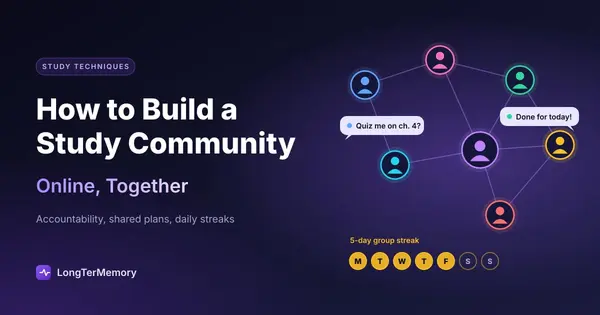
Studying alone works for some people, but for most of us, isolation is where motivation goes to die. You start strong, then miss a day, then two, and suddenly you are three weeks behind wondering where it all went wrong. The fix is not more willpower. It is more people. An online study community gives you accountability, fresh perspectives, and the social momentum to keep going when your own motivation runs out.
Building or joining a study community online is easier than ever, but not all communities are equal. Some are ghost towns. Some are distractions. The trick is finding or creating one that actually supports your goals. This guide covers where to look, how to contribute, and how to turn a group of strangers into a learning engine that keeps everyone moving forward.
Platforms for Building or Joining an Online Study Community
The best platform for your study community depends on your goals, your schedule, and how much interaction you actually want. There is no single right answer, but there are clear differences between the main options.
| Platform | Best For | Interaction Style | Commitment Level |
|---|---|---|---|
| Discord | Real-time chat, voice study sessions, niche subjects | Synchronous, high engagement | Daily or multiple times per week |
| Reddit (r/study, r/GetStudying) | Large communities, advice, resource sharing | Asynchronous, moderate engagement | A few times per week |
| Slack / Microsoft Teams | Structured groups, cohort-based courses, workplace study | Mixed sync/async | Weekly or more |
| Facebook Groups | Casual learners, broad topics, local exam prep | Asynchronous, low to moderate | Flexible |
| Dedicated apps (Focusmate, Study Together) | Scheduled body doubling, timed sessions | Synchronous, structured | Scheduled sessions |
| LongTerMemory shared study plans | Sharing one AI-generated study plan with a whole group | Asynchronous, study-focused | Daily review habits |
Discord tends to attract the most committed learners because the real-time format creates stronger bonds. If you are preparing for a major exam like the bar, USMLE, or CFA, a Discord server dedicated to that exam can be invaluable. Reddit is better for occasional questions and motivation boosts. Dedicated apps like Focusmate are ideal if your main problem is sitting down and starting, because they pair you with another person for a scheduled work session.
How to Contribute Value to a Study Community That Gives Back in Return
Communities thrive when members give before they take. The most successful online study groups are not built by lurkers. They are built by people who show up, share resources, ask thoughtful questions, and encourage others.
Here is what genuine contribution looks like in practice:
- Share what you are learning. Post a summary of a tricky concept you just mastered. Explain it in your own words. Teaching others reinforces your own understanding, and someone else will benefit from your explanation.
- Ask specific questions. “Can someone explain depreciation?” is too broad. “I understand straight-line depreciation but get lost on double-declining balance, can someone walk me through an example?” gets better answers and starts real discussions.
- Create accountability threads. Post your daily or weekly goals publicly, then report back on what you accomplished. This simple practice increases follow-through dramatically.
- Organize group activities. Propose a weekly review session, a practice test race, or a shared flashcard deck. When you take initiative, others follow.
- Celebrate wins. When someone passes a practice test or finally understands a hard topic, acknowledge it. Positive reinforcement keeps communities alive.
The reciprocity principle is real. When you invest energy into a community, others invest back into you. Lurkers get none of that benefit.
Managing the Social and Accountability Benefits of Study Communities
Online study communities deliver two main benefits: social connection and external accountability. To get the most from both, you need to be intentional about how you engage.
Accountability Structures That Actually Work
Public commitment is one of the most powerful tools in behavioral psychology. When you tell a group you will complete a task by Friday, your likelihood of doing it jumps significantly. But vague commitments fail. Use these rules:
- Make commitments specific. “I will finish chapters 5 and 6 and do 30 practice questions” beats “I will study this week.”
- Set check-in times. Announce your goal on Monday, update the group on Wednesday, and report results on Friday.
- Find an accountability partner within the larger community. One-on-one check-ins are often more effective than group announcements because the social pressure is personal.
Avoiding the Distraction Trap
Not all community time is productive time. It is easy to spend an hour chatting about study motivation and zero minutes actually studying. Set boundaries:
- Use the community for scheduled check-ins, not constant messaging.
- Turn off notifications during deep study blocks.
- If a community becomes more social than academic, it may be time to refocus or find a more disciplined group.
Building Real Relationships
The strongest study communities evolve into genuine support networks. People who start as anonymous usernames become peers who know your goals, your struggles, and your schedule. These relationships are worth cultivating. Exchange study strategies, share resources, and when appropriate, move to voice or video calls for tougher topics. The social connection makes the grind sustainable.
How Technology Can Amplify Your Community Experience
Modern study tools make online communities far more powerful than they were even five years ago. Shared flashcard decks, collaborative note-taking, and progress tracking turn a loose group into a structured learning team.
LongTerMemory fits neatly into this. Upload your course PDFs or notes and it generates question and answer flashcards automatically, then schedules them with spaced repetition. You can publish a study plan as a shareable page, so everyone in your group can try a few cards and clone the same plan into their own account. That way the whole community studies from aligned content, and each person keeps their own review schedule.
The Bottom Line
You do not have to study alone. In fact, you probably should not. An online study community gives you accountability, explanations you would not find on your own, and the social momentum to keep going when studying feels isolating.
Start by choosing a platform that matches your study style. Show up consistently, contribute value, and build real relationships with a few committed learners. The community you build will do more for your long-term success than any single study technique ever could.