How to Build a Certification Study Community Online
Learn how to build an online certification study community that keeps you accountable, motivated, and prepared to pass your exam with peer support.
Table of Contents
- Benefits of Studying with Peers Pursuing the Same Certification
- Platforms for Finding Online Study Groups and Communities
- Discord
- Dedicated Study Platforms
- Exam-Specific Forums and Vendor Communities
- Running Effective Virtual Study Sessions and Keeping Them Productive
- The Parallel Work Session
- The Topic Deep Dive
- The Practice Test Review
- Session Structure Template
- Ground Rules That Keep Groups Functional
- Building Accountability That Actually Lasts
- Public Commitment Within the Group
- Pair Up for Micro-Accountability
- Track Progress Visually
- Schedule the Exam as a Group
- Creating Shared Resources and Study Materials
- Shared Flashcard Decks
- Collaborative Note-Taking
- Practice Question Banks
- Managing Group Dynamics and Conflict
- Making Technology Work for You, Not Against You
- How LongTerMemory Powers High-Performance Study Communities
- Conclusion
How to Build a Certification Study Community Online
Studying for a professional certification can feel isolating. You spend months buried in textbooks, practice exams, and flashcard decks, often without anyone around who understands what you are going through. The solution is not to grind harder alone. It is to build an online certification study community that keeps you accountable, fills in your knowledge gaps, and makes the entire process feel less like a solo endurance test and more like a team sport.
In this guide, I will show you exactly how to find or create a study group that works, which platforms to use, and how to run virtual sessions that actually move the needle on your exam performance. Whether you are prepping for the PMP, CISSP, AWS Solutions Architect, or the bar exam, the principles are the same. Let’s get into it.
Benefits of Studying with Peers Pursuing the Same Certification
The single biggest advantage of studying with peers is that you learn faster and retain more. Research consistently shows that collaborative learning improves understanding and long-term memory compared to solo studying. A landmark review by Dunlosky et al. (2013) in Psychological Science in the Public Interest identified active recall and elaborative interrogation, two techniques that happen naturally in study groups, as among the most effective learning strategies available.
Here is what the data and real-world experience tell us about peer learning for certification prep:
| Benefit | Mechanism | Estimated Impact |
|---|---|---|
| Higher retention | Explaining concepts to peers forces elaboration and active recall | 50% more retention after one week vs. passive re-reading |
| Faster gap identification | Peers catch blind spots you do not know you have | Reduces time spent on mastered topics by 20-30% |
| Increased consistency | Social accountability reduces skipped study sessions | 65% higher completion rates for scheduled study plans |
| Lower exam anxiety | Normalizing struggle with peers reduces cortisol response | Significant reduction in pre-test anxiety scores |
| Access to diverse resources | Group members share notes, practice questions, and mnemonic devices | Expands material coverage without extra cost |
When everyone in the group is chasing the same certification, the conversations stay focused. You are not explaining basic concepts to someone outside the field. You are debating edge cases, comparing practice question strategies, and sharing updates about exam format changes. That alignment matters.
Peer teaching is particularly powerful. When you teach a concept to someone else, you have to organize it, simplify it, and anticipate questions. This process, known as the protégé effect, has been shown to produce deeper learning than studying for your own recall alone. In a study community, you get to be both teacher and student every single week.
Platforms for Finding Online Study Groups and Communities
You do not need to recruit your existing friends. The internet has made it trivial to find people who are studying for the exact same exam, often on the exact same timeline. Here are the most reliable platforms and communities for connecting with certification study partners.
Reddit is the undisputed king of exam prep communities. For virtually every major certification, there is an active subreddit full of people sharing resources, posting progress updates, and venting about difficult topics. Check out our deep dive on how to use Reddit for exam preparation research for a full guide on evaluating advice and avoiding misinformation.
Best for: Unfiltered advice, recent exam experiences, resource sharing
Discord
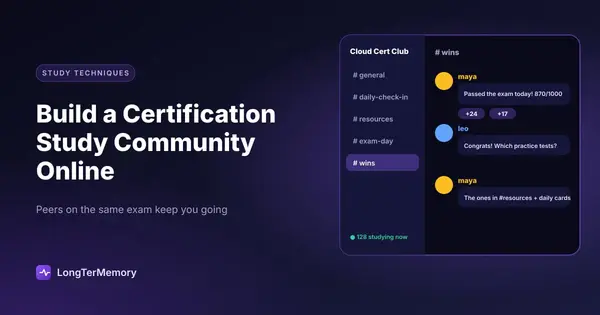
Discord servers have replaced traditional forums for many certification communities. Real-time chat, voice channels for group study, and bot integrations for scheduling make it a natural home for online study groups. Many certification subreddits maintain official Discord servers linked in their sidebar.
Best for: Real-time collaboration, voice study sessions, ongoing casual accountability
LinkedIn groups and posts are surprisingly effective for professional certifications. A simple post saying “Studying for the CISM exam, looking for an accountability partner” often generates multiple responses from people in your extended network.
Best for: Professional certifications, accountability partners with similar career goals
Dedicated Study Platforms
| Platform | Best For | Key Feature |
|---|---|---|
| StudyTogether (The Study Hall) | General certification prep | Scheduled focus rooms with Pomodoro timers |
| Focusmate | Body-doubling and accountability | One-on-one virtual co-working sessions |
| Cram Fighter | Medical licensing exams | Built-in study planning plus partner matching |
| Discord study servers | Niche certifications | Topic-specific channels and voice rooms |
For more detail on matching with the right individual partner, read our guide on how to find a study buddy online. It covers exactly how to evaluate potential partners, set expectations, and structure your first sessions.
Exam-Specific Forums and Vendor Communities
Many certification vendors maintain their own candidate forums. PMI, ISACA, (ISC)², and CompTIA all have official communities where candidates organize study groups. These are goldmines because the members are verified candidates, not random internet users.
Running Effective Virtual Study Sessions and Keeping Them Productive
The structure of your study sessions matters more than the platform you use. An unstructured group video call devolves into socializing within 15 minutes. A well-structured session can cover more ground in 90 minutes than most people cover in a full day of distracted solo studying.
The most productive virtual study sessions follow a clear protocol, have a defined purpose, and end on time. Here are the formats that actually work for certification prep.
The Parallel Work Session
Everyone joins the call, states what they will work on, mutes themselves, and works independently for a set block of time, typically 50 minutes. At the end of the block, each person reports what they accomplished. This format is ideal for accountability and works especially well for practice questions, flashcard review, or reading through dense material.
Why it works: The social presence reduces procrastination without requiring constant conversation. You are less likely to check social media when five other people can see that you have stopped working.
The Topic Deep Dive
One member leads a 20-minute review of a specific topic or domain. They present the key concepts, walk through a practice problem, and then open the floor for questions. The group discusses edge cases, compares memory tricks, and clarifies misconceptions. Rotate the leader each session.
Why it works: Teaching is one of the most effective learning techniques known to science. The leader benefits from preparation, and the group benefits from multiple explanations of the same concept. Our article on teaching as a study technique breaks down exactly how to structure these sessions for maximum retention.
The Practice Test Review
The group completes the same set of practice questions independently before the session. During the call, you review only the questions that people got wrong or found confusing. Each person who got it right explains their reasoning to those who missed it.
Why it works: This targets your collective weak points with precision. It also exposes you to the reasoning of people who think differently than you, which broadens your problem-solving toolkit.
Session Structure Template
| Time | Activity | Purpose |
|---|---|---|
| 0:00 - 0:05 | Check-in and goal setting | Align on what each person needs from the session |
| 0:05 - 0:55 | Focused work block | Deep work with social accountability |
| 0:55 - 1:05 | Break | Step away from screens |
| 1:05 - 1:35 | Collaborative review | Discuss difficult questions or teach topics |
| 1:35 - 1:45 | Wrap-up and next session planning | Lock in accountability for the next meeting |
Ground Rules That Keep Groups Functional
- Start and end on time. Respect for time is respect for each other’s lives.
- Cameras on during work blocks. The social pressure is the point.
- No unsolicited advice. Teach when asked, share when relevant, but do not lecture.
- Come prepared. Show up knowing what you will work on. Winging it wastes everyone’s time.
- Use a shared document. Keep a running list of topics to review, resources to share, and questions that came up during independent work.
Building Accountability That Actually Lasts
Most study groups fall apart within three weeks. The initial excitement fades, schedules conflict, and people drift away. To prevent this, you need to build accountability into the structure of the group itself, not just rely on good intentions.
Public Commitment Within the Group
At the start of each week, post your study goals in the group chat or shared document. Be specific. “Finish Domain 3 practice questions” is better than “study more.” The public nature of the commitment creates a mild reputation cost for failing to follow through, which is usually enough to keep people on track.
Pair Up for Micro-Accountability
Within the larger group, pair off into accountability duos. Check in with your partner daily, even if it is just a two-minute message saying what you completed. Our guide on building accountability into your study schedule explains the psychology behind why this works and how to design systems that match your personality.
Track Progress Visually
Use a shared spreadsheet or project board to track study hours, topics covered, and practice test scores. Visual progress is motivating, and it makes it obvious when someone has gone quiet. The group can then reach out and offer support before that person fully drops off.
Schedule the Exam as a Group
When possible, schedule your certification exams for the same week or even the same day. Having a shared deadline transforms the group from a casual hangout into a serious accountability structure. The social commitment to a shared timeline is one of the most powerful motivators available.
Creating Shared Resources and Study Materials
One of the best parts of a certification study community is the shared knowledge base. Instead of every member building flashcard decks and notes from scratch, the group can divide and conquer.
Shared Flashcard Decks
Divide the exam objectives among group members. Each person builds a high-quality flashcard deck for their assigned domain, then shares it with the group. Everyone gets complete coverage without the enormous time investment of building every deck alone.
This is where LongTerMemory becomes a genuine force multiplier for your study community. Instead of manually creating thousands of flashcards from your textbooks, you can upload PDFs, web articles, and lecture notes directly into LongTerMemory. The system automatically extracts key concepts and generates review-ready flashcards, then schedules them using spaced repetition optimized for your exam timeline. Your group can share these generated decks, cut months off the content creation phase, and focus actual study time on active recall and discussion rather than card formatting.
Collaborative Note-Taking
Use a shared Notion workspace, Google Doc, or Obsidian vault for group notes. Assign one note-taker per session to capture the key takeaways, questions raised, and resources mentioned. Over time, this becomes a searchable knowledge base that new members can use to catch up.
Practice Question Banks
Pool money to purchase a group license for a high-quality practice question bank, or take turns finding free official questions and sharing them. Many vendors offer discounted group rates. Even splitting a $200 question bank five ways makes it affordable for everyone.
For more on finding free and community resources, see our guide to free study materials for certification exams.
Managing Group Dynamics and Conflict
Study groups are made of humans, and humans disagree. The most common conflicts are around pace, one member dominating conversations, and uneven contribution. Address these early.
Pace mismatches are the biggest killer. If one member is three weeks ahead and another is just starting, the group sessions will frustrate both. Solve this by splitting into sub-groups by pace, or by structuring sessions so that each person works independently on their own material during work blocks and only collaborates during the review phase.
Dominant personalities can be managed with a simple facilitation rule: use a round-robin format where each person speaks before anyone speaks twice. If one person is consistently teaching everything, assign them formal leadership of one session per month and rotate the rest.
Uneven contribution is best handled with data. The shared tracking spreadsheet makes it visible who is showing up and who is not. If someone misses three sessions in a row without communication, have a direct conversation. Sometimes the fix is as simple as changing the meeting time.
Making Technology Work for You, Not Against You
The tools you use should fade into the background. If your group spends the first ten minutes of every call troubleshooting audio or arguing about which app to use, you have already lost.
For video calls: Zoom, Google Meet, and Discord all work fine. Pick one and stick with it.
For async communication: Slack or Discord threads are better than WhatsApp groups because they keep conversations organized by topic. If your certification has six domains, create a channel for each one.
For document sharing: Google Docs for live collaboration, Notion for structured wikis, and AnkiWeb or LongTerMemory for shared flashcard decks.
For scheduling: When2meet or Doodle for finding meeting times, and a recurring calendar invite so no one has to remember.
The key is to minimize friction. Every extra click, login, or app switch reduces the odds that people will engage consistently.
How LongTerMemory Powers High-Performance Study Communities
If you are serious about passing your certification, your study community needs more than good vibes and shared Google Docs. You need a learning infrastructure that handles the science of memory automatically.
LongTerMemory is built exactly for this. Here is how study groups use it to gain an edge:
- PDF and web content ingestion: Upload your textbooks, vendor whitepapers, or online course transcripts. LongTerMemory reads them and generates flashcards automatically. Your group can divide the syllabus, each member uploads their section, and everyone gets the complete deck without manual typing.
- Automatic spaced repetition scheduling: The system schedules reviews at the optimal intervals based on your performance. No one in the group has to guess when to review Domain 2 versus Domain 5. The algorithm handles it.
- Performance analytics: See exactly which topics the group is struggling with as a whole. If everyone is scoring below 70% on networking concepts, you know exactly what to focus on in your next collaborative session.
- Time saved: Manual flashcard creation takes 3 to 5 hours per textbook chapter. LongTerMemory cuts that to minutes. For a six-month certification prep, that is hundreds of hours redirected from data entry into actual learning and group discussion.
Your study community’s biggest advantage is the human interaction, the teaching, the debate, and the accountability. Let LongTerMemory handle the flashcards and scheduling so you can focus on what actually moves the needle. Start your free trial today and see how much faster your group can move when the busywork is automated.
Conclusion
Building an online certification study community is one of the highest-leverage moves you can make during exam prep. The right group will keep you consistent, catch your blind spots, and make the months of preparation feel like a shared mission rather than a lonely slog.
Start by finding three to five people who are studying for the same certification on a similar timeline. Choose a platform that everyone already uses, or is willing to learn quickly. Run structured sessions with clear protocols. Share resources so no one is building from scratch. And use tools like LongTerMemory to automate the repetitive parts of studying so your group can focus on the high-value work of teaching, debating, and holding each other accountable.
Your certification is achievable. It is just easier, faster, and more enjoyable when you do not try to achieve it alone.