How to Create a Study Routine for Night Owls
Design a productive late-night study routine that aligns with your natural chronotype, manages sleep debt, and maximizes evening cognitive performance.
Table of Contents
- Aligning Study Intensity With Your Natural Evening Cognitive Peak
- Matching Task Difficulty to Energy Level
- Managing Sleep Debt When Studying Late Conflicts With Early Commitments
- The Protected Sleep Rule
- The Graduated Schedule
- Night Owl Study Rituals That Maximize Late-Session Productivity
- The Transition Ritual
- Lighting Strategy
- The Hard Stop
- When to Consider Shifting Your Schedule
- The Bottom Line
The internet is full of advice about morning routines. Wake up at 5 AM. Do your hardest work before sunrise. Become a productivity god. But what if your brain simply does not work that way? What if 9 PM is when you actually feel alert, creative, and capable of real focus? Forcing yourself into an early-bird schedule when you are biologically a night owl is not virtuous. It is self-sabotage.
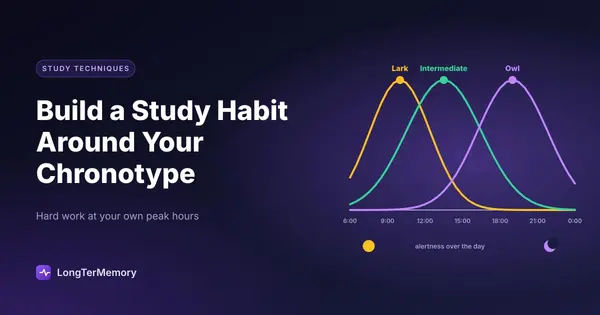
The science of chronotypes confirms what many night owls already know: circadian preferences are partially genetic. Some people genuinely perform better in the evening. The goal is not to fight that. It is to build a study routine that works with your natural rhythm instead of against it, while still protecting your sleep and health.
This guide covers how to align study intensity with your evening cognitive peak, how to manage the sleep debt that late-night study can create, and the rituals that make late sessions genuinely productive.
Aligning Study Intensity With Your Natural Evening Cognitive Peak
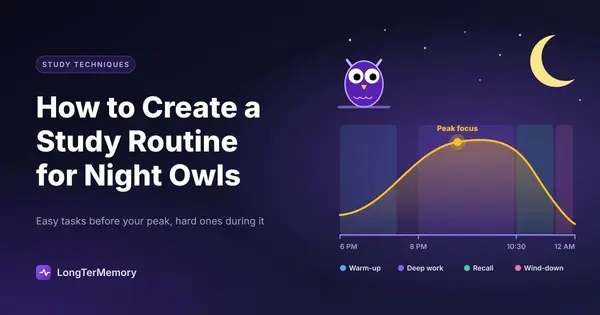
Most night owls experience a cognitive peak between 8 PM and midnight. This is when mental alertness, creative problem-solving, and sustained attention are at their highest. Your study routine should place the hardest, most demanding work in this window.
Here is a sample evening structure:
| Time Block | Activity Type | Why It Works |
|---|---|---|
| 6:00 to 7:30 PM | Light review, organization, flashcards | Warm-up period; easier tasks build momentum |
| 8:00 to 10:30 PM | Deep work: problem sets, essay writing, new material | Peak alertness window; reserve for highest cognitive load |
| 10:30 to 11:30 PM | Active recall, summarization, review | Consolidation work while still alert; reinforces what you just learned |
| 11:30 PM to 12:00 AM | Wind-down: no screens, dim lights, light reading | Signals to brain that sleep is coming |
The exact times shift based on your personal rhythm, but the principle is consistent: easy tasks before peak, hard tasks during peak, review and wind-down after peak.
Matching Task Difficulty to Energy Level
Not all study tasks are equal. Night owls should reserve the following for their peak window:
- Mathematical problem-solving
- Essay writing and argument construction
- Learning entirely new material
- Complex analytical reading
Save these for lower-energy periods:
- Flashcard review
- Organizing notes
- Light reading or watching explanatory videos
- Scheduling and planning
Managing Sleep Debt When Studying Late Conflicts With Early Commitments
The biggest risk of a night owl study schedule is sleep deprivation. If you study until midnight but have to wake up at 6 AM, you are accumulating sleep debt that will eventually destroy your cognitive performance. The solution is not to stop being a night owl. It is to be strategic about when you are a night owl.
The Protected Sleep Rule
Calculate your minimum viable sleep. For most adults, this is 6.5 to 7.5 hours. If you must wake up at 6:30 AM, your study session needs to end by 11:00 PM at the latest. If your material demands more time, you have two options:
- Shift your wake time later on days when you have control over your schedule. Protect at least one or two mornings per week for recovery sleep.
- Add a nap. A 20-minute nap in the early afternoon can partially offset a shorter night. A 90-minute nap completes a full sleep cycle and provides deeper restoration.
The Graduated Schedule
If you have early commitments on some days and late freedom on others, use a graduated schedule:
- Late nights: Deep study sessions on days when you can sleep in the next morning.
- Early nights: Lighter review and maintenance on days when you must wake early.
- Catch-up nights: At least one night per week with no study, just extended sleep.
Sleep is not optional infrastructure. It is the period when your brain consolidates what you studied. Sacrificing sleep to study more is like deleting your save file to keep playing.
Night Owl Study Rituals That Maximize Late-Session Productivity
Rituals matter for night owls because the evening lacks the external structure of morning schedules. Without deliberate boundaries, late-night study can bleed into distracted browsing, snacking, or endless scrolling.
The Transition Ritual
Create a clear transition from daytime activity to study mode:
- Change your environment. If you were working or socializing in the same space, move to your study area or change the lighting.
- Set a hard start time. Do not “start when you feel like it.” Commit to a specific minute.
- Define the session’s goal. Write down exactly what you will accomplish before you stop. Vague intentions produce vague results.
- Eliminate the phone. Nighttime is when willpower is lowest. Remove the temptation entirely.
Lighting Strategy
Light is the primary signal that regulates your circadian clock. Use it wisely:
- During study: Use bright, cool-white light to maintain alertness.
- After study: Switch to dim, warm light at least 30 minutes before bed. This helps your brain produce melatonin.
- Avoid blue light from screens in the final hour before sleep. Use blue light filters or, better yet, stop using screens.
The Hard Stop
Night owls are prone to the “just one more chapter” trap because focus feels good at night. Set a hard stop time and honor it. Use an alarm if necessary. Stopping on schedule protects your sleep, and paradoxically, it makes you more productive during the next session because you are not running on fumes.
When to Consider Shifting Your Schedule
Not every night owl needs to change. But if you are experiencing the following, it may be worth gradually shifting earlier:
- Chronic daytime fatigue that impairs non-study responsibilities
- Inability to fall asleep even when you want to
- Dependence on caffeine to function before noon
- Missed morning classes or meetings due to oversleeping
Shifting a chronotype takes weeks, not days. Move your bedtime and wake time earlier by 15 minutes every three days. Expose yourself to bright light immediately upon waking. Avoid caffeine after 2 PM. Be patient with the process.
Whatever hours you keep, short and consistent reviews matter more than long sessions. LongTerMemory turns your notes and PDFs into question and answer flashcards and schedules them with spaced repetition, so your late night sessions always start with exactly what is due.
The Bottom Line
Night owls can be just as productive as early risers. The key is respecting your natural rhythm while protecting your sleep. Align hard tasks with your peak evening window. Manage sleep debt with naps and catch-up nights. Build rituals that create structure where the world does not provide it.
Your brain has a preferred schedule. Work with it, not against it, and late-night study becomes a genuine advantage rather than a liability.