How to Memorize Things Fast for a Test
Triage your material, use active recall over re-reading, and apply last-minute memory techniques that actually hold under exam pressure.
Table of Contents
- Triage Your Material Before Memorizing Anything
- The Three-Category Sort
- Estimating Time Per Topic
- What to Do When There's Still Too Much
- Active Recall vs. Re-Reading for Fast Test Prep
- The Active Recall Protocol for Test Prep
- The 1-3-1 Method for Quick Memorization
- Practice Questions Are Your Best Friend
- Last-Minute Memory Techniques That Actually Hold
- Spaced Retrieval in the Final Hours
- Teach-Back for Tricky Concepts
- Mnemonics for Lists and Sequences
- Emotion and Vividness: The Memory Boosters
- The Pre-Sleep Review
- What to Do the Morning of the Test
- A Realistic Note on Cramming
It’s the night before , or maybe two days before , a test, and you’re staring at a pile of material that could fill a library. You need to memorize it, and you need to do it fast. No time for the ideal study plan. No time for weeks of spaced repetition. You need what works right now, under pressure, with limited time.
This isn’t the situation anyone wants to be in. But it’s the situation a lot of people find themselves in, and there are genuinely better and worse ways to handle it. The right approach can mean the difference between walking into that exam room with a functional memory of your material and walking in hoping the material somehow absorbed through osmosis.
Here’s what actually works.
Triage Your Material Before Memorizing Anything
The single most important thing you can do when time is short is stop and sort before you start. Trying to memorize everything equally is a recipe for memorizing nothing particularly well. You need to ruthlessly prioritize.
The Three-Category Sort
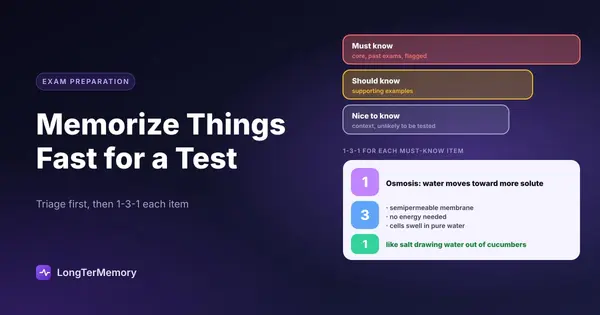
Go through everything you need to know and sort it into three buckets:
High-priority (Must know): Concepts that are core to the course, topics that have appeared on previous exams, items your instructor explicitly flagged, foundational definitions without which nothing else makes sense.
Medium-priority (Should know): Supporting material, examples, secondary concepts, things that provide context but aren’t likely to be tested directly.
Low-priority (Nice to know): Background information, tangential details, optional readings, things you’ve seen once and never again.
Now close the low-priority pile. Seriously , put it away. Every hour you spend on low-priority material is an hour you’re not spending on material that will actually be tested.
Estimating Time Per Topic
Once you have your high-priority list, estimate how long you need per topic and map it against the time you actually have. This prevents the trap of spending three hours on the first topic and running out of time for everything else , a very common test-prep failure mode.
A rough heuristic: if you can’t articulate the core of a topic in two sentences, you haven’t understood it well enough to memorize it yet. Start with the two-sentence version, get that solid, then add detail.
What to Do When There’s Still Too Much
If even your high-priority list is too large for the time available, prioritize within it based on point value and likelihood of appearing. If the test is worth 100 points and you know 50 questions cover Chapter 3, Chapter 3 gets the most attention. Strategic allocation of limited resources is itself a study skill.
Active Recall vs. Re-Reading for Fast Test Prep
Here’s the truth that will feel counterintuitive under pressure: re-reading your notes is one of the least effective things you can do when time is short. It feels safe and productive, but it mostly produces the illusion of learning rather than actual retention.
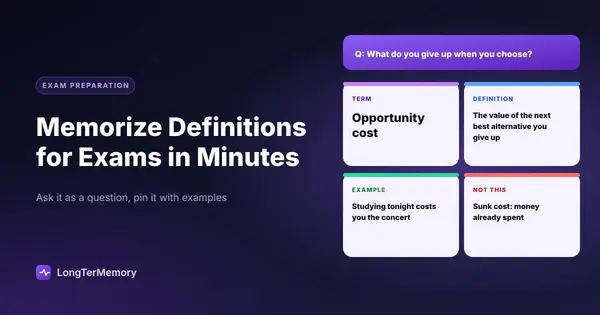
Research on retrieval practice is unambiguous: testing yourself on material produces far stronger memories than reviewing the same material passively. When time is limited, the gap in effectiveness is even more pronounced, because passive re-reading requires many repetitions to produce retention, while retrieval practice produces retention much faster.
The Active Recall Protocol for Test Prep
Here’s the protocol. For each topic in your priority list:
- Read the material once , just once, but actively. Underline key terms. Write brief margin notes.
- Close everything , book closed, notes face down, screen minimized.
- Recall everything you can about that topic on a blank piece of paper. Write it in your own words, including definitions, key arguments, examples, anything.
- Check your notes against what you wrote. Highlight what you missed.
- Focus your remaining study time on the gaps , don’t re-read what you already got right.
This process is uncomfortable, especially when the blank page stares back at you. Resist the urge to peek. The struggle of retrieval is where encoding happens. If you answer immediately with the notes in front of you, you’re not retrieving , you’re recognizing. Recognition doesn’t transfer to exam conditions.
The 1-3-1 Method for Quick Memorization
For individual facts, definitions, or concepts, use the 1-3-1 method:
- 1 sentence: State the concept or fact in plain language
- 3 details: Note three supporting facts, examples, or characteristics
- 1 connection: Link it to something else you know
This forces you to process each item at three levels , definition, detail, and relationship , which is far more powerful than reading the definition alone five times.
Practice Questions Are Your Best Friend
If there are practice exams, past papers, or end-of-chapter questions available, use them. Work through them without looking at the answers first. Every question you work through , even ones you get wrong, maybe especially those , is worth more than reading pages of notes.
Getting a question wrong under practice conditions and then looking up the correct answer produces one of the strongest memory traces possible. Your brain registers the error, feels the gap, and actively encodes the correction. This is dramatically more effective than reading the correct answer before you’ve tried.
Last-Minute Memory Techniques That Actually Hold
When you’re in the final hours before an exam, a few specific techniques have proven useful for locking in material that needs to survive the night and the stress of test conditions.
Spaced Retrieval in the Final Hours
Even with only a few hours available, you can apply a mini version of spaced repetition. Instead of studying each topic once and moving on, cycle through your material repeatedly:
- Round 1: Go through all high-priority topics once, testing yourself briefly on each
- Round 2: Return to the topics where you were shakiest, test again
- Round 3: One more pass over the weakest areas
This cycling , even compressed into a two- or three-hour session , produces significantly better retention than spending equal time on everything linearly. The topics you struggled with get more repetition. The topics you have solid are reviewed just enough to stay fresh.
Teach-Back for Tricky Concepts
For concepts that won’t seem to stick , complex processes, multi-step arguments, anything with a lot of moving parts , try teaching it out loud. Stand up, pretend someone is sitting across from you, and explain the concept from scratch.
When you hit a point where your explanation breaks down , when you stumble, go vague, or realize you can’t actually complete the explanation , that’s your gap. That’s the exact thing you need to fix. Go back to your notes, fill the gap, then try the explanation again.
This is uncomfortable. It’s also remarkably effective. Verbal explanation requires a different kind of processing than silent reading, and the act of making something communicable to someone else is one of the deepest forms of encoding.
Mnemonics for Lists and Sequences
When you need to memorize a list of items in order, acronyms and acrostics are your fastest tool:
- Acronym: First letter of each item forms a word (HOMES for the Great Lakes: Huron, Ontario, Michigan, Erie, Superior)
- Acrostic: First letter of each item starts a word in a sentence (“Every Good Boy Does Fine” for musical notes)
- Story method: Create a brief story connecting the items in order , the more vivid and ridiculous, the better
For categorized information (multiple lists, grouped concepts), create a master framework first, then attach details. Your brain stores hierarchical information better than flat lists. If you can create a mental map of how everything fits together, individual facts become much easier to place and recall.
Emotion and Vividness: The Memory Boosters
Memory is strongly influenced by emotional salience , things that feel significant get encoded more deeply. You can deliberately exploit this.
When you need to lock in a piece of information, make it vivid and personal. Create a mental image. Add a character you know. Make the scenario absurd or funny. Attach an emotional response , surprise, laughter, concern. The more emotionally charged the encoding context, the stronger the memory trace.
This works even better when combined with physical movement. If you can pace, gesture, or use your body while drilling material, you add motor memory as another retrieval pathway. Some people genuinely perform better when they’ve physically moved while studying particular content.
The Pre-Sleep Review
Research consistently shows that information studied just before sleep is often consolidated more effectively than information studied earlier in the day. If you’re studying the night before an exam, use this:
- Do your most intensive review work in the early part of the evening
- In the last 30 minutes before sleep, do a final pass , not new material, but a light review of your highest-priority items
- Go to sleep. Your brain will do some of the consolidation work overnight.
Don’t sacrifice sleep to study longer. The memory consolidation that happens during sleep is not optional , it’s a core part of how long-term memories form. A fully rested brain performing at capacity will outperform an exhausted one working with a slightly more complete note set.
What to Do the Morning of the Test
The morning of the exam, your goal is activation, not new learning.
Trying to learn new material in the final hour before an exam is rarely effective , you won’t have time to properly encode it, and the anxiety of realizing there are still gaps you haven’t filled will hurt your performance on everything else. Instead:
- Do a brief review of your key frameworks , the big-picture structure of each subject
- Quiz yourself on the five to ten things you were least confident about yesterday
- Stay calm: Test anxiety impairs working memory, which impairs performance. A few minutes of controlled breathing or light exercise can genuinely help.
If you’ve been using LongTerMemory or a similar spaced repetition app throughout your study period, the morning review is simple , just run through your due cards for the day. The app will surface exactly what’s most at risk of being forgotten.
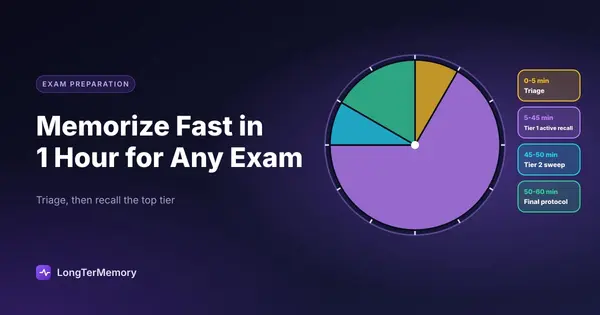
If all you have left is the final hour before the test, our guide on how to memorize fast in 1 hour walks you through a minute-by-minute protocol for making that last hour count.
If the test is tomorrow morning, our guide on how to study for exams in one night lays out a realistic overnight plan.
A Realistic Note on Cramming
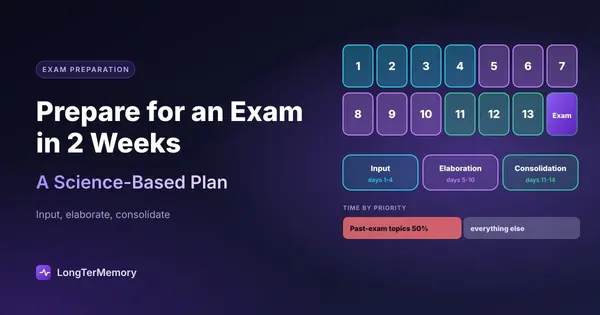
Everything in this guide works better with more time. The techniques described here will help you in a crunch , but they’re not as effective as weeks of distributed practice, and they shouldn’t be your primary strategy if you have a choice.
The honest truth about cramming, even good cramming: most of what you learn will be gone within a week of the exam. You’re optimizing for test performance, not long-term retention. In many cases, that’s acceptable , you need to pass the test. But if the material is foundational for future courses or professional practice, a short-term cram isn’t enough. You’ll need to re-learn it properly later.
The best use of the techniques in this guide is as a complement to a longer study plan , a final sharpening before the exam, not the entire strategy. If you’re starting from scratch the night before for every exam, the structural problem isn’t technique , it’s process. The techniques will help you survive the immediate situation, but building a sustainable study habit will serve you much better in the long run.
For now, though: triage your material, test yourself actively, cycle through your weak spots, and sleep. That’s your best shot at walking into that exam room ready.